
NEWS
Senate Passes 2026 Electoral Act Amendment Bill, Introduces Rerun Elections for INEC-Declared Ineligible Winners, Retains 2022 Provisions on Electronic Transmission

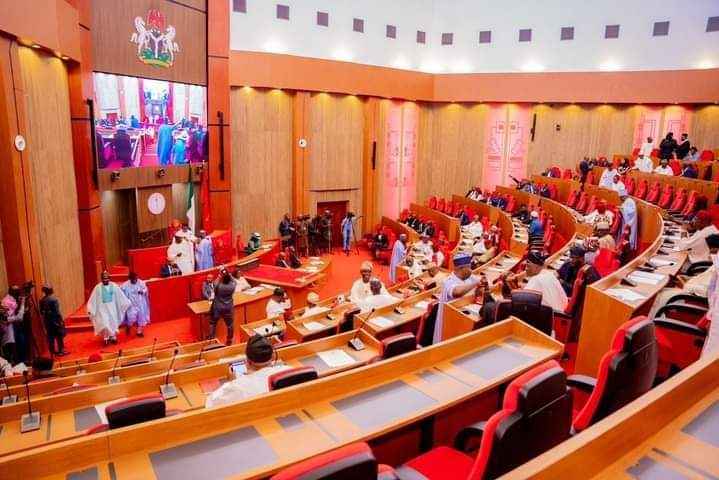
After weeks of legislative hurdles and several unsuccessful attempts within the last two months, the Nigerian Senate has finally passed for third reading the 2026 amendment bill to the 2022 Electoral Act, marking a major step toward refining the country’s electoral legal framework.
The bill, passed on Wednesday, contains far-reaching amendments aimed at strengthening the credibility of elections, clarifying procedures in post-election litigation, and tightening timelines for the electoral process.
One of the most significant changes introduced in the 2026 Electoral Bill is the amendment of Clause 136, which makes fresh provisions for rerun elections in cases where courts nullify the victory of a candidate declared winner by the Independent National Electoral Commission (INEC) on the grounds of ineligibility.
Under the new provision, where an election is annulled because the declared winner is later found to be ineligible, a rerun election will be conducted among the remaining candidates of the political parties that participated in the election.
The Senate further clarified that ineligibility, as contemplated under the new law, refers specifically to situations where a candidate is later discovered to have submitted forged or fake documents.
As contained in the bill:
“Under the new provisions, political parties would no longer be allowed to replace candidates disqualified after an election, and where necessary, fresh polls would be conducted excluding both the disqualified candidate and the sponsoring party.”
This amendment represents a major departure from previous practices, where parties were often permitted to substitute candidates whose victories were overturned by the courts. The new approach is expected to promote internal party accountability and discourage political parties from fielding questionable candidates.
Senate Rejects Committee Proposal on Electronic Transmission
Despite adopting several amendments, the Senate rejected a proposal by its committee seeking to strengthen provisions on electronic transmission of election results.
The committee had recommended the following amendment to Section 60 of the Act:
“60. Counting of votes and forms
(1). The Presiding Officer shall, after counting the votes at the polling unit, enter the votes scored by each candidate in a form to be prescribed by the Commission.
(2). E(2) The form shall be signed and stamped by the Presiding Officer and countersigned by the Candidates or their polling agents where available at the polling unit.
(3). The Presiding Officer shall electronically transmit the results from each polling unit to IREV portal in real time and such transmission shall be done after the prescribed Form EC8A has been signed and stamped by the Presiding Officer and /or countersigned by the candidates or polling agents where available at the polling unit.
(4). The Presiding Officer shall count and announce the result at the polling unit.
(5). The Presiding Officer shall transmit the results including total number of accredited voters to the next level of collation.
(6). A Presiding Officer who wilfully contravenes any provision of this clause commits an offence and is liable on conviction to a fine of not less than ₦500,000 and imprisonment for a term of not less than six months or both.”
However, the amendment was not adopted. Instead, the Senate resolved to retain the existing provisions of the 2022 Electoral Act, which state:
“Counting of votes and forms
(1) The Presiding officer shall, after counting the votes at the polling unit, enter the votes scored by each candidate in a form to be prescribed by the commission as the case may be.
(2) The form shall be signed and stamped by the Presiding officer and counter signed by the candidates or their polling agents where available at the polling unit.
(3) The presiding officer shall give to the polling agents and the police officer where available a copy each of the completed forms after it has been duly signed as provided under subsection (2).
(4) The presiding officer shall count and announce the result at the polling unit.
(5) The presiding officer shall transfer the result, including total number of accredited voters and the results of the ballot in a manner as prescribed by the Commission.
(6) A presiding officer who willfully contravenes any provision of this section commits an offence and is liable on conviction to a fine not more than ₦500,000 or imprisonment for a term of at least six months.”
The decision effectively maintains INEC’s discretionary powers over the mode and manner of transmitting election results, rather than mandating real-time electronic transmission to the IREV portal as proposed.
Timelines for Elections and Nominations Shortened
The Senate also amended Section 76 of the 2022 Electoral Act by reducing the period for issuing notice of election from 360 days to 180 days before the expiration of the tenure of an incumbent office holder.
In the same vein, the period for nomination of candidates was shortened from 180 days to 90 days before the expiration of the tenure of the incumbent.
These adjustments are aimed at streamlining the electoral calendar and reducing the long campaign season that often heightens political tension across the country.
Harmonisation Committee Set Up
Following the passage of the bill for third reading, the Senate constituted a harmonisation committee to reconcile its version of the amendment bill with that of the House of Representatives before final transmission to President Bola Tinubu for assent.
The committee is chaired by Senator Simon Lalong (Plateau South). Other members are Tahir Monguno (Borno North), Adamu Aliero (Kebbi Central), Orji Uzor Kalu (Abia North), Abba Moro (Benue South), Asuquo Ekpenyong (Cross River South), Aminu Iya Abbas (Adamawa Central), Tokunbo Abiru (Lagos East), and Adeniyi Adegbonmire (Ondo Central).
The passage of the bill signals the Senate’s determination to fine-tune Nigeria’s electoral laws in response to emerging legal and operational challenges, as stakeholders await the outcome of the harmonisation process and presidential assent.