
Entertainment
GRAMMYS SET TO ETCH FELA KUTI’S NAME IN GLOBAL IMMORTALITY AS AFROBEAT ARCHITECT BECOMES FIRST AFRICAN RECIPIENT OF LIFETIME ACHIEVEMENT AWARD, NEARLY THREE DECADES AFTER HIS PASSING

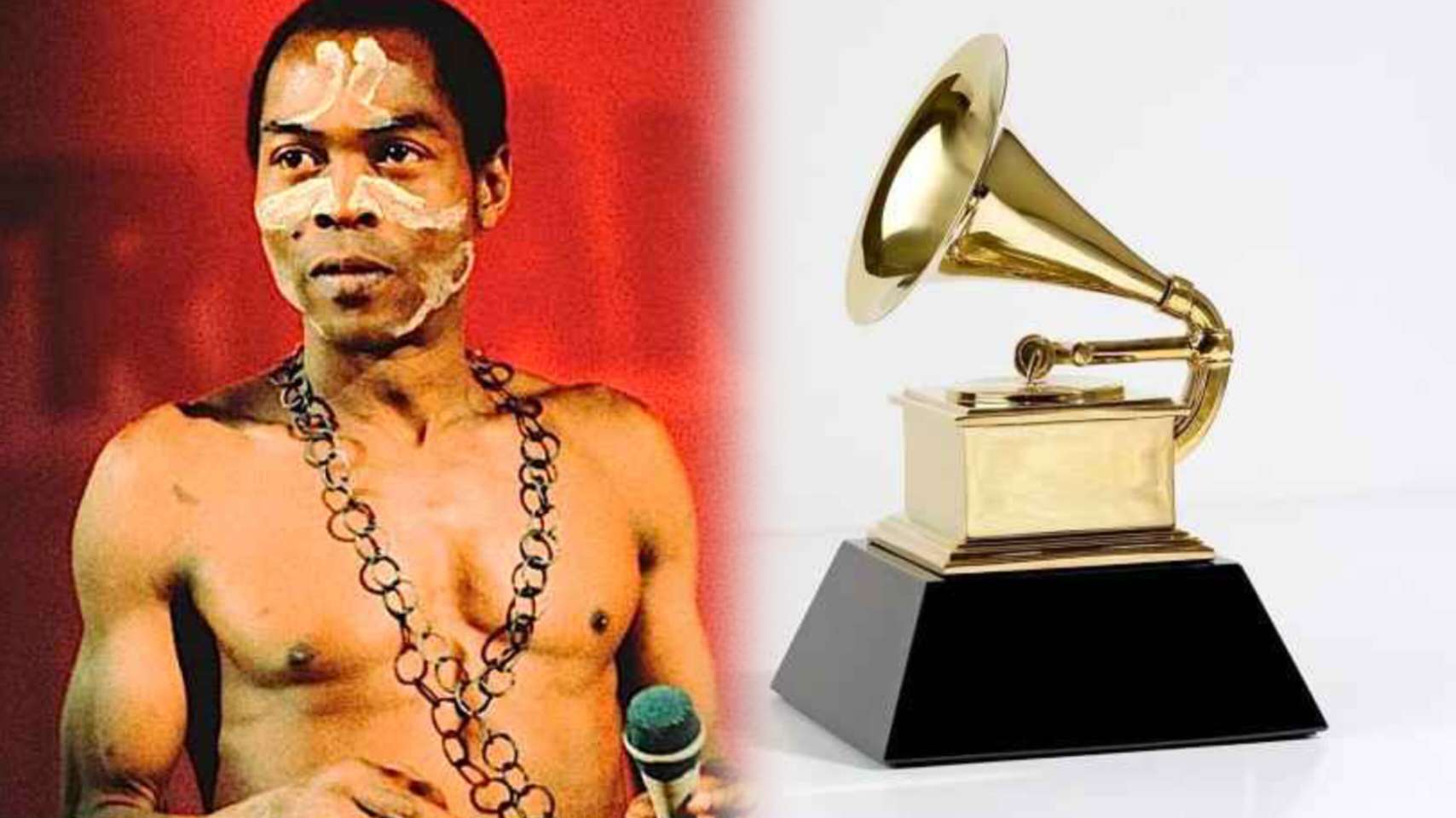
Long crowned by his legion of fans as the king of Afrobeat, the late Fela Kuti is finally being recognised by the global music industry.
The Nigerian star will posthumously receive a Lifetime Achievement Award at the Grammys, almost three decades after his death at the age of 58, marking a historic moment not only for his family, but for Nigeria, Africa and the global cultural community.
“Fela has been in the hearts of the people for such a long time. Now the Grammys have acknowledged it, and it’s a double victory,” his musician son Seun Kuti tells the BBC.
“It’s bringing balance to a Fela story,” he adds.
For many who worked closely with the Afrobeat pioneer, the honour is overdue but deeply meaningful.
Rikki Stein, a long-time friend and manager of the late musician, says the recognition by the Grammys is “better late than never”.
“Africa hasn’t in the past rated very highly in their interests. I think that’s changing quite a bit of late,” Stein tells the BBC.
The timing of Fela Kuti’s recognition aligns with a growing global embrace of African music. Following the worldwide success of Afrobeats, a contemporary genre inspired by Fela’s original Afrobeat sound, the Grammys introduced the category of Best African Performance in 2024. This year, Nigerian superstar Burna Boy is also nominated in the Best Global Music Album category, further underlining Africa’s expanding influence on the global stage.
Yet Fela Kuti’s honour stands in a league of its own. He will become the first African ever to receive a Lifetime Achievement Award from the Recording Academy, joining a prestigious lineage that began in 1963 with American singer and actor Bing Crosby. Other recipients this year include Mexican-American guitarist Carlos Santana, Chaka Khan, widely known as the Queen of Funk and Paul Simon.
Members of Fela Kuti’s family, along with close friends and collaborators, will be present at the ceremony to accept the award on his behalf.
“The global human tapestry needs this, not just because it’s my father,” Seun Kuti tells the BBC.
Beyond music, those who knew Fela insist that his legacy must be understood through the lens of social struggle and moral courage. Stein describes him as a relentless advocate for the oppressed, a man who championed people who had “drawn life’s short straw”, and who “castigated any form of social injustice, corruption [and] mismanagement” in government.
“So it would be impossible to ignore that aspect of Fela’s legacy,” he tells the BBC.
Indeed, Fela Anikulapo Kuti was far more than an entertainer. He was a cultural theorist, political agitator and the undisputed architect of Afrobeat, a genre distinct from, but foundational to, today’s Afrobeats movement.
Working closely with drummer Tony Allen, Fela pioneered a revolutionary musical form that blended West African rhythms, jazz, funk, highlife, extended improvisation, call-and-response vocals and fiercely political lyricism. Across a career that spanned roughly three decades until his death in 1997, he released more than 50 albums, building a catalogue that fused rhythm with resistance, sound with philosophy, and performance with protest.
That fearless artistry brought him into direct conflict with Nigeria’s military governments. In 1977, following the release of Zombie, an album that mocked soldiers as obedient, brainless enforcers, his Lagos compound, Kalakuta Republic, was raided. The property was burned, residents were brutalised, and his mother, Funmilayo Ransome-Kuti, later died from injuries sustained during the assault.
Fela did not retreat. Instead, he carried his mother’s coffin to government offices and released Coffin for Head of State, transforming personal tragedy into a searing act of political defiance.
His worldview drew from pan-Africanism, anti-imperialism and African-rooted socialism. His mother, a towering feminist and activist, profoundly shaped his political consciousness, while US-born singer and activist Sandra Izsadore sharpened his revolutionary outlook.
Born Olufela Olusegun Oludoton Ransome-Kuti, he later dropped the surname Ransome because of its Western origins, choosing to define himself strictly on African terms. In 1978, he married 27 women in a highly publicised ceremony, uniting partners, performers and organisers into a single communal and cultural vision around Kalakuta Republic.
Arrests, beatings, censorship and surveillance became routine features of his life. Yet repression only magnified his voice.
*He wasn’t doing what he was doing to win awards. He was interested in liberation. Freeing the mind. He was fearless. He was determined,” Stein tells the BBC.
Fela’s musical roots extended beyond Nigeria. Highlife music, pioneered by Ghanaian greats such as ET Mensah, Ebo Taylor and Pat Thomas, deeply influenced his early development. Time spent in Ghana exposed him to highlife’s melodic guitar lines, horn arrangements and dance-oriented structures, which he later fused with jazz, funk, Yoruba rhythms and political storytelling.
The result was Afrobeat, a sound whose DNA reflects not only Nigeria, but a broader West African and diasporic heritage.
On stage, Fela was unforgettable: often bare-chested or draped in wax-print fabrics, hair sculpted into a bold Afro, saxophone in hand, leading bands of more than 20 musicians. His performances at the Afrika Shrine in Lagos were legendary, operating simultaneously as concerts, political rallies and spiritual gatherings.
Stein recalls that the atmosphere at the Shrine defied conventional concert etiquette.
“When Fela played, nobody applauded. The audience wasn’t separate. They were part of it,” he tells the BBC.
Music, for Fela, was communion.
His visual legacy was also carefully crafted. Artist and designer Lemi Ghariokwu created 26 of his album covers between 1974 and 1993.
*Fela has been an ancestor for 28 years. His legacy is growing by the day. This is immortality,” Ghariokwu tells the BBC.
Today, Fela Kuti’s influence remains unmistakable. His music continues to attract millions of listeners worldwide, while his spirit echoes in the work of artists such as Burna Boy, Kendrick Lamar and Sir Idris Elba.
Elba, a devoted admirer, has curated an official vinyl collection, Fela Kuti Box Set 6, and has publicly likened Fela’s singularity to that of icons such as Sade and Frank Sinatra, artists whose sounds are instantly recognisable and impossible to replicate.
Fela also took his message to major international festivals across Europe and North America, presenting global audiences with a bold, unapologetic and politically conscious image of modern Africa.
Seun Kuti was only 14 when his father died, yet the lessons remain vivid.
“Fela never made me feel like I was a child. He didn’t hide anything from me. He talked about everything openly,” he recalls.
There was no myth-making in their household.
“I didn’t even realise my dad was famous. That’s credit to him. He kept me grounded,” he says.
For Seun, the defining memories centre on discipline, clarity and humanity.
“The human part of him, leadership, musicianship, fatherhood, that was the epitome of who he was.”
One reflection captures Fela’s philosophy of independence.
“Fela was our dad, but you didn’t own him. Fela belonged to himself. But we all belonged to him.”
He insisted on being called by name, not title, even by his children. Seun recalls losing pocket money after calling him “Pops”, a small but powerful lesson in respect.
“He always reminded us that he was in service to others more than himself.”
That ethic continues to shape Seun’s path.
“I used to make music to make money. But as I’ve grown, I lean more toward working for my people as well as my art.”
Fela led multiple ensembles, most notably Africa 70 and later Egypt 80, now carried forward by his son. These were not ordinary bands, but disciplined collectives driven by ideology as much as by rhythm.
Stein recalls Fela Kuti’s obsessive precision.
“He tuned every instrument personally. Music wasn’t entertainment to him. It was his mission.”
With the Grammys now set to honour him, that mission, once persecuted, often misunderstood, has achieved global validation. Nearly three decades after his death, Fela Anikulapo Kuti’s voice continues to speak, his rhythms continue to march, and his legacy continues to grow.