
NEWS
HOW A YOUNG NIGERIAN’S 1971 DREAM OF BUILDING AN AI-POWERED ROBOT LANDED HIM IN A PSYCHIATRIC HOSPITAL — THE FORGOTTEN STORY OF MUDASHIRU AYENI

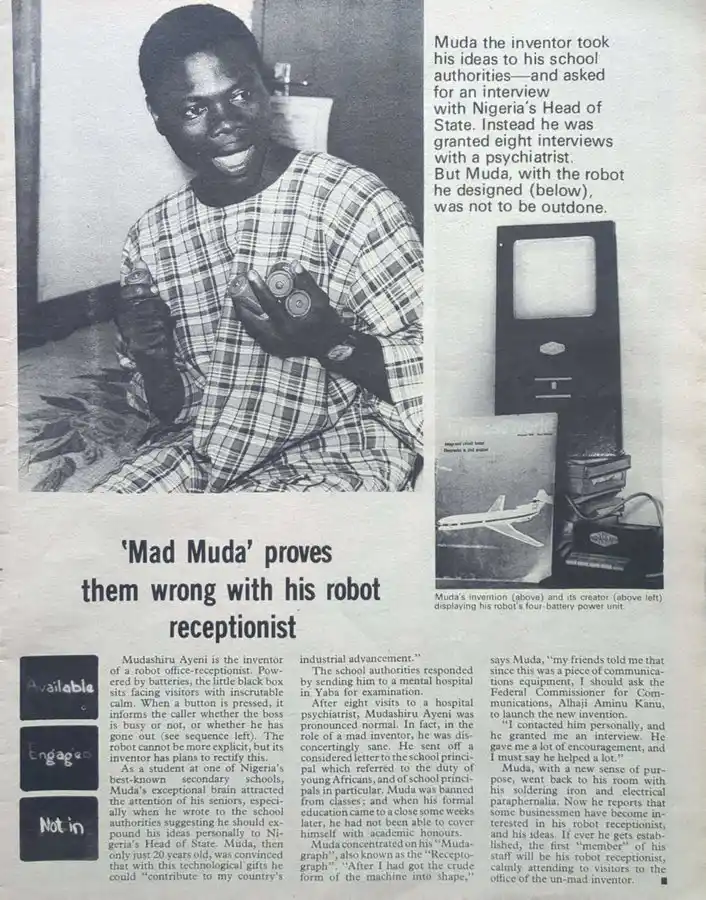
In the early 1970s, at a time when computers were still rare across Africa and the concept of Artificial Intelligence was largely confined to advanced research institutions in Europe and America, a young Nigerian dared to dream differently.
His name was Mudashiru Ayeni.
In 1971, Ayeni, then a 20-year-old student, believed he had successfully invented a battery-powered robot office assistant, a device designed to function as an automated receptionist capable of responding to visitors and callers at the press of a button.
Confident in the potential of his creation, Ayeni sought the opportunity to personally demonstrate his invention to Nigeria’s then Head of State, General Yakubu Gowon.
But instead of receiving a platform to showcase his innovation, the young inventor was met with disbelief. Rather than being ushered into the corridors of power, Ayeni was referred to a psychiatrist.
According to a 1971 feature story published by TRUST magazine, Ayeni was made to visit a psychiatric hospital eight separate times before he was eventually certified to be of sound mind. What he considered technological ingenuity was, at the time, perceived by authorities as a possible sign of delusion. The incident reflected the technological climate of that era, a period when futuristic thinking, particularly from young Africans, was often misunderstood or dismissed outright.
Undeterred by his psychiatric evaluation, Ayeni continued to pursue his intellectual ambitions. He wrote a letter to his school principal, outlining what he believed to be the crucial role young Africans were expected to play in driving the continent’s development through innovation and scientific advancement.
However, this bold move did not produce the encouragement he hoped for. Instead, he was banned from attending classes and was ultimately forced to quit school entirely, a devastating blow to a young man driven by ideas far ahead of his time.
At a critical moment in his journey, Ayeni reached out to Nigeria’s Federal Commissioner of Communications, Aminu Kano. Unlike others who doubted him, Aminu Kano reportedly encouraged the young inventor, offering him reassurance and restoring his sense of purpose. That gesture provided Ayeni with renewed motivation to continue believing in his ideas despite institutional setbacks.
Ayeni’s invention was described as a battery-powered robot designed to serve as an office assistant. With the press of a button, the device could inform a visitor or caller whether the boss was busy, available, or away from the office. In essence, it functioned as an automated communication system, decades before digital assistants, voicemail systems, and AI-powered reception tools became mainstream globally.
At the time TRUST magazine published the story in 1971, Ayeni reportedly stated that several businessmen had already expressed interest in his invention, suggesting that beyond the skepticism he faced, there were individuals who recognized its commercial potential.
Mudashiru Ayeni’s experience stands today as a powerful reminder of how innovation can be misunderstood, especially when it emerges in environments not yet ready to embrace it. In an era where Artificial Intelligence now powers virtual assistants, automated call systems, robotics, and smart devices across the world, the story of a young Nigerian who attempted something similar in 1971 invites reflection. It raises enduring questions about how societies respond to bold ideas, how institutions treat unconventional thinkers, and how many innovations may have been delayed not by lack of talent, but by lack of belief.