
NEWS
Federal High Court Fixes February 24, 2026 for Hearing on Suit Seeking Deregistration of (ADC), ZLP, Others Over Alleged Constitutional Breaches

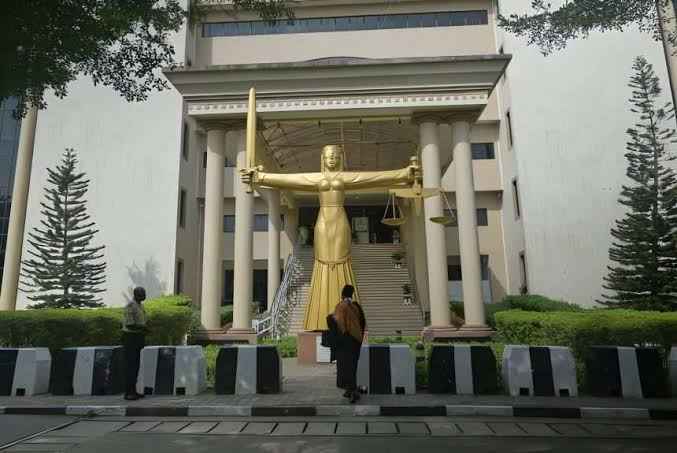
The Federal High Court sitting in Abuja has fixed February 24, 2026, for the hearing of a high-stakes suit seeking to compel the deregistration of the African Democratic Congress and other political parties over alleged violations of constitutional provisions governing party registration and continued recognition.
The suit, marked FHC/ABJ/CS/2637/25, was instituted by the Incorporated Trustees of the National Forum of Former Legislators against the Independent National Electoral Commission, the Attorney-General of the Federation, and five political parties — African Democratic Congress (ADC), Accord Party, Zenith Labour Party (ZLP), and Action Alliance (AA).
The matter, initially slated for mention on Monday before Justice Peter Lifu, was not heard. Following the brief court appearance, proceedings were adjourned to the new date for substantive consideration.
Addressing journalists after the stalled hearing, counsel for the plaintiff, Yakubu Ruba (SAN), clarified the essence of the legal action.
“We are before the court purely for constitutional interpretation. Some parties, in our view, have acted in breach of the Constitution, and we seek the court’s guidance on the relevant provisions,” Ruba said.
Court documents reveal that the action was commenced by originating summons pursuant to Section 225(A) of the 1999 Constitution (as amended), Section 75(4) of the Electoral Act, 2022, and relevant provisions of the Federal High Court (Civil Procedure) Rules, 2019.
At the heart of the dispute is the question of whether INEC is constitutionally obligated to deregister political parties that fail to meet minimum electoral performance thresholds stipulated by law. These benchmarks include securing at least 25 per cent of votes cast in one state during a presidential election, winning a local government area in a governorship election, or clinching at least one seat in elections ranging from councillorship to the National Assembly.
The plaintiffs are asking the court to determine whether INEC is not only empowered but duty-bound to enforce these constitutional thresholds against parties that allegedly failed to win any ward, legislative seat, or elective office in previous electoral cycles.
Beyond deregistration, the suit raises broader constitutional questions about the continued legal recognition of such parties. It seeks judicial clarity on whether INEC can lawfully recognise or give effect to their political activities, including congresses, primaries, campaigns, and participation in the 2027 general elections without strict compliance with Section 225(A) of the Constitution.
Among the reliefs sought are declaratory orders affirming that INEC is duty-bound to enforce constitutional benchmarks as a precondition for party registration and electoral participation. The plaintiffs are also asking for orders compelling the electoral body to deregister the affected parties.
Additionally, the suit seeks mandatory and perpetual injunctions restraining INEC from recognising, accepting, or giving effect to any political activities or correspondence from the parties unless and until they comply fully with constitutional and statutory requirements.
In an affidavit supporting the originating summons, deposed to by Hon. Igbokwe Nnanna, Chairman of the Board of Trustees and National Coordinator of the NFFL, the forum accused INEC of neglecting its constitutional responsibilities by continuing to recognise parties that allegedly failed to meet prescribed electoral benchmarks.
According to the affidavit, the affected parties have, since their registration, failed to secure a single elective position at any level of government, including presidential, governorship, National Assembly, state assembly, chairmanship, or councillorship elections.
The deponent further asserted that the parties did not obtain the constitutionally mandated 25 per cent of votes in at least one state in presidential elections, nor secure representation across Nigeria’s 8,809 wards, 774 local government areas, 36 states, and the Federal Capital Territory.
Despite what was described as total electoral failures, the forum maintained that INEC has continued to accord the parties full legal recognition, an action it argued runs contrary to the 1999 Constitution, the Electoral Act 2022, and INEC’s Regulations and Guidelines for Political Parties, 2022.
Framing the action as a public interest litigation, the group warned that unless restrained by the court, INEC may permit the affected parties to participate in the 2027 general elections, thereby clogging ballot papers, overstretching administrative resources, and potentially misleading voters.
The plaintiffs urged the court to compel strict constitutional compliance through the deregistration of underperforming political parties, insisting that such enforcement is necessary to strengthen Nigeria’s democratic process and uphold the rule of law ahead of future elections.
Justice Lifu subsequently adjourned the matter to February 24, 2026, for further proceedings.