
NEWS
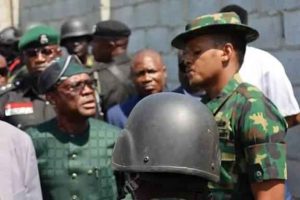
FCT MINISTER WIKE AND NAVY LIEUTENANT YARIMA CLASH: UNDERSTANDING THE LEGAL AND ETHICAL DIMENSIONS OF THE CONFRONTATION


By @TheKELVINATOR
A recent altercation between the Minister of the Federal Capital Territory (FCT), Nyesom Wike, and a Naval Officer, Lieutenant Ahmad Yarima, has sparked national debate, raising key questions about authority, jurisdiction, and professional conduct within Nigeria’s governance and security structures.
The incident reportedly began when workers at a construction site alleged they were being harassed by officials from the Federal Ministry of Lands. The individual in possession of the land, seeking to maintain order and prevent further intrusion, dispatched his naval security detail to “maintain peace.” However, the situation escalated when the FCT Minister himself intervened in person to address the matter, a move that led to a tense confrontation between the minister and the naval officer.
Section 1 of the Land Use Act clearly states that all lands within a state or territory are vested in the Governor (or Minister, in the case of the FCT), who holds them in trust for the use and common benefit of all Nigerians.
In this regard, the FCT Minister, Nyesom Wike, acted within his lawful powers by demanding proof of ownership, documentation, or an official title for the disputed property. This is consistent with his constitutional responsibility to manage and regulate land use within the Federal Capital Territory.
On the other hand, the primary responsibility of a naval officer lies in the protection of Nigeria’s maritime territories, including the country’s coastal areas, seaports, and territorial waters. The Nigerian Navy’s constitutional mandate does not extend to land-based civil matters or property disputes.
Thus, the involvement of a naval officer in a land-related confrontation was arguably outside the purview of his official duties.
While the FCT Minister, as a high-ranking public official, deserves respect and honour in the discharge of his duties, the same principle applies reciprocally, he must also treat others with dignity and respect.
Section 34 of the 1999 Constitution of the Federal Republic of Nigeria (as amended) guarantees the right to dignity of the human person, which prohibits any form of inhuman or degrading treatment, regardless of rank or office.
In the military tradition of “Esprit de Corps,” officers are bound by strict chains of command. A naval officer’s loyalty lies not to an individual minister or politician, but to his superior officers and the established command structure similar to how police officers answer to the Inspector General of Police, not directly to state governors.
Therefore, in any situation involving a member of the armed forces or security services, the lawful procedure for removal or disciplinary action is through a court order or by formally engaging the officer’s command hierarchy.
As the Igbo adage goes, “Eji ara na le ara” — meaning “madness is handled by madness.” In essence, when a civilian authority encounters a trained military personnel in an uncontrolled situation, both sides must exercise restraint, understanding, and respect for lawful procedure.
The clash between Minister Wike and Lieutenant Yarima serves as a vital reminder that the rule of law and due process must guide interactions between civil authorities and military personnel. While the FCT Minister was legally right to assert ownership over the disputed land, maintaining professionalism, respect, and adherence to established command structures remains essential to preserving order, discipline, and mutual respect among Nigeria’s institutions of g

 overnance and security.