
security
Security Concerns Rock National Assembly as Akpabio Urges Tinubu to Reconsider Withdrawal of Police Orderlies from Lawmakers

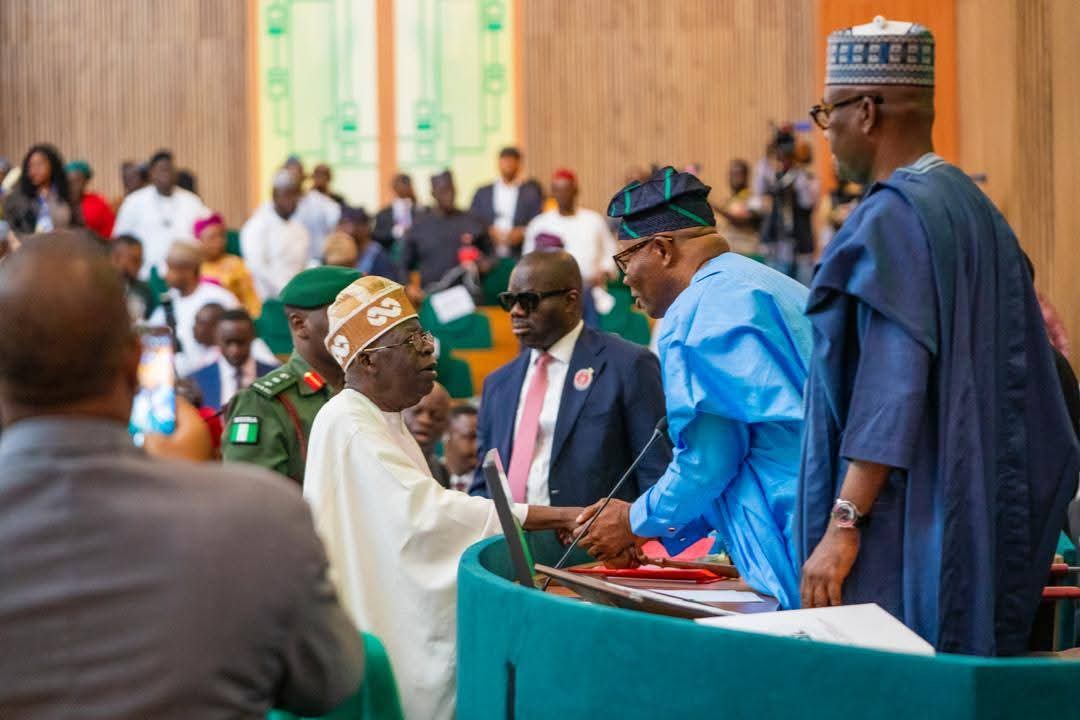
…says “…Some of the National Assembly said I Should Let You Know They May Not be Able to Go Home…”
Senate President, Godswill Akpabio, has appealed to President Bola Ahmed Tinubu to reconsider the Federal Government’s directive withdrawing police orderlies from members of the National Assembly, warning that the decision poses serious safety concerns for federal lawmakers.
Akpabio made the plea on Friday during the presentation of the 2026 budget to a joint session of the National Assembly, where he disclosed that the sudden withdrawal of police escorts had triggered anxiety among legislators over their personal safety.
According to the Senate President, some lawmakers expressed fears that they might be unable to return home safely following the enforcement of the directive. He conveyed their concerns directly to the President during the high-level budget session.
His words: “As we direct the security agencies to withdraw policemen from critical areas, some of the National Assembly said I should let you know they may not be able to go home today.
“On that note, we plead with Mr President for a review of the decision.”
The appeal comes amid the implementation of President Tinubu’s order issued on November 23, directing the withdrawal of police officers attached to Very Important Persons (VIPs) across the country. The directive mandated that the affected officers be redeployed to core policing duties to strengthen security nationwide.
According to the President’s Special Adviser on Information and Strategy, Bayo Onanuga, the decision followed a crucial security meeting involving service chiefs and the Director-General of the Department of State Services (DSS), held against the backdrop of heightened security challenges across the country.
Under the new security arrangement, VIPs requiring personal protection are expected to seek cover from the Nigeria Security and Civil Defence Corps, as the Federal Government intensifies efforts to increase police visibility in communities, especially in rural and remote areas battling insecurity.
President Tinubu later reaffirmed his stance on December 10, moments before presiding over a meeting of the Federal Executive Council (FEC). He expressed dissatisfaction with delays in implementing the directive and ordered immediate action to prevent security gaps.
In his directive, the President instructed the Minister of Interior, Olubunmi Tunji-Ojo, to collaborate with the Inspector-General of Police, Kayode Egbetokun, and the Nigeria Security and Civil Defence Corps to ensure that withdrawn police escorts are promptly replaced.
“I honestly believe in what I said…It should be effected. If you have any problem because of the nature of your assignment, contact the IGP and get my clearance,” Tinubu said.
“The minister of interior should liaise IG and the Civil Defence structure to replace those police officers who are on special security duties.
“So that you don’t leave people exposed,” he insisted.
However, the directive has continued to generate debate within political circles, with some lawmakers raising concerns over what they describe as selective enforcement.
Senator Ningi, speaking on the matter, argued that the policy should be uniformly applied across all categories of public office holders.
“It should be done across the board from the office of the President, to the Vice President, the Senate President, the Speaker of the House, Ministers, and others.
“I have been in public service since 1999 and have never kept more than one police orderly. Yet, mine was withdrawn without prior notice,” Ningi said.
He further questioned why some individuals outside public office still enjoy heavy security presence, despite the new directive.
He highlighted instances where ministers, business tycoons, and children of political office holders continue to move around with multiple security personnel.
“I have seen singers and other private individuals with orderlies and complimentary protection.
“I cannot imagine that a senator of the Federal Republic of Nigeria would have his only orderly withdrawn while others retain theirs,” he added.
As discussions continue, the issue has drawn national attention, raising critical questions about security equity, the safety of lawmakers, and the broader implications of reallocating police resources in a country grappling with complex security challenges.