
DEVELOPMENT
FG Unveils ₦40bn CCTV Control Centre on Third Mainland Bridge, Targets Suicide Prevention, Speed Control and Enhanced Security

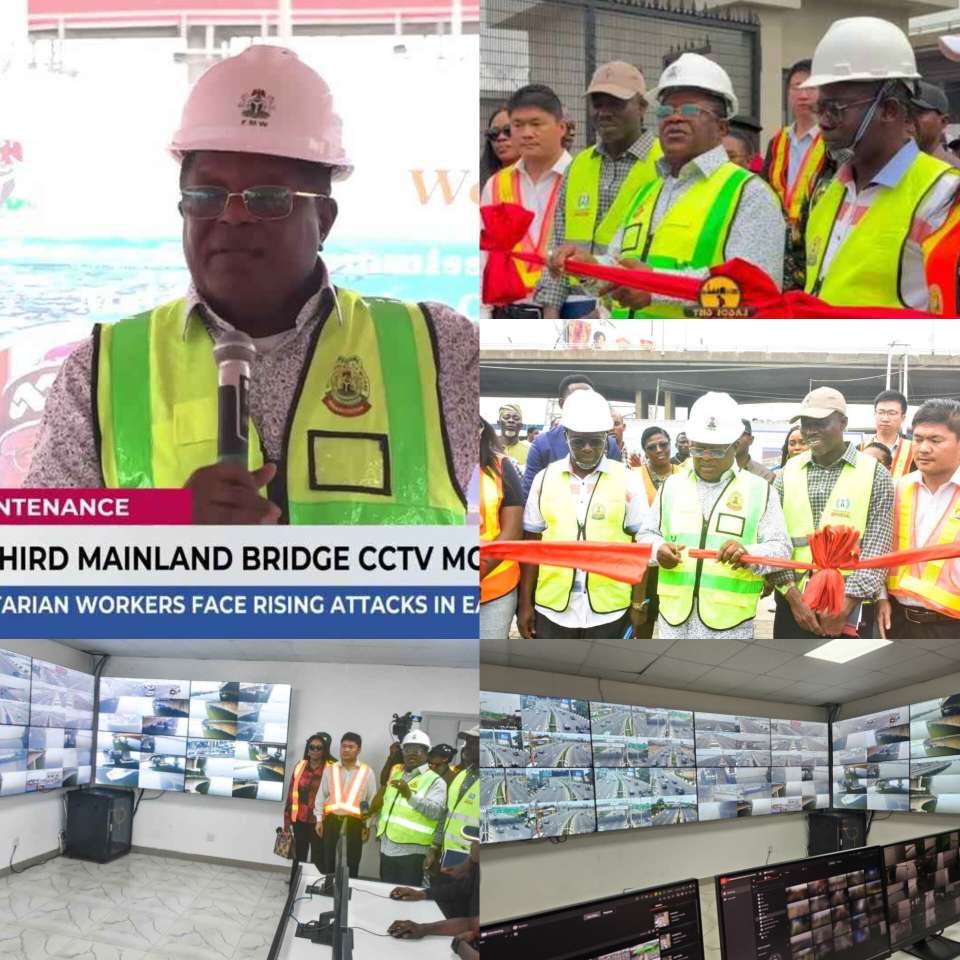
The Federal Government has inaugurated a ₦40 billion closed-circuit television (CCTV) control centre for the Third Mainland Bridge in Lagos, marking a major milestone in infrastructure surveillance, road safety, and security management on one of Africa’s busiest bridges.
The project is part of a broader intervention by the federal government to modernise critical national infrastructure and ensure the safety of motorists and other bridge users. The Third Mainland Bridge, which links Lagos Mainland to the Island, has long been a strategic economic and transportation corridor, handling thousands of vehicles daily.
In 2025, the Minister of Works, David Umahi, had announced that surveillance cameras were being installed on the bridge. At the time, he explained that the installation of closed-circuit television (CCTV) cameras was designed not only to improve security but also to prevent suicide attempts, which had become a growing concern on the bridge.
The minister had also disclosed that security personnel would actively monitor live footage from the CCTV system, while speed regulations would be enforced to reduce accidents and reckless driving.
Speaking on Sunday at the formal inauguration of the CCTV control centre, Umahi said the current administration inherited bridges in extremely poor condition when it assumed office in 2023.
“When we came on board in 2023, we met a very terrible Third Mainland Bridge, Carter Bridge and Iddo Bridge, both on the pavement, surface, infrastructure above the water and even infrastructure below the water,” he said.
According to him, President Bola Tinubu immediately ordered a comprehensive technical reassessment and total rehabilitation of the affected bridges.
“The president, therefore, directed total re-evaluation and rehabilitation of the surfaces of the Third Mainland Bridge and changing the expansion joints.
“Lagosians were very happy with the president for that beautiful work, and that work completed and commissioned is still succeeding because of the quality.”
Umahi praised China Civil Engineering Construction Corporation (CCECC), the contractor that handled the project, for delivering what he described as high-quality and durable work. He noted that the success of the rehabilitation has reinforced public confidence in the administration’s infrastructure agenda.
The minister also revealed that as part of the CCTV project, the ministry would officially hand over a surveillance boat and two Hilux vans included in the contract to the Nigeria Police Force for effective monitoring of activities on and around the bridge.
“If they need to incorporate other security agencies, they can do that, but the idea of this project is that we have a lay-by on the bridge, so we view everything going on on this bridge,” he said.
Expressing concern over excessive speeding, Umahi warned motorists against violating traffic rules, stressing that the new surveillance infrastructure would make it easier to identify offenders and enforce compliance with road safety regulations.
Earlier, the Federal Controller of Works in Lagos, Olufemi Dare, described the CCTV control centre as the first of its kind in Nigeria, setting a new benchmark for bridge monitoring and infrastructure security in the country.
“I doubt if there is any bridge in Nigeria that has what we have deployed here today, where you have CCTV to monitor both the underwater and even the bridge itself,” Dare said.
Providing details of the facility, he explained that the project goes beyond cameras alone, incorporating a wide range of modern surveillance and power solutions.
“We have a boat that has been bought for surveillance of the bridge. There are two Hilux vans, too.
“We have 240 solar panels in this environment, and that is not enough. The whole place is fully air-conditioned. We have 10 inverters inside the building.
“We have the powering units. We have a transformer, a 300 KVA transformer. We have a standby generating plant and monitoring screens.”
Dare thanked President Bola Tinubu for approving the project and commended Umahi for ensuring transparency and due process throughout its execution.
“We have about 1,268 solar street lights that are part of this contract,” he said.
He further disclosed that the project also includes a borehole facility and was awarded at the cost of ₦40.17 billion, adding that the federal government has so far paid ₦36 billion to the contractor.
Describing the event as a phased commissioning, Dare said more work remains.
“This is the first level of commissioning. We are still going to come back here to do even for the extension of the bridge, which is about to be completed,” he said.
“We pray that very sooner than later, we will come back to do a full-blown commissioning.”
The inauguration of the CCTV control centre is expected to significantly enhance safety, security, and operational efficiency on the Third Mainland Bridge, while serving as a model for s



 imilar infrastructure projects across the country.