
NEWS
GOV. ALEX OTTI SPEAKS TO ABIANS: Gov. Otti Unveils Digital Healthcare Revolution as Abia Retrofitted 200 PHCs, Expands World Bank–Backed Intervention to 270 Facilities

By @TheKELVINATOR, The Eyes Opener News | February 27, 2026
The Abia State Government has commenced a pilot Digital Healthcare Programme in select hospitals as part of deliberate and strategic efforts to migrate from manual to technology-driven medical services across the State, marking a bold transition into a modern, efficient and patient-centered healthcare system.
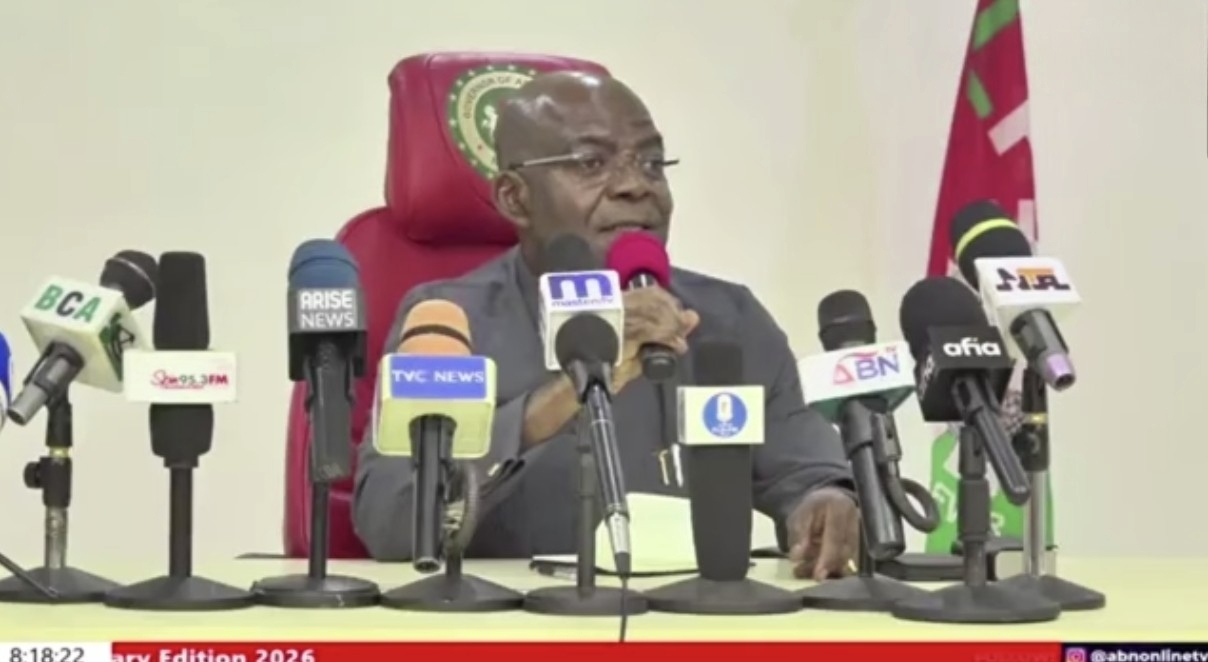
Governor Otti who disclosed this on Friday night during the February edition of his monthly media interaction with Journalists tagged, “Governor Otti Speaks to Abians,“ said that the ongoing digital transition in the state is already delivering measurable and positive results.
“In terms of digital health care programmes, we have started a pilot programme in select hospitals. The whole idea is to migrate from manual to digital. It is looking quite good. Our people are happy, Governor Otti said.
The pilot phase, according to findings, is designed to test-run an integrated digital framework that will eliminate cumbersome paperwork, reduce medical errors, improve patient data management, enhance transparency, and significantly cut waiting time in public hospitals. The programme represents a major structural reform aimed at repositioning Abia’s health sector to align with global standards in medical service delivery.
Governor Otti recalled that upon assumption of office, his administration declared a state of emergency in critical sectors including Health, Environmental Sanitation and Infrastructure, noting that significant progress had been recorded in the sectors. The declaration, widely regarded as a decisive governance move, laid the foundation for systematic interventions that are now visibly transforming public institutions across the State.
In what appears to be one of the most far-reaching primary healthcare upgrades in Abia’s history, Governor Otti revealed that the phase one of the Project Ekwueme Primary Healthcare intervention programme is coming to a close with 200 Primary Health Care Centres retrofitted, rebuilt and remodelled across the State.
“All the 200 primary health care centres are now in place and are retrofitted, rebuilt or remodelled. Some of them have not been functionalised because we insist on minimum standards in terms of equipment and in terms of health care professionals.
“We have given the directive that in the next four to six weeks all of them should be functionalised,” he stated.
The insistence on minimum operational standards underscores the administration’s shift from merely commissioning projects to ensuring sustainability, functionality, and quality service delivery. The retrofitted facilities are being equipped with modern medical tools while qualified healthcare professionals are being deployed to guarantee efficiency and professionalism.
The Governor further disclosed that recruitment of Healthcare personnel is ongoing to ensure adequate staffing across the facilities, signaling a comprehensive approach that combines infrastructure renewal with human capital development. Beyond state-funded interventions, Abia is also implementing the World Bank-supported IMPACT project, strengthening collaboration with international development partners.
According to him, 77 additional Primary Healthcare Centres have been rehabilitated under the World Bank scheme, bringing the total to over 270 healthcare facilities once fully operational. This expansion significantly widens access to quality healthcare services, especially for rural and underserved communities.
In a move to deepen capacity building and ensure continuous professional development, Governor Otti disclosed that the State has engaged Quantus Medical Foundation, a United States-based firm, to train healthcare professionals in line with global best practices.
“We know a lot of them are highly qualified. But then, just like every other thing, the information age makes it compulsory that things continue to change. So we want our people to be updated,” he said.
The partnership with the US-based foundation reflects the administration’s recognition that healthcare transformation goes beyond bricks and mortar. It requires continuous training, exposure to evolving medical technologies, and adherence to international standards of practice.
With digital healthcare rollout underway, over 270 primary healthcare facilities either upgraded or rehabilitated, and structured human capital investment ongoing, Abia’s health sector is steadily transitioning from a fragile system to a technology-enabled, globally compliant healthcare framework designed to serve its people
efficiently and sustainably.