
NEWS
Iran Rejects Trump’s Claim of Role in Choosing Next Leader After Death of Supreme Leader, Says Nation Will Decide Its Future Without Foreign Interference

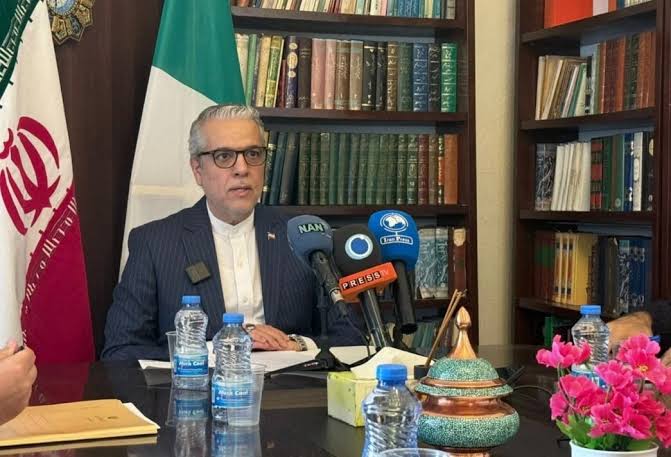
The Ambassador of the Islamic Republic of Iran to Nigeria, Gholamreza Ahdavi Raja, has strongly criticised remarks by United States President Donald Trump suggesting that he would be involved in determining Iran’s leadership following the death of the country’s Supreme Leader, Ayatollah Ali Khamenei, during Saturday’s attack.
Speaking during a press conference in Abuja on Thursday, Raja firmly rejected the notion that any foreign power could influence the leadership or political future of the Islamic Republic, stressing that the Iranian people alone hold the authority to determine the direction of their nation.
According to the ambassador, Iran remains a sovereign nation that will not tolerate external interference in its domestic affairs or leadership decisions.
“The United States is always interfering in our domestic issues. We are an independent country. We will not let the United States interfere in our domestic affairs,” he said.
Raja’s remarks came shortly after Trump reacted publicly to the confirmation of Khamenei’s death, making statements that suggested Washington could play a role in shaping the leadership succession in Tehran.
The U.S. president took to his social media platform, Truth Social, where he urged Iranians to take control of their country and leadership in the aftermath of the Supreme Leader’s death.
During a separate bilateral meeting at the White House with German Chancellor Friedrich Merz, Trump also claimed that successive waves of joint U.S.-Israeli attacks had eliminated several figures he believed were being groomed to assume senior military leadership roles in Iran.
“Most of the people we had in mind are dead. I guess the worst case would be, we do this, and then somebody takes over who’s as bad as the previous person, right? We’d like to see somebody in there that’s going to bring it back for the people,” Trump said.
In a further interview with Axios on Thursday, Trump insisted that he should play a role in determining who becomes Iran’s next leader, referencing his alleged involvement in political developments elsewhere.
“I have to be involved in the appointment, like with Delcy in Venezuela,” Trump said.
Reacting to the comments, Ambassador Raja dismissed the suggestion as unacceptable and reaffirmed Iran’s independence in deciding its leadership and national future.
“We are an independent country. We decide ourselves about our leadership, about our future, and all the decisions which we are taking are based on the people in order to preserve the interests of our country,” he said.
The Iranian envoy also moved to reassure Nigerians whose relatives or associates may be in Iran, stating that Nigerian citizens currently residing in the country remain safe despite escalating tensions in the region.
“Your citizens in Iran are safe and secure because some of your citizens are in Tehran. Some of them are in Qom and other cities.
“So far, we haven’t received any reports regarding Nigerian casualties or injuries. So they are secure,” he said.
Raja further emphasised that diplomatic relations between Nigeria and Iran remain cordial and mutually beneficial, noting that the two nations have maintained strong ties for more than five decades.
“Our relationship goes back more than 55 years. During these decades, we have had good relations. We are satisfied with the level of the relationship between the two countries,” the envoy said.
He added that cooperation between the two countries spans several strategic sectors, including politics, agriculture, energy, oil and gas, industry, and education.
The ambassador also used the press briefing to condemn the recent military assault on Iran, describing it as a deliberate and premeditated act of aggression that violated international law and the United Nations Charter.
According to him, responsibility for ending the conflict lies with the aggressors and the international community rather than Iran.
“It’s not our responsibility to find a solution for ending the war. It’s the responsibility of the aggressors; it’s the responsibility of the international community. It’s the responsibility of international bodies to intervene in this conflict. But all of them are silent.
“Where is the European Union now? Where is the position of the United Nations? Specifically, the body responsible for security, which is the Security Council. Why haven’t they even held an urgent session? The whole region is facing conflict, but you can see that the Security Council has kept silent,” he said.
Raja further accused the United Nations of being influenced by the United States and failing to act decisively in the face of what he described as acts of terror and aggression.
“Because it’s the hand of the United States. Because it’s a tool of the United States. The United Nations is under the hand of the United States. No actions have been taken against acts of terror, acts of assassination, or acts of aggression. No action,” he said.
According to him, the global body risks losing its legitimacy if it fails to uphold its founding principles of safeguarding global peace and security.
“They are responsible; they were created in order to manage the security of the world, but nowadays they haven’t done anything in this regard,” he stated.
Defending Iran’s global record, Raja maintained that the country has not initiated military aggression against any nation for more than two centuries.
“Iran has not initiated an attack on any country. Iran has not attacked for 200 years now. We were attacked by other countries, but we haven’t started any war,” he said.
By contrast, he accused the United States of repeatedly engaging in military interventions across the world since the end of World War II.
“The United States, since the end of the Second World War, has invaded more than 50 countries. Who is seeking the conflict? Iran or the United States?” he asked.
The ambassador described the attacks carried out by Israel and the United States as a violation of Article 2(4) of the United Nations Charter, which prohibits the use of force against the territorial integrity or political independence of any state.
“What has been done against Iran is not merely a military operation; it is a flagrant violation of Article 2, paragraph 4 of the UN Charter,” he said.
He further cited Article 51 of the Charter, asserting Iran’s inherent right to defend itself against armed aggression.
“The Islamic Republic of Iran, in accordance with Article 51 of the UN Charter, has the inherent and legitimate right to defend itself against armed aggression. Iran’s defensive measures are exercised strictly within this legal and rightful framework,” he said.
Raja also highlighted damage to civilian infrastructure, including schools and hospitals, which he said were affected by the attacks.
According to him, such actions constitute serious violations of international humanitarian law and may amount to war crimes.
“Let me state clearly: targeting children in a school is not a wartime accident; it is an unmistakable war crime,” he said.
He further revealed that the attacks occurred at a time when Iran was actively engaged in diplomatic negotiations with the United States.
“At the time these attacks occurred, Iran was actively engaged in diplomatic negotiations with the United States. Yet, once again, the United States chose to carry out a military attack in the midst of an ongoing diplomatic process,” he said.
Despite the tensions, the Iranian envoy emphasised that his country remains committed to peace and stability in the region, even as it prepares to defend its sovereignty and national interests.
“We are committed to defending ourselves, and we will do all that we can, but Iran is not a country seeking war. We are seeking peace and stability for the region,” he said.
He concluded by stressing that the Iranian people would not bow to external aggression, adding that they would continue to defend their legitimate rights while advocating for a fair and peaceful global order grounded in respect for international law.