
NEWS
Federal Government Unveils Bold Telecom Reforms, Orders Operators to Improve Service Quality Nationwide


 The Federal Government has declared that Nigerians should begin to experience noticeable improvements in telecom service delivery as major reforms and infrastructure investments aimed at transforming the country’s digital economy begin to take shape.
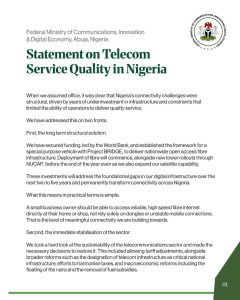
In a statement issued by the Minister of Communications, Innovation and Digital Economy, Bosun Tijani, the Federal Ministry of Communications, Innovation and Digital Economy disclosed that the current administration inherited deep-rooted connectivity challenges caused by years of underinvestment in telecommunications infrastructure and operational constraints affecting service providers.
According to the Minister, the government has now moved decisively to tackle the crisis through a two-pronged strategy focused on long-term infrastructure expansion and immediate stabilisation of the telecommunications sector.
Dr. Tijani revealed that the Federal Government has secured funding led by the World Bank and established a framework for a Special Purpose Vehicle under Project BRIDGE to drive nationwide open-access fibre infrastructure deployment across Nigeria.
He further disclosed that fibre deployment projects, alongside new telecom tower rollouts through NUCAP, are expected to commence before the end of the year, while efforts are also underway to strengthen the nation’s satellite communication capabilities.
The Minister explained that the investments are designed to permanently transform digital connectivity across Nigeria within the next two to five years by addressing long-standing foundational gaps in the country’s telecommunications infrastructure.
He noted that the goal of the reforms is to ensure that ordinary Nigerians, including small business owners, can access reliable and high-speed fibre internet services directly from their homes and business premises rather than depending solely on unstable mobile networks and internet dongles.
On the immediate stabilisation of the sector, the Minister stated that the government carried out critical reforms to restore sustainability within the telecommunications industry. These reforms included the approval of tariff adjustments, the designation of telecom infrastructure as critical national infrastructure, tax harmonisation efforts, and broader macroeconomic policies such as the floating of the naira and the removal of fuel subsidies.
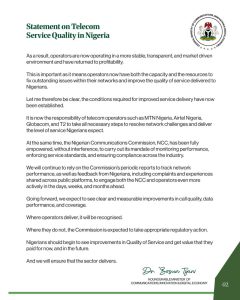
According to the statement, the reforms have helped telecom operators return to profitability and positioned them within a more stable, transparent, and market-driven environment capable of supporting improved service delivery.
The Minister stressed that the responsibility now lies with telecom companies including MTN Nigeria, Airtel Nigeria, Globacom, and T2 to resolve persistent network issues and deliver the level of service Nigerians deserve.
He also affirmed that the Nigerian Communications Commission has been fully empowered to independently monitor network performance, enforce service standards, and ensure compliance across the telecommunications industry without interference.
The government further assured Nigerians that it would continue to rely on periodic reports from the NCC, as well as complaints and feedback from telecom users across public platforms, to intensify engagements with operators and ensure accountability within the sector.
Dr. Tijani maintained that the Federal Government expects measurable improvements in call quality, data performance, and network coverage in the coming months, warning that operators who fail to meet expected standards could face regulatory actions from the NCC.
The statement concluded with assurances that Nigerians should begin to receive better value for money through improved Quality of Service, adding that the government remains committed to ensuring that the telecommunications sector delivers efficiently both now and in the future.