
NEWS
Kim Jong Un Vows to “Beef Up Our State’s Nuclear Forces at an Exponential Rate” After Inspecting New Nuclear Facility

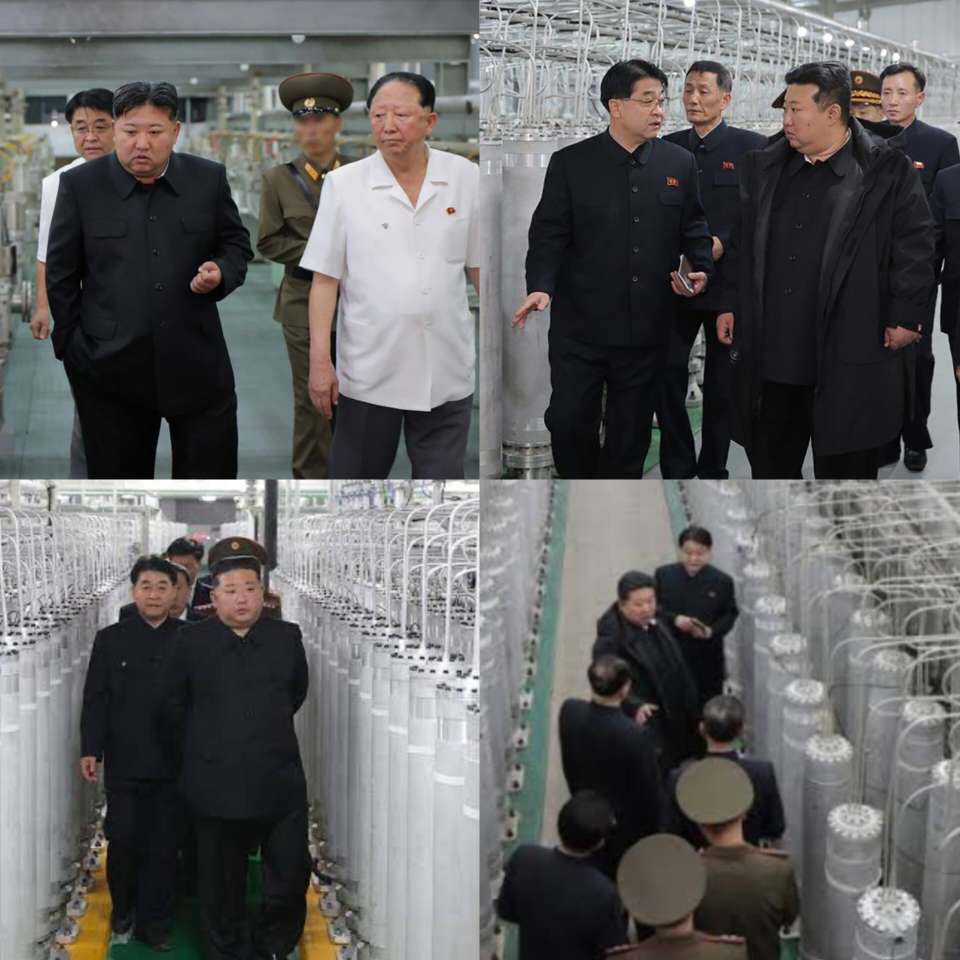
North Korean leader Kim Jong Un has intensified global concerns over Pyongyang’s growing nuclear ambitions after inspecting a newly established plant producing weapons-grade nuclear material and declaring that the country would continue to “beef up our state’s nuclear forces at an exponential rate.”
According to a report released Wednesday by the state-run Korean Central News Agency (KCNA), Kim said North Korea has more than doubled its ability to produce weapons-grade nuclear material over the last five years, adding that the newly unveiled facility would further strengthen the country’s nuclear war deterrent.
The move signals a major escalation in North Korea’s long-standing pursuit of nuclear supremacy and comes amid rising geopolitical tensions surrounding nuclear programs across the globe.
Kim’s renewed nuclear drive stems from a five-year strategic plan introduced after denuclearization negotiations with the United States collapsed. Those talks had included three high-profile meetings between Kim and former US President Donald Trump during Trump’s first administration but ultimately ended without a breakthrough agreement.
The announcement of the new facility also comes at a sensitive moment internationally, as Washington continues diplomatic efforts to end the prolonged US-Israeli conflict with Iran and pressure Tehran into surrendering nuclear materials that could potentially be weaponized.
Security analysts estimate that North Korea already possesses enough nuclear material to build as many as 90 warheads and may have assembled approximately 50 nuclear weapons already, according to a March report by the Congressional Research Service.
Further concerns were raised earlier this year when the International Atomic Energy Agency (IAEA) revealed that North Korea currently operates at least two active nuclear enrichment plants located in Yongbyon and Kangson.
The agency also disclosed that it had been monitoring the construction of another major structure in Yongbyon.
According to the IAEA, the building possesses “dimensions and infrastructure, including power supply and cooling capacity, similar to the Kangson enrichment facility.”
“The new building is externally complete and internal fitting is likely underway,” the IAEA report said.
Adding to mounting concerns, the head of the US Defense Intelligence Agency, Lt. Gen. James Adams, told the US House Armed Services Committee in April that Pyongyang was “building a probable additional uranium enrichment facility at Yongbyon.”
However, analysts remain uncertain whether the facility Kim inspected on Wednesday is the same Yongbyon project identified by US and international intelligence agencies or an entirely separate undisclosed site, as KCNA did not reveal the location of the plant.
Wednesday’s inspection marks at least the third occasion since September 2024 that North Korean state media has publicly shown Kim touring uranium enrichment or nuclear production facilities, a move widely interpreted as deliberate messaging to the international community.
KCNA reported that the latest facility utilizes “more sophisticated technology,” while released photographs showed Kim walking through long rows of centrifuges used for uranium enrichment.
Hong Min, a senior research fellow at the Korea Institute for National Unification in Seoul, told CNN that the newly unveiled facility demonstrates both the expansion and maturity of North Korea’s nuclear program.
According to Hong, the development “gives the impression that the center of the gravity has shifted from ‘research and production’ to ‘mass production and munitions’” as Kim was accompanied during the inspection by officials from both the munitions industry and the Nuclear Weapons Institute.
Hong further explained that by publicly releasing detailed images of the control rooms, processing pipelines, and module sections of the plant, North Korea was “intentionally highlighting the aspect of a completed factory in operation.”
Experts say the emphasis on industrial-scale production facilities, rather than dramatic missile launches or military parades, reflects Pyongyang’s growing confidence in its ability to sustain a robust nuclear weapons program.
Alongside its enrichment capabilities, North Korea has also accelerated missile development in recent years. According to the 2026 Annual Threat Assessment released by the Office of the US Director of National Intelligence, Pyongyang has successfully tested Intercontinental Ballistic Missiles (ICBMs) capable of reaching anywhere within the United States.
North Korea’s rise as a nuclear-armed power has increasingly become a reference point in international debates over Iran’s nuclear ambitions, particularly amid ongoing discussions tied to Operation Epic Fury and Washington’s efforts to prevent Tehran from following a similar path.
Critics of Trump, however, argue that the current tensions are partly linked to the collapse of the Obama-era nuclear agreement with Iran, which Trump withdrew from during his first term. They contend that renewed diplomatic efforts now come after months of conflict failed to secure regime change in Tehran or eliminate Iran’s nuclear infrastructure.
Meanwhile, global concerns over nuclear proliferation continue to grow. The 2026 edition of the Nuclear Weapons Ban Monitor revealed that the number of nuclear warheads available for military use among the world’s nine nuclear-armed nations has climbed to 9,745.
“The number of nuclear warheads available for use by the armed forces of the world’s nine nuclear-armed states had risen to 9,745, with a combined explosive yield equating to more than 135,000 Hiroshima bombs,” the report stated.
The report further noted that 2025 marked the ninth consecutive year of growth in the number of deployable nuclear weapons worldwide.
Russia currently maintains the world’s largest nuclear arsenal with more than 5,400 warheads, while the United States follows closely behind with nearly 5,300.