
NEWS
Dangote, Ruto Break Ground on $16bn Lamu Refinery as Africa Eyes New Era of Energy Self-Sufficiency

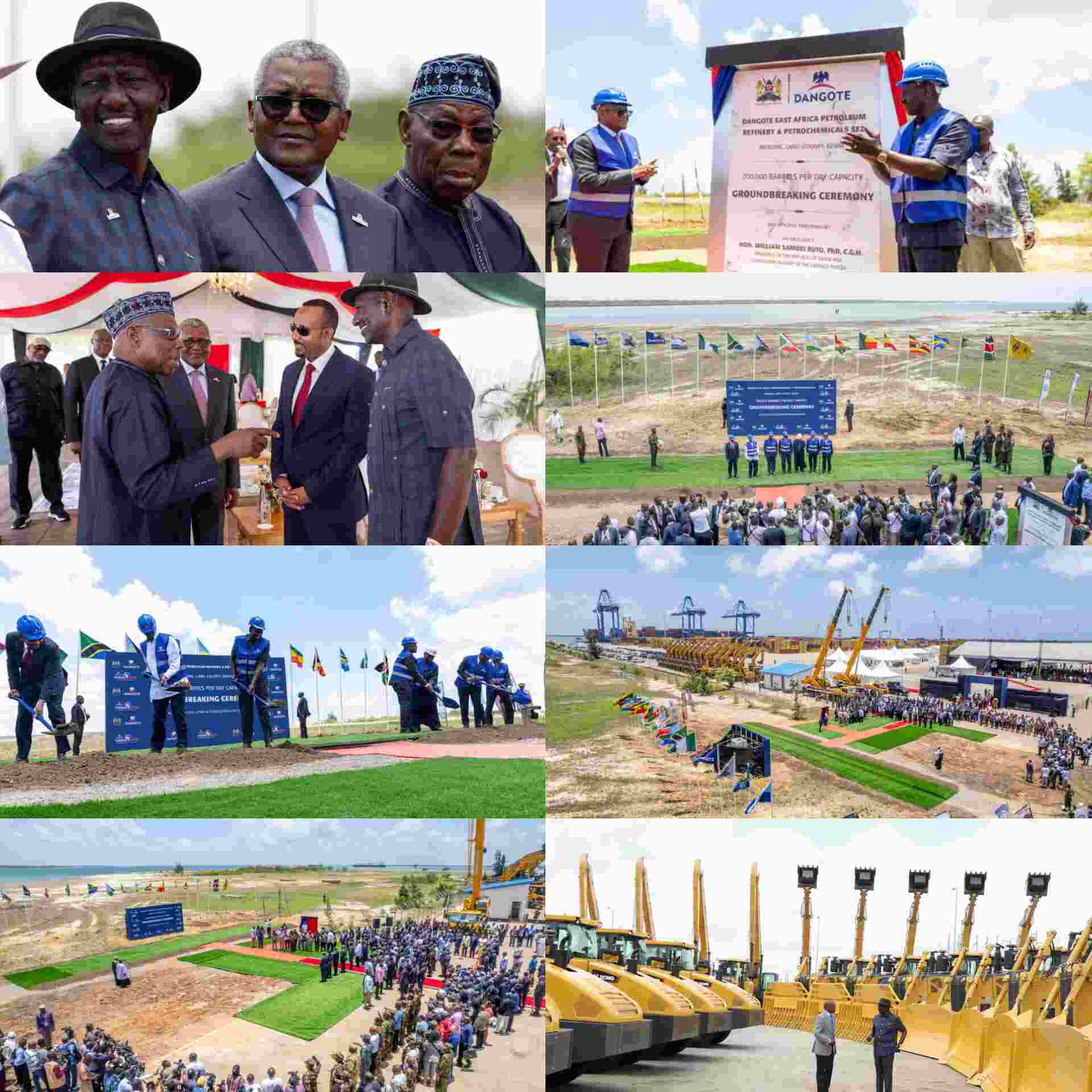
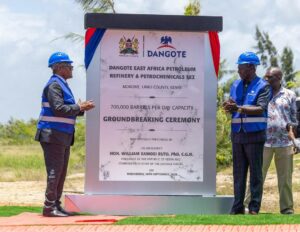
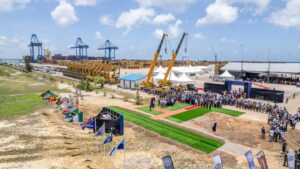
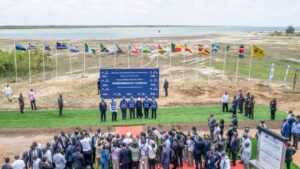
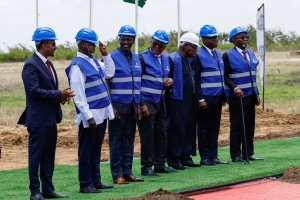
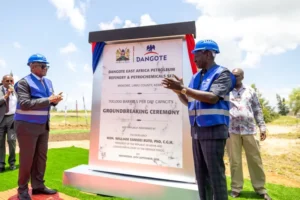
Construction has officially commenced on a landmark $16 billion oil refinery in Lamu, Kenya, with Nigerian billionaire and President of Dangote Group, Alhaji Aliko Dangote and Kenyan President, William Ruto leading the groundbreaking ceremony on Wednesday, September 30, 2026.
The ambitious project, which is expected to be completed within 40 months, is designed to transform East Africa’s energy landscape by reducing the region’s dependence on imported refined petroleum products, conserving foreign exchange and creating a major industrial hub along Kenya’s northern coastline.
Dangote, Africa’s richest man, is seeking to replicate the model of his 700,000-barrel-per-day Lekki refinery in Nigeria, as Kenya, Uganda and other countries in the region move towards increased crude oil production.
The proposed Lamu refinery will have a processing capacity of approximately 700,000 barrels of crude oil per day, potentially making it one of Africa’s largest refining facilities.
At the groundbreaking ceremony, Dangote challenged the project to match the achievements of his Nigerian refinery and set an ambitious commissioning deadline.
“Lekki refinery in Nigeria proved that it is capable, so Lamu must prove that it can be repeated. Mr President, and our other respected presidents, my brother, Prime Minister Abiy, I want to assure you will come back here and commission this refinery in 40 months from today,” Dangote said.
The project is expected to become Kenya’s largest-ever foreign direct investment and a major component of the country’s strategy to transform Lamu into an energy, logistics and industrial centre.
President Ruto said the refinery would increase Kenya’s annual gross domestic product by 12 per cent, while the wider development is expected to attract billions of dollars in investment and create tens of thousands of jobs.
“It is an investment in energy security, industrialisation and regional integration,“ he said.
Ruto also described the development as part of a broader effort to end Africa’s long-standing dependence on exporting raw materials while importing finished products.
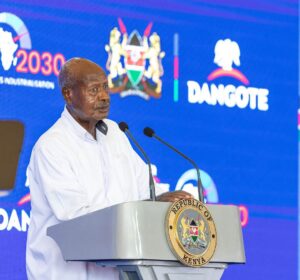
“The establishment of this refinery is a turning point, demonstrating our resolve to reimagine Africa’s industrial future, turn our ambitions into action and tap the continent’s massive potential.
“For too long, Africa has exported raw materials and imported finished products, exporting wealth and jobs. We are firm in our determination to reverse this trend.
“The project will boost the Kenyan economy by 12 per cent, inject additional $4 billion in foreign direct investment each year for the four years of construction, providing 60,000 direct jobs, building local expertise and accelerating the transformation of the Lamu Port South Sudan and Ethiopia Transport (LAPSSET) Corridor into a major industrial hub.
“But this is more than a refinery. It is an integrated industrial complex featuring a 1,000MW power plant, plastic factory and the manufacturing of fertilisers and chemicals,“ he stated.
Dangote has offered regional governments a combined 30 per cent stake in the refinery, with the company’s shares eventually expected to be listed on the Nairobi Securities Exchange.
Engineers India Limited has been awarded a $450 million project engineering contract, while Honeywell Technologies will provide technological support for the development.
Dangote said the refinery would not simply be a petroleum-processing facility but the foundation of a much larger industrial ecosystem.
“We are not here merely to build tanks, pipelines, processing units and jetties. We are here to help build an industrial ecosystem,” he said.
According to him, the development will create opportunities across energy, petrochemicals, logistics, engineering, marine services, manufacturing, technology, skills development and small and medium-sized enterprises.
The facility is also planned to produce one million tonnes of polypropylene and base oil, alongside other petroleum and petrochemical products.
One of the major components of the Lamu project will be a 1,000-megawatt power plant, which Dangote said would supply electricity to the refinery and associated industries while excess electricity could be sold to other customers.
“We have 1,000 megawatts that we are going to generate here,” he said.
The planned power generation capacity is expected to provide an important boost to the industrialisation drive around Lamu and support businesses that emerge around the refinery.
Dangote also said the refinery would target the international aviation fuel market, with the company seeking to supply jet fuel equivalent to at least 20 per cent of consumption in Europe and the United Kingdom.
“That’s what we did during this crisis. If not because of the Dangote refinery, a lot of people wouldn’t have had the chance to go on summer holiday in Europe,” he said.
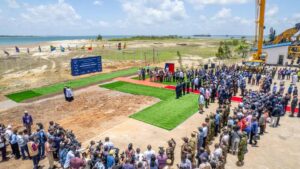
The groundbreaking ceremony at Lamu Port attracted several African leaders, underscoring the regional significance attached to the project.
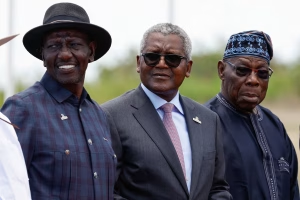
Dangote and Ruto were joined by Ethiopian Prime Minister Abiy Ahmed, Ugandan President Yoweri Museveni, Benin President Romuald Wadagni and Togolese President Jean-Lucien Savi de Tové.
Former Nigerian President Olusegun Obasanjo and representatives of other African governments also attended the event.
The leaders witnessed the commencement of a project that is expected to serve markets beyond Kenya and strengthen energy and trade connections across East Africa.
“We are breaking ground for a new chapter in Africa’s industrial journey to a brighter future,“ Dangote said.
Dangote also announced that the project would have a strong local skills-development component, including the establishment of a training school in Lamu.
He said the company would train 1,000 residents of Lamu, including people with engineering degrees and diplomas, to equip them for opportunities created by the refinery and its associated industries.
“We are coming here to set up a training school that will train 1,000 of your people,” Dangote said.
The training programme is expected to prepare local residents for technical, engineering, manufacturing and operational roles within the refinery and the wider industrial ecosystem.
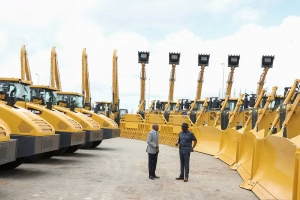
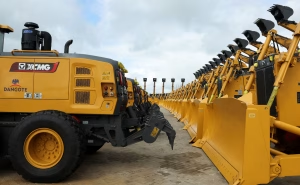
For residents such as Evans Hundo, the arrival of the construction equipment already represents the possibility of a new career.
“I am very hopeful when I see these machines lined up here because I know I have a chance to work and change my life from my menial jobs now to become a machine operator which is what I’m trained to do,“ said local resident, Mr. Evans Hundo.
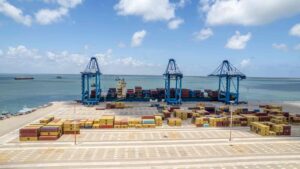
The refinery is being developed at Lamu Port, which received its first cargo ships in 2021 and forms a critical part of Kenya’s plan to establish a new transport and trade corridor linking the country’s northern regions and neighbouring countries to the Indian Ocean.
The refinery is expected to strengthen the Lamu Port-South Sudan-Ethiopia Transport Corridor, commonly known as LAPSSET, while creating new demand for logistics, transportation, engineering and manufacturing services.
Kenyan officials estimate that annual petroleum-product demand across the region stands at between 20 million and 30 million metric tonnes. Meeting that demand would require more than one million barrels per day of refining capacity, according to a financier involved in African refinery projects.
The development comes against the backdrop of heightened fuel-price pressures across East Africa, with rising petroleum costs contributing to economic hardship and protests in some countries.
Dangote said the refinery would help reduce dependence on imported refined products by processing crude closer to the markets where petroleum products are consumed.
The facility is also expected to process crude from Kenya and other African producers, creating an additional outlet for African crude while supplying refined products to regional markets.
Despite the scale of the project, analysts have raised questions about whether the Lamu refinery can replicate the success of the Lekki refinery in Nigeria.
Among the issues under scrutiny are the availability of sufficient local crude supplies, regional energy infrastructure and the logistics required to operate a refinery of such scale.
Environmental campaigners have also raised concerns over the potential impact of the project on Lamu’s fragile marine ecosystem and the historic Lamu Old Town, a UNESCO World Heritage site.
Kenya’s High Court has ordered the preservation of parts of the site pending a hearing in a case brought by local residents.
Dangote, however, dismissed concerns that legal challenges would derail the project and said the company was prepared to defend the development.
“We are really not scared about people taking us to court. Anybody who wants to cause trouble, we are ready for his trouble and we will give him a headache,“ he said.
Dangote said the long-term objective of the refinery extends beyond Kenya, describing the facility as a mechanism for strengthening energy security across a large part of the continent.
He said the project could contribute to energy self-sufficiency across a region stretching from Ethiopia to Mozambique by replacing imported refined petroleum products with locally processed fuel.
The project is also expected to stimulate downstream industries, including petrochemicals, plastics, base oils, bitumen, fertiliser and chemical manufacturing.
With construction now underway, attention will turn to whether Dangote’s ambitious 40-month completion target can be achieved and whether Lamu can em





 erge as a new centre of petroleum refining, power generation and industrial production in East Africa.