
NEWS
Retiring Supreme Court Justice, Ibrahim Saulawa Warns Judges Against ‘Greek Gifts’ From Politicians

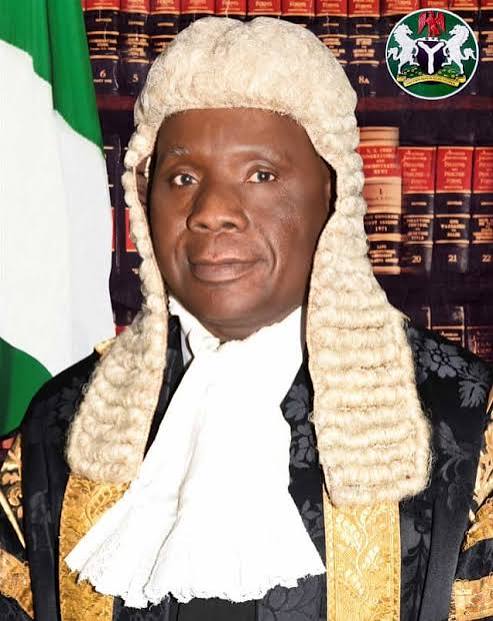
…says “Why Should a Politician Send a Ram, Cow or Other Items to a Supreme Court Justice?“
Retiring Justice of the Supreme Court, Ibrahim Saulawa, has issued a strong warning against attempts by politicians and other influential individuals to compromise the independence and integrity of the judiciary through gifts and personal inducements.
Justice Saulawa, who retired from the apex court upon attaining the mandatory retirement age of 70, specifically called for urgent action against the practice of politicians presenting judges with items such as cows, rams, vehicles and other gifts, describing such gestures as attempts to influence judicial officers.
Speaking during a valedictory court session held in his honour by the Supreme Court, the retiring jurist disclosed that he had previously raised concerns over the practice with the Chief Justice of Nigeria, Justice Kudirat Kekere-Ekun.
“Why should a politician send a ram, cow or other items to a Supreme Court Justice? It is unheard of in other countries.
“I am calling on the CJN to do something about this. I once raised the issue. It is demeaning and equally frustrating,” added Justice Saulawa, who bowed out of the bench after a 44-year journey in the legal profession.
Justice Saulawa used his final appearance on the bench to urge judges across the country to remain committed to integrity, honesty and morality, stressing that the credibility of the judiciary depends not only on the judgments delivered from the bench but also on the personal conduct of judicial officers away from the courtroom.
Recounting one of his experiences on the bench, the retiring Justice disclosed how an influential individual attempted to win his favour before judgment in a case by presenting him with a brand-new vehicle.
Justice Saulawa said he rejected the vehicle and maintained his independence despite efforts by the individual to enlist prominent traditional rulers and other influential personalities to persuade him to accept the gift.
“Prior to the case, the Alhaji had donated to me a brand new Peugeot motor vehicle, which I flatly rejected.
“He went to the extent of seeking the intervention of some prominent personalities, including the Emir, Alhaji Muhammadu Kabir Usman, the District Head, Alhaji Balan Goggo, et al., with a view to influencing me to accept the ‘Greek gift,’ but to no avail,” Justice Saulawa added.
The jurist said the incident reinforced his belief that judicial officers must be prepared to withstand pressure from powerful individuals and resist anything capable of creating an appearance of compromise.
He also disclosed that he deliberately avoided certain social engagements while in service as part of efforts to protect the independence of his office and prevent situations that could raise questions about his impartiality.
“But some of my learned friends are always there, even if they didn’t need to be there,” he noted.
The valedictory ceremony was, however, marked by a relatively low turnout of lawyers and dignitaries, with only six Senior Advocates of Nigeria and 13 other lawyers reportedly attending.
The attendance contrasted with similar ceremonies in previous years, which often attracted serving and former governors, senior politicians, legal practitioners and other prominent personalities.
A representative of the Body of Senior Advocates of Nigeria, Mr. Damien Dodo, SAN, expressed embarrassment over the poor attendance by members of the legal profession. He attributed the situation to what he described as miscommunication, stressing that the turnout did not reflect the stature or contribution of Justice Saulawa, whom he described as having served Nigeria “with granite integrity.”
The retiring Justice also used the occasion to revisit one of the most turbulent chapters in Nigeria’s political and judicial history, the crisis surrounding the annulment of the June 12, 1993 presidential election.
Justice Saulawa recalled that he was serving as Chief Registrar of the Court of Appeal at the time and played a role in responding to a series of conflicting court orders that emerged during the crisis.
According to him, the legal confusion arose after the FCT High Court issued two interim orders restraining the Professor Humphrey Nwosu-led National Electoral Commission from conducting the presidential election and announcing its results.
He said several state high courts subsequently issued conflicting orders directing that the results be announced, creating a complex legal situation that he attributed to military interference.
Justice Saulawa said that, acting on the directive of the then President of the Court of Appeal, Justice M. Akanbi, he immediately travelled from Lagos to Kaduna to take control of the Court of Appeal registry and ensure that the appeals filed by the electoral commission were properly processed.
“Appeals were filed at the Court of Appeal, Kaduna Division, by the NEC. As the Chief Registrar of the Court of Appeal, and the only spokesperson thereof, I flew from Lagos to Kaduna and took effective control of the Registry and supervised the registering of the appeals and the issuing of the appropriate court processes to the respective parties to the appeals.
“I equally issued a press release regarding the circumstances surrounding the two appeals and motions relating to.
“Later in the evening, I flew back to Lagos and briefed the PCA, Hon. Justice MMA Akanbi, a man of unquestionable integrity and unwavering courage. Upon my advice, the Hon. PCA called for an emergency meeting of the Hon. Presiding Justices over the crisis,” he added.
Justice Saulawa maintained that the military authorities had attempted to exploit conflicting court orders and that efforts were made to prevent the judiciary from being drawn into the political crisis.
He said that after attempts by the military to infiltrate the judiciary “was frustrated by myself and Justice Akanbi,” the then Head of State, General Ibrahim Babangida, eventually annulled the presidential election.
According to Saulawa, the justification subsequently given for the annulment was that the military leader was attempting to save “the judiciary from self-destruction.”
The retiring Justice also criticised the practice of “forum shopping,” which he said contributed to the proliferation of conflicting judicial orders during the June 12 crisis.
Looking back at the conduct of judicial officers during the period, Justice Saulawa maintained that the judiciary deserved “a gold medal” for resisting pressure.
“We actually did all we could do to frustrate the military,” he added.
In her address at the valedictory session, the Chief Justice of Nigeria, Justice Kudirat Kekere-Ekun, paid tribute to Justice Saulawa, describing him as “a man whose life has been defined by service.”
The CJN recalled her own experience working alongside Justice Saulawa when he was the Presiding Justice of the Port Harcourt Division of the Court of Appeal.
She said a particular incident during that period had remained memorable because it demonstrated the shared commitment of both jurists to protecting the integrity of judicial office.
“There was, during that period, a particular moment which has remained with me, because of what it revealed about the values we both held dear.
“A situation arose which called for a clear and principled response to an attempt, however discreetly made, to place a matter of personal benefit in the path of judicial duty.
“Without hesitation, we each took the position that the integrity of the judicial office admits of no compromise and that even the appearance of impropriety must be guarded against.
“What followed was a quiet but unmistakable affirmation of a principle that needed no elaborate expression: that the honour of the judicial office is preserved not merely in our judgments from the Bench, but also in the choices we make when no judgment is being written.
“I believe that moment deepened my appreciation of my Lord’s character and, in its own quiet way, helped to define the mutual respect and understanding that have characterised our relationship since,” the CJN added.
Justice Saulawa’s retirement brings to a close a 44-year legal career marked by service across different levels of Nigeria’s judicial system. His valedictory remarks placed renewed focus on the challenges facing judicial independence, particularly the need for judges to remain insulated from gifts, influence and pressures capable of undermining public confidence in the administration of justice.