
NEWS
Alleged Plot to Remove Dayo Israel: Secret Abuja Meeting, Reported Financial Offers and Rising Tensions Rock APC Youth Wing

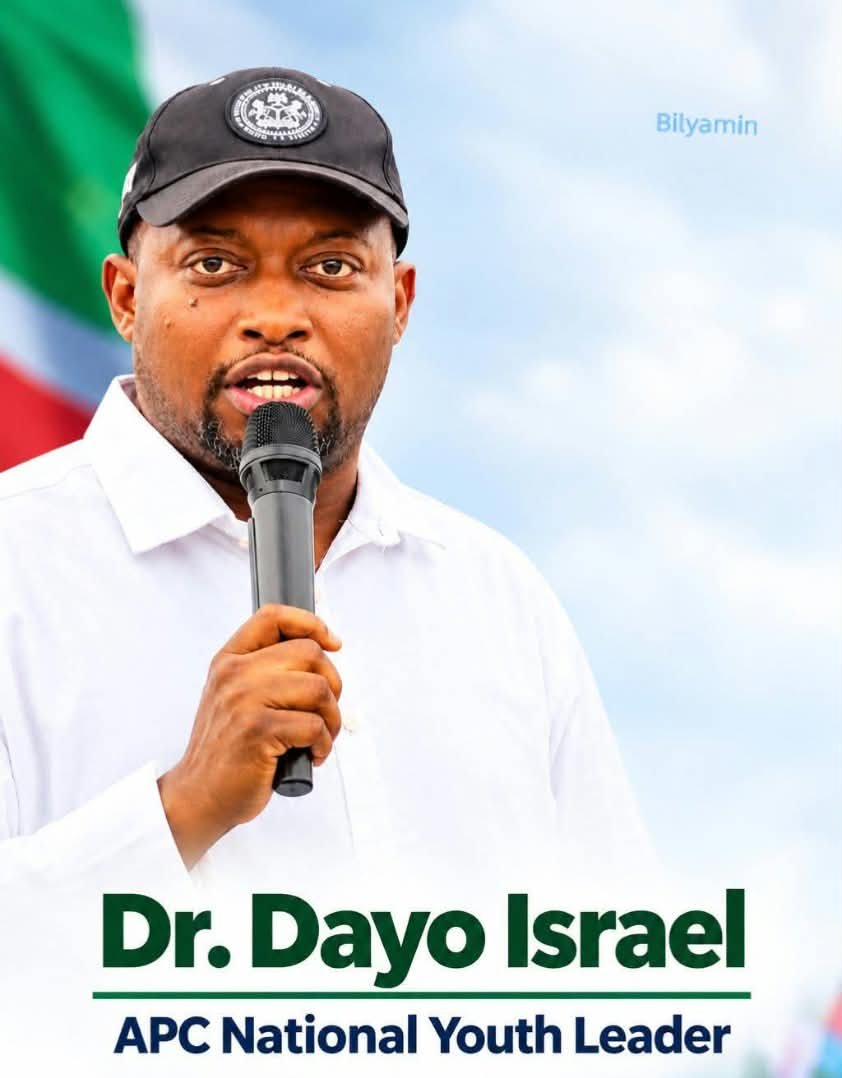
An alleged behind-the-scenes campaign to remove Dr Dayo Israel as the All Progressives Congress (APC) National Youth Leader has sparked fresh controversy within the ruling party, following claims of a late-night meeting in Abuja where state and zonal youth leaders were allegedly urged to pass a vote of no confidence in his leadership.
Details of the reported meeting, which allegedly continued until late Monday night, October 26, 2026, have begun to emerge, raising questions about internal party politics, competing loyalty structures and the influence of campaign groups within the APC youth wing.
According to accounts attributed to individuals who reportedly attended the meeting, participants were summoned to Abuja at short notice and allegedly assured that transportation and accommodation expenses would be provided upon arrival, despite some being required to make their own flight arrangements.
One of the sources, who spoke on condition of anonymity, claimed that the meeting involved influential political figures whose identities were not disclosed in the account. The source alleged that the principal objective was to force the removal of Israel, with participants reportedly told that his continued leadership had become an obstacle to efforts to transfer control of the party’s youth structure to another political leadership bloc.
According to the account, state and senatorial youth leaders were allegedly encouraged to collectively pass a vote of no confidence in the national youth leader, a move that could provide grounds for further action against him within the party.
The most explosive aspect of the allegations concerns reported financial inducements allegedly offered to secure support for the proposed move.
One source claimed that participants were promised ₦30 million for state youth leaders, to be shared among them every three weeks, alongside ₦5 million for senatorial youth leaders at the same interval throughout the campaign period. The source further alleged that the proposed arrangement was intended to continue until after the election, while campaign funds would not be channelled through the office of the national youth leader to the party’s youth structure. These claims, however, remain unverified, and the identities of the alleged sponsors and the individuals said to have attended the meeting have not been independently established in the account.
Another source reportedly familiar with the discussions alleged that access to the proposed financial allocations was conditional on participants organising a press conference and compiling signatures for a formal vote of no confidence in Israel. The source claimed that the intended outcome was to publicly challenge his leadership and demand his removal from office. If substantiated, the allegations could point to a significant struggle over the control of the APC’s youth mobilisation machinery ahead of the next election, particularly as political actors position themselves to influence campaign operations and grassroots engagement.
However, the reported developments have not been presented alongside an official statement from the APC leadership confirming the meeting, the alleged financial arrangements or any formal decision to remove the national youth leader.
Amid the controversy, a northern youth leader reportedly expressed reservations about participating in the proposed action, stressing the importance of trust, loyalty and personal integrity in political relationships. The source said he would not participate in the planned press conference or append his signature to any document seeking a vote of no confidence in Israel, adding that some of his colleagues shared the same position.
The reported resistance suggests that the alleged campaign may not enjoy unanimous support among the party’s youth leaders, potentially complicating efforts to build a united front against the national youth leader. Beyond the immediate allegations, the controversy has also drawn attention to the relationship between the APC’s official youth leadership and independently organised political mobilisation groups, particularly the City Boy movement.
The competing structures appear to have become a focal point in the debate over who should coordinate youth mobilisation, manage political resources and determine the direction of the party’s youth engagement ahead of the elections.
Reacting to the unfolding controversy, social commentator and activist Segun Awosanya, popularly known as Segalink, offered a more nuanced assessment of the situation, acknowledging concerns about Israel’s performance while cautioning against what he described as a potentially damaging attempt to force him out shortly before the election.
Segalink, who said he had known Israel since his teenage years and shared longstanding connections with individuals involved in the Project Nigeria movement, described the national youth leader as an intelligent individual who might nevertheless have made serious political miscalculations in recent times.
He argued that while Israel’s leadership record deserved scrutiny, removing him without adequately examining the circumstances surrounding his performance could create further complications within the party.
According to Segalink, the dispute appears to extend beyond an individual’s leadership shortcomings and may reflect deeper tensions over political loyalty, operational control and competing centres of influence within the ruling party. He maintained that Israel’s side of the story was equally important, warning against judging the controversy solely through the allegations being circulated by his critics.
Segalink also questioned whether the national youth leader’s difficulties could partly be attributed to inadequate operational funding, arguing that a political officeholder’s performance should be assessed alongside the resources and institutional support available to the office.
He further observed that the City Boy movement’s independent mobilisation activities could create friction with the official youth leadership, particularly where both structures seek to organise supporters and influence political engagement without a clearly defined relationship.
In his assessment, the emergence of parallel mobilisation structures could generate conflicts over authority, accountability and loyalty, potentially weakening coordination within the party at a critical political moment.
While expressing dissatisfaction with aspects of Israel’s performance, Segalink maintained that replacing him without resolving the underlying disagreements could simply transfer the problem to another individual. He therefore called for intervention by senior party stakeholders, arguing that experienced leaders should mediate the dispute, establish clear lines of authority and guide the youth wing towards a more coordinated approach.
His intervention also broadened the discussion beyond the immediate leadership contest, highlighting the financial realities of political mobilisation and the need for greater responsibility among political actors in a country where many citizens continue to struggle with economic pressures.
Segalink argued that political mobilisation requires resources, but maintained that campaign activities must remain within reasonable limits and that politicians should demonstrate sensitivity to the economic circumstances facing ordinary Nigerians. The controversy comes at a time when youth participation remains a significant component of political organisation in Nigeria, with the APC’s ongoing membership registration efforts underscoring the importance of younger supporters to the party’s electoral prospects.
For the APC, the unfolding situation presents a delicate balancing act: addressing concerns about the performance of its youth leadership while preventing internal disagreements from undermining its mobilisation capacity ahead of the election.
Whether the reported Abuja meeting represents a coordinated effort to restructure the party’s youth leadership or an episode in a broader struggle for political influence remains unclear.
For now, the allegations have placed the relationship between the APC’s national youth leadership, influential political blocs and independent campaign movements under renewed scrutiny.
The critical questions remain unanswered: Who allegedly convened the meeting? Were the reported financial offers actually made? Does the proposed vote of no confidence enjoy broader support among the party’s youth leaders? And will the APC’s senior leadership intervene before the dispute escalates?
Until the relevant parties respond publicly and the claims are independently verified, the reported meeting and its alleged financial arrangements remain allegations rather than established facts.
What is already clear, however, is that the controversy has opened a fresh window into the internal power dynamics shaping the APC’s youth mobilisation structure as political activities intensify ahead of the next election.