
NEWS
Netanyahu Suffers Major Election Setback as Gadi Eisenkot’s Opposition Gains Ground

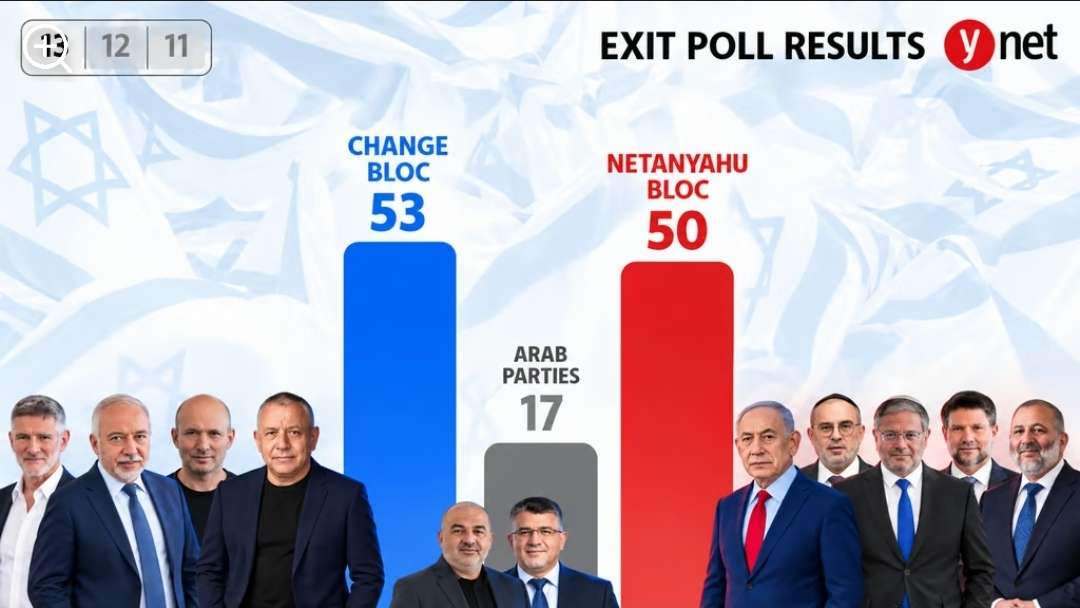
Israeli Prime Minister Benjamin Netanyahu has suffered a significant electoral setback, with exit polls indicating that his ruling right-wing bloc is trailing the opposition led by former military chief Gadi Eisenkot, although neither side appears to have secured the parliamentary majority required to form a new government.
The exit polls, released after voting ended on Tuesday, October 27, 2026, suggest a major shift in Israel’s political landscape, with opposition parties gaining ground and Arab political parties emerging as potentially decisive players in the formation of the next government.
According to the Kan 11 exit poll, Netanyahu’s Likud party is projected to win 25 seats, while his broader right-wing alliance is expected to secure approximately 50 seats in the 120-member Knesset, Israel’s parliament. The result would represent a substantial decline from the 32 seats currently held by the governing bloc.
Meanwhile, the opposition bloc campaigning for political change is projected to win between 52 and 53 seats, giving it a narrow advantage over Netanyahu’s alliance. However, both camps remain short of the 61 seats required to command a parliamentary majority and establish a government.
Despite the setback, Likud is expected to remain Israel’s largest individual political party, leaving Netanyahu with a potential role in the complex coalition negotiations that will follow the release of the official election results.
Opposition leader Gadi Eisenkot has declared his readiness to move swiftly to replace Netanyahu’s government, describing the preliminary results as a strong indication that a significant section of the Israeli electorate wants political change.
Eisenkot, leader of the Yashar! party and a former chief of staff of the Israel Defense Forces, said the outcome, if confirmed, would represent a victory for the mainstream Zionist majority and a rejection of the government that was in office during the October 7, 2023, Hamas-led attacks on Israel. He pledged to work immediately towards forming a new government focused on military conscription and other priorities of his political platform.
Exit polls published by Kan 11, Channels 12 and 13 give the opposition bloc an average of approximately 53 seats, compared with 50 for Netanyahu’s alliance.
Eisenkot’s Yashar! party is also projected to emerge as one of the strongest political forces in the new parliament, with exit polls placing its expected seat count between 19 and 23. The Kan 11 poll projects 21 seats, Channel 12 estimates 22, while Channel 13 places the party at 23.
Other surveys have offered slightly lower projections, but the overall figures point to a strong performance for Eisenkot, who entered politics in 2022 after serving as Israel’s top military commander.
One of the most significant developments in the election is the projected surge in representation for Israel’s Arab political parties. The parties are expected to secure a combined 17 seats, a substantial increase from the 10 seats they held before the election. The outcome reflects increased Arab voter participation and could give their representatives considerable influence over the negotiations to establish the next government. With both major political blocs falling short of the 61-seat threshold, Arab lawmakers could become decisive in determining which political alliance ultimately secures power.
However, their potential influence will depend on whether Eisenkot and other opposition leaders are willing and able to negotiate political arrangements with Arab parties. The issue presents a significant challenge for the opposition, particularly because Eisenkot has campaigned on a platform centred on Zionist political principles and has faced questions about the extent of cooperation he would accept with Arab political factions.
Retired Israeli Air Force Major General Nimrod Sheffer, a candidate of the left-wing Democrats party, disclosed that anti-Netanyahu political forces had held discussions with Arab leaders about the possibility of forming a government together if the election results supported such an arrangement.
The Democrats party itself is projected to win approximately nine to 10 seats, according to the exit polls. The potential involvement of Arab lawmakers could therefore become central to the political bargaining that follows the election.
Although the preliminary figures suggest that Netanyahu’s opponents have gained a narrow advantage, the election has not produced an outright winner capable of forming a government independently.
Israel’s proportional electoral system makes coalition-building essential, meaning parties must negotiate agreements with other parliamentary groups to assemble a governing majority.
The presence of numerous competing parties, including smaller factions that may hold only a handful of seats, is expected to complicate the negotiations.
The official results are expected to provide a clearer picture after the ballots are counted. However, forming a coalition could take several weeks, as political leaders seek agreements on government positions, policy priorities and the terms of cooperation.
Israeli President Isaac Herzog will eventually play a crucial constitutional role in the process by selecting a political leader to attempt to form a government.
Under Israel’s system, the designated candidate must secure sufficient parliamentary support to establish a governing coalition. If the initial attempt fails, further opportunities may be available under the applicable constitutional procedures. A prolonged deadlock could ultimately lead to another election.
Until a successor is elected and a new government is established, Netanyahu is expected to remain caretaker prime minister.
The election represents a potentially decisive moment for Israel, with the results highlighting growing political divisions and uncertainty over the country’s future leadership.
For Netanyahu, the projected decline in support threatens his ability to retain power and raises questions about the future of his long-standing political dominance.
For Eisenkot and the wider opposition, the results offer an opportunity to challenge the incumbent government, although their ability to translate the projected advantage into power will depend on successful coalition negotiations.
The strong performance of Arab parties adds another important dimension to the contest, potentially giving them greater influence over the formation of Israel’s next government than they have enjoyed in previous parliamentary configurations.
Ultimately, the official results and the negotiations that follow will determine whether Netanyahu can retain power, whether Eisenkot can assemble a viable governing coalition, or whether Israel will face another round of political uncertainty.
For now, the exit polls point to a weakened Netanyahu bloc, a strengthened opposition and an election outco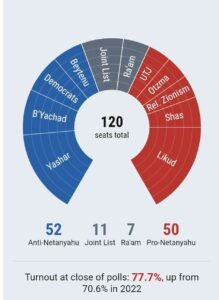 me that could reshape Israel’s political direction.