
NEWS
2027: Abure Rules Out Peter Obi, Opens Door to Tinubu and Atiku, Threatens to Mobilise Supporters Against Him

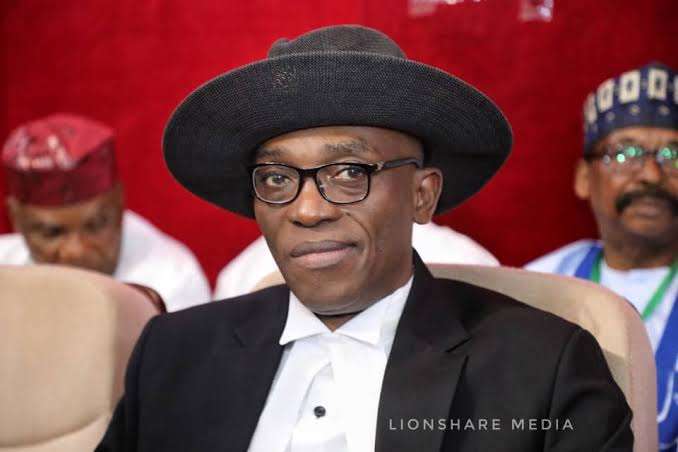
The immediate past National Chairman of the Labour Party (LP), Julius Abure, has declared his willingness to support President Bola Tinubu or former Vice-President Atiku Abubakar in the 2027 presidential election, while categorically ruling out any possibility of backing the party’s former presidential candidate, Peter Obi.
Abure’s declaration signals a potentially significant realignment ahead of the 2027 general election, as political parties and influential figures continue to position themselves for what is expected to be a fiercely contested presidential race.
In a revealing interview with The Punch, the former Labour Party chairman said his eventual political alignment would depend on the outcome of the ongoing leadership dispute within the party, the interests and ideology of his political camp, and the acceptability of whichever candidate seeks his support.
He also threatened to mobilise his political supporters against Obi, accusing the former Anambra State governor of squandering the goodwill, human resources, political structures and electoral advantages that contributed to his impressive performance in the 2023 presidential election.
Abure maintained that he was awaiting the Supreme Court’s judgment on the Labour Party leadership crisis but warned that he would begin considering offers from interested presidential candidates if the court failed to deliver its ruling before the end of November.
Explaining his position, he said, “As for me, we are waiting for the Supreme Court to decide our case, and if the judgment is not coming before the end of this November, we will rationalise the offer of whoever wants our support.
“However, it must tally with our interest and ideology, and he must be a sellable candidate. Once these are settled, our faces will be everywhere. I am talking about the same faces that took Peter Obi everywhere in 2023.”
His remarks suggest that the political network he claims to have built within the Labour Party could become a factor in the emerging calculations for the 2027 election, particularly if he decides to throw his weight behind a rival presidential candidate.
Although Abure did not commit himself to either Tinubu or Atiku, he made it clear that Obi had been excluded from his political considerations, regardless of the eventual outcome of the leadership dispute.
Drawing a parallel with a statement attributed to former Head of State Ibrahim Babangida, Abure said he had already determined whom he would not support, even though he had yet to decide who would receive his backing.
He stated, “We are open to working with any of the major candidates, but as former Head of State, Ibrahim Babangida, said, ‘I know whom I will not hand over to. But I don’t know who I will hand over to.’
“So, similarly, I am very sure that I wouldn’t support Peter Obi for the 2027 general election. But I am open to an alignment with others.”
The former LP chairman specifically excluded the Nigeria Democratic Congress (NDC) from the list of political platforms he would consider supporting, citing Obi’s presence in the party as the principal reason for his decision.
Abure insisted that his position against Obi was definitive, although he clarified that he had not entered into negotiations with Tinubu, Atiku or any other presidential aspirant.
According to him, any decision on his political future must take into account not only his personal interests but also the aspirations of his followers, whose support he hopes to carry into the next election cycle.
“Yes, obviously the NDC is not included. I don’t see any reason to support Peter Obi again. I will not. And I am saying this with conviction and without any fear of contradiction.
“However, as of now, I am not in talks with any candidate yet. This is because it’s not just about me. It’s also about my followers and their interests,” Abure said.
The former Labour Party chairman further claimed that a considerable number of his supporters remained loyal to the political structure he controlled before the party’s protracted leadership crisis, despite defections by some members to other political platforms.
He accused Obi and Abia State Governor Alex Otti of dismantling his leadership network, alleging that individuals loyal to him were removed from party positions across the country, from ward and state levels to the national leadership.
Abure described the alleged actions as a disservice to the party, insisting that the leadership dispute had weakened the political structure that helped the Labour Party emerge as a formidable opposition force in the 2023 elections.
“Right now, they are standing by the structure of the party, the same one Otti and the illegal leadership he forced on the Labour Party sacked from wards, states to national level. What these people did to this party was a big disservice. But we know that I was their target,” he said.
He also questioned Obi’s leadership credentials, arguing that the former governor’s handling of the internal crisis within the Labour Party had become a subject of scrutiny in assessing his suitability for the presidency.
“Obi’s behaviour in the Labour Party is now what people are using to assess if he can truly lead the country. This is because if you can’t lead a micro, there is no way you can lead a macro,” he stated.
Abure also criticised Obi’s political movement from the Labour Party to the African Democratic Congress (ADC) and subsequently the NDC, alleging that the former governor expected to recreate the same circumstances that characterised the leadership struggle in the Labour Party.
According to Abure, Obi’s political influence in the NDC would not necessarily mirror the level of freedom and control he allegedly enjoyed under the previous Labour Party leadership.
He pointed to the role of the NDC’s national leader, Senator Seriake Dickson, whom he described as firmly in control of the party’s affairs and unlikely to surrender its leadership structure to another political figure.
Asked whether Obi would enjoy the same freedom and political leverage he allegedly exercised in the Labour Party, Abure responded emphatically.
“No way! Let Obi compare the freedom and leverage he enjoyed under our leadership to what he is experiencing in the NDC; he already knows the difference. You can see that Senator Dickson is fully in charge and he’s not giving up the party’s leadership,” Abure said.
He added that Dickson had learnt from the Labour Party crisis and was determined to prevent a similar dispute from emerging within the NDC.
Beyond the leadership controversy, Abure expressed doubts about Obi’s prospects in the 2027 presidential election, predicting that the former governor would struggle to replicate the electoral performance that made him one of the most prominent opposition figures in the country in 2023.
Obi secured more than six million votes in the 2023 presidential election, establishing a substantial support base, particularly among young Nigerians and voters who rallied behind his campaign for political change.
However, Abure argued that the former governor had failed to preserve the political capital accumulated during that election, blaming what he described as the mismanagement of his goodwill, human resources and other electoral advantages.
“Let me say clearly that Obi will not record the successes he recorded in the 2023 general election. That is because he has squandered his goodwill, human capital, resources, and mismanaged all the gains he had in 2023,” he said.
Abure’s prediction comes as political actors begin to assess the strength of competing presidential campaigns, the durability of existing political alliances and the extent to which the 2023 voting patterns could influence the next general election.
However, Obi’s camp and the NDC have dismissed Abure’s remarks, maintaining that their attention is firmly on the 2027 presidential contest rather than the former Labour Party chairman’s grievances over the party’s leadership dispute.
The spokesperson for the NDC Presidential Campaign Council, Constance Ikokwu, said Obi was occupied with campaigning and efforts to mobilise Nigerians around what she described as a national movement to change the country’s direction.
Ikokwu suggested that Abure’s political choices were his own to make, wishing him well in his future political engagements.
She said, “Mr Peter Obi is fully occupied with the campaign trail, focused on the important task of leading a national effort towards the 2027 presidential contest, an election that offers Nigerians an opportunity to rescue the country and change its direction.
“In the light of that, all we can say is good luck to Mr Julius Abure in his new ventures.”
Similarly, Obi’s media aide, Idris Zekeri, dismissed the former Labour Party chairman’s comments, insisting that the campaign had moved beyond the internal disputes that previously rocked the party.
Zekeri said Obi and his supporters were concentrating on the approaching election and had little interest in engaging Abure in a public exchange over political differences.
“We no longer talk about Abure. We have moved on from them.
“We have an election less than 70 days away, and then we are campaigning,” Zekeri said.
He called on Nigerians who believed in equity, justice, fairness, capacity, compassion and competence to support Obi, whom he described as the candidate best positioned to move the country forward.
While acknowledging that Obi could not expect universal support, Zekeri maintained that differences of opinion were an inevitable feature of democratic politics.
He also suggested that Abure’s decision to reject Obi was driven by personal grievances rather than a broader consideration of the country’s interests.
“The individual you mentioned (Abure) has now said he doesn’t want to support Obi, and his reason for that was that he has an axe to grind. I think he should be asking himself why he should place his personal sentiment and belief above national interest. But that is up to him.
“However, we are not discussing him. He is not critical to what we are doing at this time,” he added.
The exchange underscores the lingering divisions within the Labour Party political family following the leadership crisis that emerged after the party’s unexpected rise to national prominence in 2023.
While Abure insists that his political structure and loyalists could play a role in determining his eventual alignment, Obi’s camp appears determined to distance its campaign from the dispute and focus on building support for the next presidential election.
With Abure leaving the door open to possible alliances with Tinubu or Atiku while firmly rejecting Obi, the coming months could reveal whether the former Labour Party chairman’s claimed political network translates into a meaningful electoral advantage or remains part of the wider contest for influence ahead of 2027.