
NEWS
Anambra Debt Controversy: KAA Breaks Down Peter Obi’s Financial Record With Simple Arithmetic

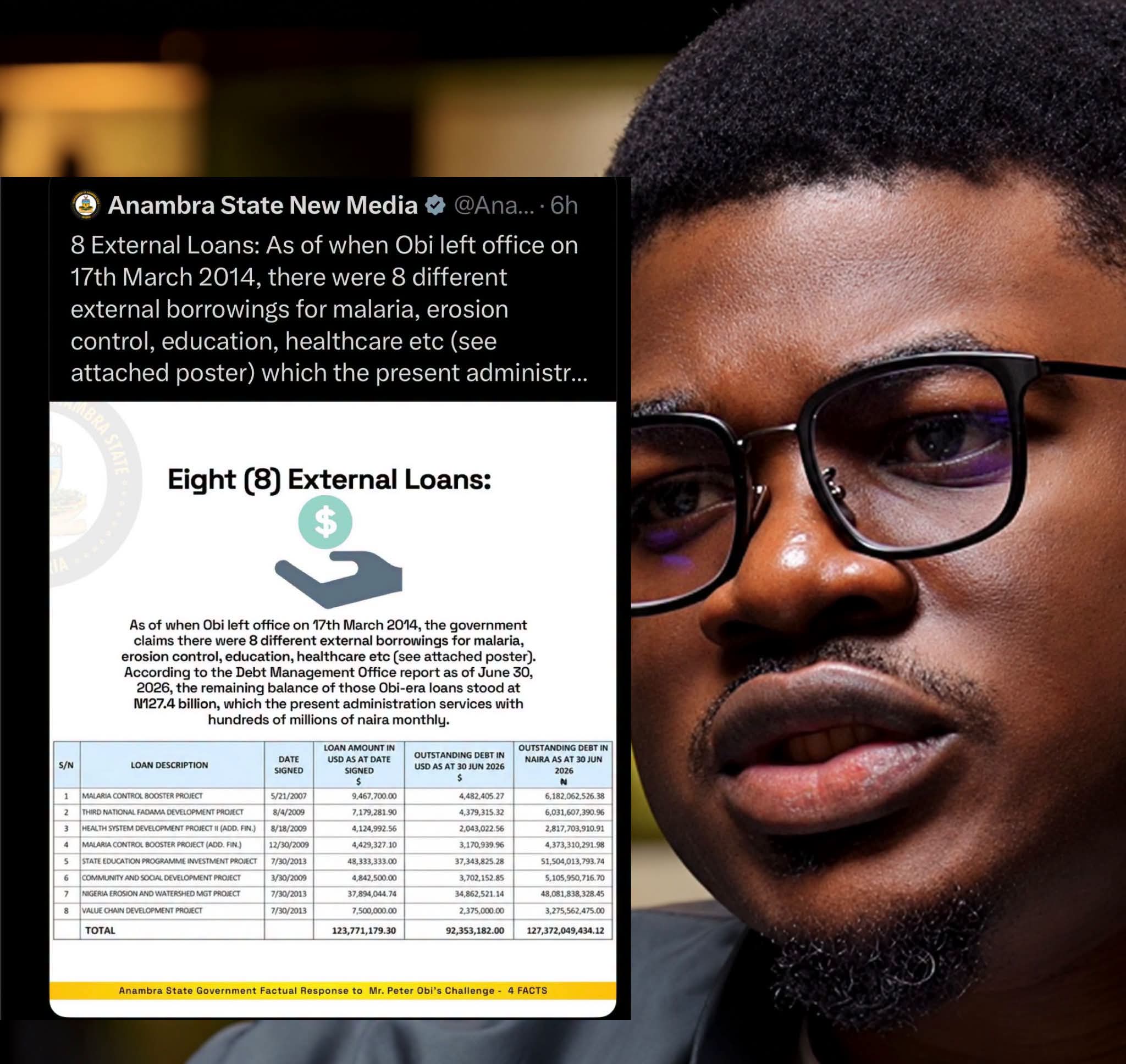
The controversy surrounding the debt profile of Anambra State under former Governor, Peter Obi has continued to generate heated arguments online, with competing figures being presented by political actors and commentators.
However, KAA, host of the KaaTruths Podcast, has attempted to simplify the debate by taking politics and personalities out of the equation and focusing on one thing: the numbers.
In an extensive explanation, KAA argued that the central issue is not whether Anambra had any recorded debt when Obi left office, but rather how much debt was actually outstanding at the point of handover and how much of the loans associated with his administration was disbursed after he had left office.
To illustrate the point, KAA used a simple business analogy. He asked readers to imagine a business being handed over by an older brother to a younger brother with ₦100 million in assets and ₦10 million in bank debt.
According to him, the business could hardly be described as broke because the ₦10 million debt could theoretically be paid from the ₦100 million in assets, leaving ₦90 million. He said the same principle was relevant to understanding the financial position of Anambra State at the time Obi left office.
According to figures attributed to the Debt Management Office (DMO), as of December 31, 2013, shortly before Obi left office in March 2014, Anambra State had an external debt of $30,323,574.40 and domestic debt of ₦3,025,797,046.67.
Using the exchange rate applicable around that period, KAA put the combined value at approximately ₦7.7 billion to ₦7.8 billion. He urged readers to keep that figure in mind when examining the broader financial picture.
KAA then turned to the assets reportedly listed in Obi’s March 2014 handover report.
According to the figures cited, the state had local investments worth N₦27 billion, foreign currency investments of ₦26.5 billion, certified state and Ministries, Departments and Agencies balances of ₦28.166 billion, as well as an FGN-approved refund of ₦10 billion.
Together, the figures amounted to N₦91.666 billion.
The handover document reportedly made provision for approximately ₦5 billion in estimated liabilities, including salaries, pensions, gratuities and certificates for projects that had already been executed. That brought the widely cited net balance to approximately ₦86.666 billion.
KAA stressed, however, that the ₦86.666 billion should not be interpreted as money sitting as cash in a single bank account.
Rather, he explained that the figure comprised investments, foreign currency holdings, government balances and an approved federal refund that was still expected to be collected. That distinction, he argued, is important when assessing both the state’s assets and liabilities.
KAA further pointed to comments previously attributed to Alex Otti, who was then the Managing Director of Diamond Bank, saying Otti had stated publicly that he personally oversaw part of the state’s investment arrangements and confirmed that the funds existed.
On that basis, KAA argued that even if the approximately ₦7.8 billion recorded debt were deducted from the ₦86.666 billion net balance, a substantial balance would still remain.
He said this was the basis for describing Obi’s administration as having left Anambra “effectively debt-free” in ordinary conversation, while acknowledging that the phrase should not be interpreted literally to mean that the state had no loan or recorded public debt whatsoever.
The discussion, however, becomes more complicated when the state’s current debt figures are introduced.
According to KAA, the Anambra State Government has published details of eight external loan facilities associated with the Obi administration and stated that their outstanding balance, converted at the official exchange rate, stood at approximately ₦127.4 billion as of June 30, 2026.
KAA argued that this figure should not automatically be described as the amount of debt Obi left behind in 2014 because the two figures refer to different points in time. He illustrated the distinction with another simple example.
If a father obtained a ₦10 million credit facility but only N₦2 million had been drawn before he handed over the business, while another ₦6 million was subsequently disbursed after his departure, KAA argued that describing the entire ₦8 million as debt the father “left” would require additional explanation about when the money was actually drawn.
According to KAA, the Anambra Government’s own figures provide an important part of that explanation. He noted that the eight facilities were originally signed for a combined amount of approximately $123.77 million, while the outstanding balance listed in 2026 was approximately $92.35 million.
That $92.35 million figure, he said, is what produces the approximately ₦127.4 billion value when converted at the stated official exchange rate.
KAA contrasted this with the DMO’s December 2013 record of Anambra’s total external debt stock, which he put at $30.323 million. He argued that the difference demonstrates why the timing of loan disbursements is central to the controversy.
According to his explanation, several of the facilities were multilateral development loans connected to projects, including malaria control and the Fadama agricultural programme, with funds being released progressively as projects advanced.
Consequently, he argued, money could continue to be drawn from loan facilities after Obi had left office.
For KAA, this distinction changes the question that should be asked. Rather than asking simply how much Anambra owes in 2026 on loan facilities associated with an earlier administration, he said the more precise question is how much had actually been disbursed and outstanding when Obi handed over power in 2014.
He maintained that the DMO’s December 2013 figures provide a clearer starting point for answering that question.
KAA said the figures show approximately $30.323 million in external debt and ₦3.026 billion in domestic debt at the relevant period, while the handover report placed the state’s net financial position at approximately #86.666 billion.
He therefore argued that the available figures indicate that the state’s reported assets substantially exceeded its recorded debt at the time of handover. He compared the situation to two individuals: one owning a ₦100 million house and having ₦20 million in the bank while owing ₦5 million, and another having ₦500,000 while owing ₦10 million.
Both, he observed, technically have debt, but their overall financial positions are fundamentally different.
KAA consequently maintained that three separate questions should not be conflated.
First, he said, the claim that Obi left Anambra with literally zero loans or zero recorded public debt is not supported by the DMO figures.
Second, the available figures support the assertion that the state had reported assets substantially exceeding its recorded debt around the time of Obi’s handover.
Third, he argued that taking the outstanding balance of loan facilities in 2026, converting the amount into today’s naira and presenting the entire figure without explaining subsequent disbursements can create a misleading impression about the amount of debt actually outstanding when Obi left office in 2014.
“The proper questions are simple,“ KAA said in his explanation, urging Nigerians to establish how much had actually been disbursed before Obi left office, how much was disbursed afterwards, and what assets the state held against its liabilities at the point of handover.
He argued that answering those questions with primary documents could provide greater clarity than the increasingly heated exchanges taking place online.
Beyond the figures, KAA also revealed that the controversy had a personal connection to his work as a podcast host.
He disclosed that during an interview with Aisha Yesufu, he had raised questions concerning the debt issue and that the matter was among the reasons he wanted to interview Peter Obi.
According to him, his decision to ask questions attracted criticism from some supporters of the former Anambra governor, with some allegedly bullying and insulting him over the issue.
KAA, however, said his intention was not to attack Obi but to provide an opportunity for the former governor’s team to explain the matter comprehensively. He maintained that the explanation he had hoped to obtain was now being independently debated across social media platforms.
“As a podcast host, when I ask questions, it’s not for me.
“It’s so that an answer can be given for those who may have such questions,“ KAA explained.
The debate over Anambra’s finances under Peter Obi therefore remains heavily dependent on the distinction between loan facilities, actual disbursements, outstanding debt at handover and subsequent debt accumulation.
For KAA, separating those figures by date and examining the underlying primary documents is essential to understanding what Anambra actually owed when Obi left office, rather than relying solely on the value of loan facilities that remain outstanding more than a decade later.