
COMMENTARY
FCT Minister, Nysome Wike Shuts Down ‘APC 001’ Narrative in Rivers, Says Leadership Is Earned, Not Inherited by Office


The Minister of the Federal Capital Territory, Nyesom Wike, on Monday firmly dismissed circulating claims that Rivers State Governor, Siminalayi Fubara, has automatically emerged as the leader of the All Progressives Congress (APC) in the state following his recent defection to the ruling party.
Wike’s reaction comes amid heightened political conversations in Rivers State, where the governor’s move to the APC has continued to generate debate, speculation, and competing interpretations of party hierarchy and leadership structure.
Speaking pointedly on the matter, Wike rejected the idea of an automatic “001” status within the party, stressing that party leadership does not flow from executive office but from clearly defined party processes and earned influence.
In his words:
“There is nothing like 001 in the state. You register in your ward, and your local government is in your ward. Everybody registers in his own ward. You could be the first person to register, but not in the sense that by becoming governor you automatically become leader of the party,”
Wike further emphasized that political leadership goes beyond titles and positions, insisting that authority within a political party must be built on capacity, structure, and acceptance by party members.
“Leadership is not because I am a governor. You must have something that makes you a leader,” he said.
His remarks appear aimed at correcting what he described as a growing misconception that the governorship alone confers supremacy within party ranks, especially in a state with complex political alignments and established party stakeholders.
Observers note that Wike’s intervention underscores the internal dynamics within the APC in Rivers State, where questions of structure, loyalty, and influence remain sensitive following recent political realignments.
The statement has since stirred reactions across political circles, with many interpreting it as a reminder that party leadership remains rooted in grassroots organization, ward-level structures, and collective recognition rather than the mere acquisition of executive power.
As Rivers State navigates its evolving political landscape, Wike’s comments signal that leadership contests within parties are far from settled and that authority must be negotia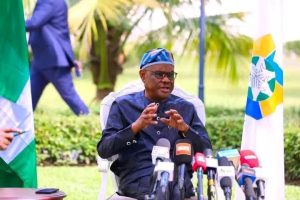 ted, not assumed.