
NEWS
Gov. Otti Approves Feasibility Study for Strategic Azumini–Obeaku Seaport Corridor, Moves to Unlock Abia’s Maritime Access and Economic Expansion

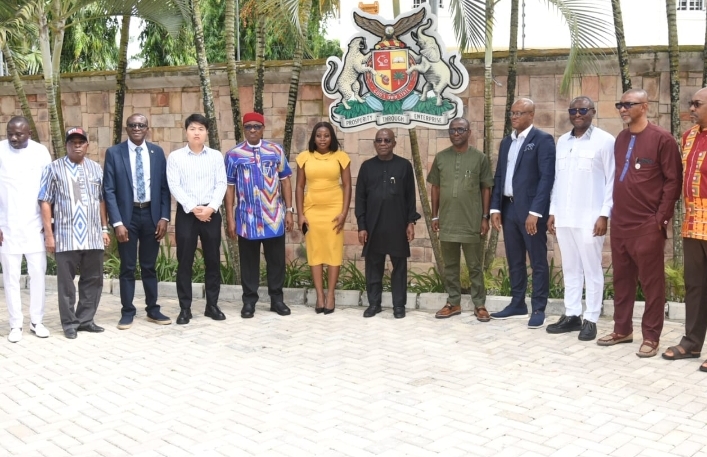
The Executive Governor of Abia State, Dr. Alex Chioma Otti, OFR, has approved the commencement of a feasibility study for the proposed Azumini–Obeaku seaport and inland waterway corridor project in Ukwa West Local Government Area, in a decisive move aimed at opening up the state to direct maritime trade and economic transformation.
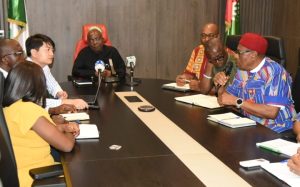
The Governor granted the approval on Tuesday during a high-level meeting with a delegation from China Harbour Engineering Company (CHEC), held at his office in Nvosi, Isiala Ngwa South Local Government Area. The meeting followed a detailed technical presentation by the company outlining its proposed approach to the ambitious infrastructure project.
“Somehow, deep in my mind, I know that this is the approach. I may not have worked it out in these details, but it is good to understand the details and all what is required.
“So I think you can take it that approval has been given for the feasibility study to commence.
“We need to start the process immediately, hoping that the feasibility study will return positive,“ Governor Otti said.
While granting approval, Governor Otti emphasized urgency and efficiency, urging the firm to explore ways of shortening the projected six to seven months timeline for the feasibility study, describing it as lengthy and in need of reduction to fast-track progress.
Demonstrating readiness on the part of the state government, the Governor assured that steps would be taken immediately to secure necessary regulatory clearances from key federal authorities, including the Federal Ministry of Marine and Blue Economy and the Presidency, to ensure seamless project execution.
In a further directive, Governor Otti advised the CHEC team to carry out an on-the-ground inspection of the Obeaku Blue River, describing it as a crucial step in the preliminary assessment phase of the project.
“It may be appropriate for you to visit. I believe that that visit will precede the feasibility study. I do know that where we are talking about is about 19 nautical miles from the high sea.
“That’s the impression I got. Maybe when you go and visit, you come out with the specifics. If it is about 19 miles, the question of viability will now come to play, because what it requires will now be dredging, and dredging increases the cost.
“I’m not a technical person, but at least I have an idea of what I want to achieve. So I think that’s where to start. Pay a visit to the place, then come back to the team, and then we can now take the next steps from feasibility all the way to construction,” he stated.
The Governor expressed appreciation to the CHEC delegation for their comprehensive presentation and conveyed optimism that continued engagements would yield concrete outcomes as the state charts a new course toward maritime development.
Earlier in his presentation, the Marketing Manager of China Harbour Engineering Company described the Azumini–Obeaku Seaport Inland Waterway Corridor as a transformative and strategic infrastructure initiative designed to position Abia State and the South-East region for direct access to global shipping routes and international trade networks.
He noted the company’s extensive footprint in major maritime and infrastructure projects across Africa, including its role in the development of the Lekki Deep Sea Port, affirming CHEC’s technical and financial capacity to deliver large-scale, end-to-end infrastructure projects.
Mr. Liu further outlined the structured development roadmap for the project, beginning with a comprehensive feasibility study to evaluate its technical, commercial, and financial viability. This, he explained, would be followed by detailed design phases, funding arrangements, and eventual construction.
He reiterated the company’s readiness to partner with the Abia State Government in driving the realization of the seaport corridor project, which is expected to significantly boost trade, industrialization, and eco


 nomic growth in the region.