
NEWS
“I Don’t Know How Up to 1.5 Million Entries Can Be Made in the Register” — Former INEC Director, Oluwole Osaze-Uzzi Challenges Commission, Demands Explanation

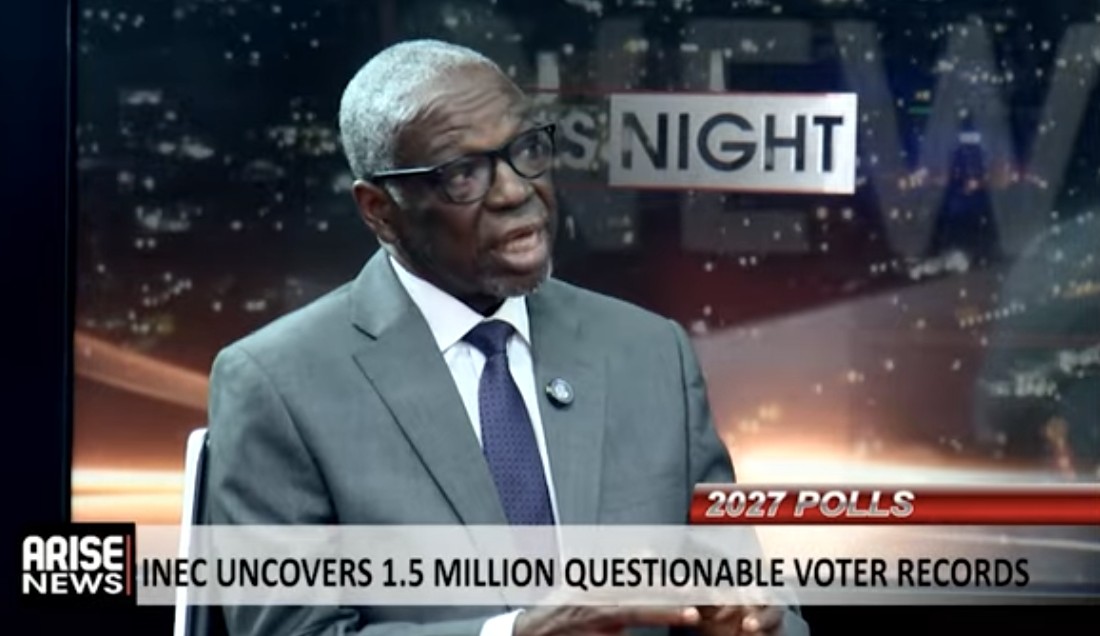
A former Director of Voter and Publicity Education at the Independent National Electoral Commission (INEC), Oluwole Osaze-Uzzi, has questioned how approximately 1.5 million questionable entries were allowed into the commission’s voter register, despite existing safeguards designed to prevent multiple registrations and other electoral irregularities.
Osaze-Uzzi raised the concerns during an interview on Arise Television, expressing surprise that such a significant number of questionable voter records could have accumulated in the national register, considering the technological and administrative measures already established by INEC to maintain an accurate and credible database of eligible voters.
He argued that voter registration should ordinarily be a simple and transparent exercise, given that the requirements for eligibility are clearly stipulated by law. According to him, an individual must be a Nigerian citizen, have attained the age of 18 and personally appear before electoral officials for registration and biometric capture.
He maintained that these requirements, alongside the commission’s existing verification mechanisms, should make it considerably difficult for ineligible individuals or multiple registrations to go undetected.
Expressing concern over the discovery, the former INEC director said the commission needed to account for how the questionable records entered the register in the first place.
“The work ordinarily ought to be easier for the commission. The law is quite clear about who is entitled to be on the register: you’re a Nigerian citizen, you’re 18 years and above, and then you go there, and you register. It’s as simple as that.
“You must turn up physically for the registration.
“So it should be a straightforward, simple process. But Nigeria, being what it is, the simpler it is, the more complex things, issues, and challenges arise from those things.
“I don’t know how up to 1.5 million entries can be made in the register. You’ve heard of AI. You’ve heard of multiple registrants. That ought not to be with things that have been put in place by the commission,“ he stated.
Beyond questioning the discovery itself, Osaze-Uzzi expressed reservations about the limited information INEC had made available regarding the scope and methodology of the exercise that uncovered the questionable records.
He pointed out that the commission had yet to sufficiently clarify whether the review was restricted to the Continuous Voter Registration (CVR) exercise conducted last year or whether it involved a comprehensive examination of the national voter register, including records accumulated since the first registration exercise in 2011.
According to him, understanding the period covered by the verification exercise is essential to determining the extent of the problem, identifying its possible sources and assessing the effectiveness of INEC’s voter registration and database management systems.
He further emphasised the importance of explaining how the questionable entries were created and whether they resulted from multiple registrations, administrative lapses, technological shortcomings or other irregularities.
Osaze-Uzzi also highlighted the Automated Fingerprint Identification System (AFIS) as a critical technology that INEC could deploy to identify individuals who may have registered more than once.
He explained that biometric verification, particularly fingerprint matching across different states, local government areas and communities, could help expose multiple registrations, including cases where individuals deliberately or unknowingly registered more than once.
The former director also drew attention to the role of Artificial Intelligence (AI) in the exercise, noting that INEC’s Director of Information and Communication Technology had reportedly acknowledged its use. He suggested that the commission needed to provide greater clarity on how the technology was deployed, the nature of the records identified and the verification processes used to establish their questionable status.
While acknowledging reports that INEC had successfully cleaned up approximately 1.2 million records, Osaze-Uzzi maintained that the achievement should not overshadow the more fundamental issue of how such a substantial number of questionable entries found their way into the electoral database.
He stressed that the commission must go beyond announcing the number of records identified or removed and provide Nigerians with a transparent account of the circumstances surrounding their appearance in the register.
The development raises important questions about the integrity of Nigeria’s voter registration system, the effectiveness of INEC’s biometric safeguards and the commission’s capacity to maintain a credible register ahead of future elections.
With the credibility of elections heavily dependent on an accurate and reliable voter register, Osaze-Uzzi’s intervention underscores the need for INEC to provide comprehensive explanations, strengthen its verification mechanisms and reassure Nigerians that every eligible voter is properly captured while questionable entries are e ffectively identified and addressed.