
NEWS
“I go remain single?” — Military Lady Laments as Civilians Allegedly Fear Approaching Her

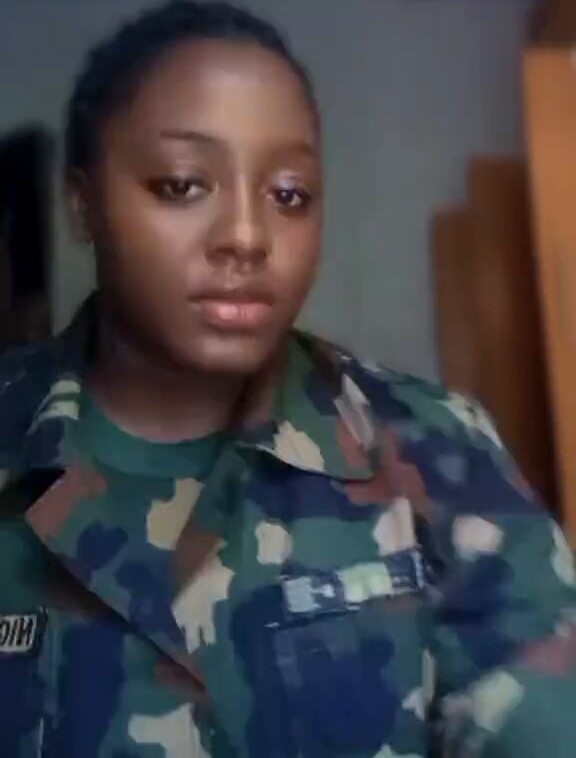
A female military personnel has sparked reactions online after humorously expressing frustration over the way civilians allegedly behave whenever they see her in uniform.
The military lady said she had become confused by what she described as the hesitation and nervousness displayed by some civilians around her, particularly those who might otherwise want to start a casual conversation or establish a personal relationship.
According to her, her military appearance appears to create an unintended barrier between her and members of the public, with some people seemingly becoming too formal or intimidated to interact with her normally.
Sharing her thoughts, the woman said she was unsure why some civilians appeared afraid to approach her or engage her in an ordinary conversation.
She said, “I don’t know what to talk at this point because I’m very confused. I don’t know why some Civilians will see me and be afraid to approach me and be afraid to talk to me.”
The military lady appeared particularly amused by the manner in which people greet her, explaining that instead of simply saying hello or addressing her by her name, some civilians immediately switch to formal titles such as “ma” or “officer.”
She said, “Una no fit say hi mama or call me by my name. Everytime Good morning ma, Good morning ma, or officer, who be officer?”
Her comments appeared to reflect the difference between how people may perceive someone in military uniform and how that person may actually want to be treated during everyday social interactions.
The conversation took a more humorous turn when the military lady linked the situation to her romantic life.
She jokingly questioned whether the fear and formality surrounding her military status could eventually make it difficult for her to find a partner.
She added, “Una no fit say mama can I have your number or can you be my girlfriend? Why una dey do me like this?”
Her statement appeared to be a playful invitation for potential admirers to relax and interact with her more naturally rather than allowing her uniform to discourage them.
The humorous manner in which she presented the issue has also opened up a wider conversation about relationships involving people in uniform and how their professional appearance can influence social interactions.
Military uniforms are generally associated with discipline, authority and responsibility, and this perception can sometimes make members of the public more cautious when interacting with military personnel.
For some civilians, addressing a military officer formally may simply be a sign of respect, while others may genuinely feel uncomfortable initiating a personal conversation with someone they perceive to be in a position of authority.
In the case of the military lady, however, her comments suggest that she would prefer people to see beyond the uniform and recognize the person behind it.
Her light-hearted question about whether she would “remain single” has added a relatable relationship angle to what could otherwise have been a discussion about military-civilian interaction.
The woman did not identify any particular civilian or group as responsible for the behaviour she described, and her remarks appeared to have been made largely in a humorous and conversational manner.