
NEWS
RESTORING ORDER AT THE GRASSROOTS: ABIA GOVT MOVES TO REVIEW AND RE-GAZETTE AUTONOMOUS COMMUNITIES, ENFORCE STRUCTURED LEADERSHIP AND END PERSISTENT COMMUNAL CONFLICTS

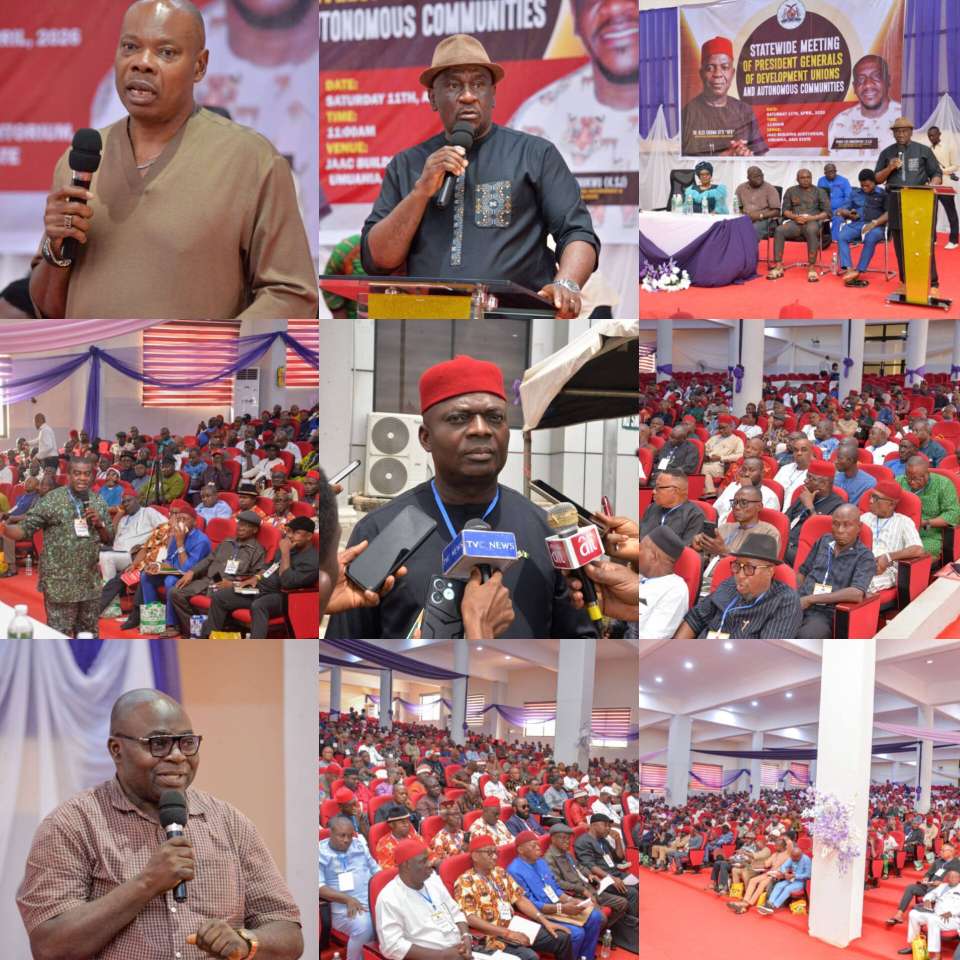
The Abia State Government says it is embarking on a review and regazeting of autonomous communities across the state to restore order and tranquillity.
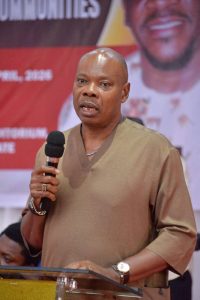
The Commissioner for Local Government and Chieftaincy Affairs, Prince Uzor Nwachukwu revealed this on Saturday, at JAAC Secretariat Umuahia, during a statewide meeting of Presidents General of Towns and Development Unions across Abia State, convened by the Abia State Government through the Ministry of Local Government and Chieftaincy Affairs.
Addressing the gathering of grassroots leaders, Prince Nwachukwu noted that the review was long overdue, stressing that the exercise is critical to correcting deep-rooted anomalies and restoring sanity in community structures across the state.
“We are embarking on review of autonomous communities. If we go to our gazettes, as carried out about 11 years ago, when the last gazetting was done, we are overdue, but we are supposed to have re-gazetted by last year because it’s done once every 10 years.
“You see all sorts of operations. You will find instances where one village is gazetted into two autonomous communities.
“You will find instances where one village is in one community but certain kindreds and families are in another community. Those are confusions.
“There are situations where a traditional ruler, in his domain, who is a custodian of an autonomous community, has his village ceeded to another Traditional Ruler.
“So he has become a subject of that Traditional Ruler. Are you aware of those things? Those are operations.
“So this year we are going to do a regazeting.
“These things call for crisis. There is no week I receive anything less than 50 petitions in my office. None!“ Prince Nwachukwu stated.
He noted that, it is these issues that led to the establishment of conflict management and mediation centres across all the local government by the state government, as part of deliberate efforts to curb disputes and strengthen peacebuilding mechanisms at the grassroots.
In a decisive move to further streamline community governance, Prince Uzor Nwachukwu announced that the state government is going to institutionalise town and development unions in the state, describing the initiative as a major step toward accountability, coordination, and proper documentation of leadership structures.
“We want to institutionalise town and development unions. So, you (participants) can find out that your details have been taken.
“We want to make sure, who the leaders of these town and community development unions in the various communities are.
“So we want to make sure we are doing documentations.The same kind of thing that is happening with traditional institutions, where two, three, four, five people will go through the process of being elected traditional rulers of their places.
“And then one person will win, the other four will not agree. And everybody, four of them or five of them will go to the local government and insist that they must be received. And all of them are received.
“We are putting a stop to all those for the sake of the progress of our land.
“So we are creating a statewide database,“ Prince Nwachukwu stated.
The Commissioner further explained that the state government has no interest in who emerges as leaders of town unions, emphasizing that due process and community-established guidelines must be respected at all times.
“And I want to say that the government has no interest in who becomes the president general or the community development chairman of any community.
“We just want to make sure that in your community, you follow your process according to the condition you gave yourself as gathered in the law that is published in the community.
“We are not interested in foisting any leadership on the people. But you must be sure that you are picking the best of your best to become your leaders,“ Prince Chukwu explained.
Describing the meeting as a landmark engagement, he said it represents a bold and decisive intervention by the present administration to reposition grassroots governance and restore the integrity of community leadership systems.
“Community, town, development unions have long served as the engine of rural development.
“However, over time we have observed lack of clear structure, absence of proper documentation, persistent rural conflicts, especially between the Presidents General and Chairman of community development organisations and their Traditional Rulers.
“The government has both constitutional and statutory responsibility to ensure that community leadership structures are properly organised, recognised and accountable,“ Prince Nwachukwu stated.
To eliminate role conflicts and ensure seamless collaboration, the Commissioner clarified the distinct responsibilities of traditional rulers and development union leaders, noting that harmony between both institutions is key to sustainable development.
He explained that traditional rulers are custodians of culture and tradition, symbols of unity and authority, and representatives of government presence at the community level, while development union leaders serve as administrative drivers and coordinators of development initiatives.
“They are the interface between the people, the leadership at the local level, their community level, and as we establish it now, they can also interface with the government at the ministry level where there are issues.
“They are responsible for executing development initiatives, organising community structures, and supporting peace and coordination. There must be no conflict of authority, only collaboration or development,“ Prince Nwachukwu stated.
He further called on the leaders to mobilise their people towards civic responsibilities and ensure that all community leadership structures align with recognized government frameworks for effective governance.
Also speaking, the Special Adviser to the Governor on Security Matters, Navy Commander MacDonald Uba (rtd.), described the meeting as a novel initiative, reiterating that security remains a collective responsibility.
He urged community leaders to take security matters seriously and prioritise timely information sharing, noting that actionable intelligence remains the backbone of effective security management.
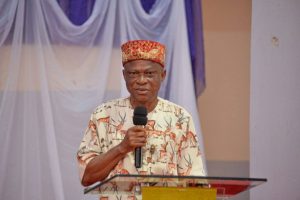
In their separate remarks, the Mayor of Umunneochi LGA, Hon. Sunday Afuruobi, and Eze Sampson Jinanwa, who represented the 1st Deputy Chairman of Abia State Council of Traditional Rulers, Eze Nelson Mmerengwa, pledged continued collaboration with development unions to deepen peace, unity, and development across communities.
Earlier in her welcome address, the Permanent Secretary, Ministry of Local Government and Chieftaincy Affairs, Lady Oge Maduka, described the meeting as the beginning of a new phase in the government’s commitment to strengthening grassroots governance and enhancing coordination among community leadership structures.
She acknowledged the longstanding contributions of town and development unions to community advancement, while emphasizing the urgent need for reforms to align them with modern governance realities.
“However, as society evolves and governance structures become more dynamic, it has become necessary to ensure that all grassroots institutions are placed within a coordinated, structured and accountable framework that aligns with the vision of the present administration for effective governance and sustainable development.
“This engagement has therefore be convened to establish a direct interface between government and the leadership of town and development unions,“ Lady Maduka stated.
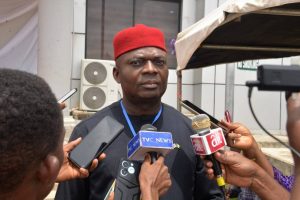
Reacting to the development in separate interviews, grassroots leaders including the President General of Oro-Ibere Autonomous Community, Ikwuano LGA, Dr Greene Nwoha; President General, Abiriba Communal Improvement Union (ACIU) Worldwide, Ohafia LGA, Chief Yuccee Ottah Uwah; and President General of Ozuitem Community, Bende LGA, Hon. Chukwudi Edward Egwuonwu, commended Governor Alex Otti for convening what they described as a historic and first-of-its-kind engagement.
They expressed optimism that the resolutions from the meeting would significantly enhance security, peace, tranquillity, and overall development across Abia communities.
The meeting featured interactive sessions with participants, providing a platform for robust dialogue, experience sharing, and collaborative problem-solving aimed at building a more structured, 
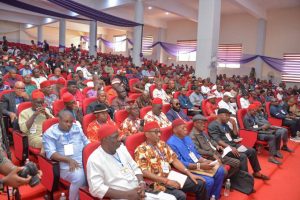


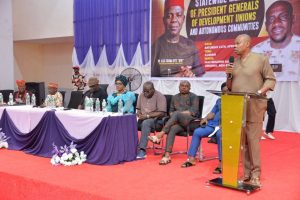

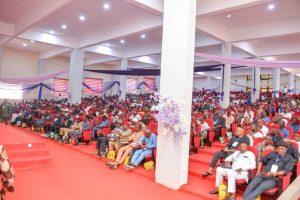
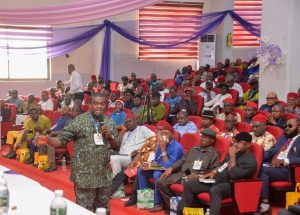
 peaceful, and development-driven grassroots governance system in Abia State.