
NEWS
Timipre Sylva Quits APC, Accuses Party of Abandoning Founding Ideals, Copies EFCC in Resignation Letter

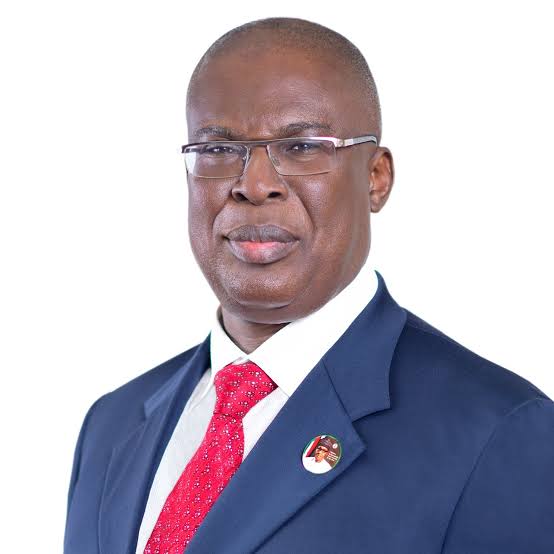
Former Minister of State for Petroleum Resources, Chief Timipre Sylva, has resigned from the All Progressives Congress (APC), delivering a major political blow to the ruling party ahead of the 2027 general elections.
Sylva, who was among the founding members of the APC and has remained a prominent political figure in the Niger Delta, announced his resignation in a letter addressed to the party chairman.
The former minister said his decision was not taken impulsively, explaining that he had consulted with his family, associates, colleagues and supporters before arriving at the decision to leave the party.
At the heart of his resignation is a deep dissatisfaction with what he described as the APC’s departure from the principles and ideals upon which the party was established.
In his letter, Sylva expressed disappointment over what he described as the “thorough” and “unrecognisable” thwarting of the ideals that motivated him and other founding members to build the APC.
According to him, the political organisation he helped establish has increasingly moved away from the values that originally attracted him to it, leaving him unable to continue his membership.
Sylva said he could no longer, “in all good conscience,” remain in a party whose leaders, according to him, operate on the belief that “all is fair in politics.”
He declared: “All cannot be fair in any endeavour of life. The demands of basic decency and morality forbid it,” stressing that political competition should not be allowed to override fundamental standards of decency and morality.
Criticism of Tinubu Administration:-
Beyond his criticism of the APC as a political organisation, Sylva also turned his attention to the Federal Government formed under the party’s platform.
The former petroleum minister said the administration had disappointed a large number of Nigerians, suggesting that the government had failed to live up to the expectations that accompanied its emergence.
Sylva further argued that he could neither identify a credible effort nor see any realistic possibility of revamping the APC and its administration.
His conclusion, therefore, was that remaining within the party would amount to continuing on a path he no longer believed in.
He said he was left with no choice but to abandon what he described as a “floundering ship,” while expressing confidence that Nigerians would use the next election to “vote for Nigeria” and free the country from what he described as a political stranglehold.
The language of the resignation letter signals not merely a personal departure from the APC but a broader political disagreement over the direction of the party and the administration it currently controls.
Sylva Copies EFCC in Resignation Letter:-
One of the most striking elements of Sylva’s resignation was his decision to copy the Economic and Financial Crimes Commission (EFCC) in the letter.
Sylva alleged that the anti-corruption agency had recently conducted itself more as an organ of the APC than as an institution of the Nigerian state.
The decision to formally include the EFCC in his resignation correspondence adds another layer to the political significance of his departure, particularly as Sylva acknowledged the potential consequences of his decision.
He said his resignation could expose him and his associates to what he described as a possible “redoubled witch-hunt.”
Despite the potential risks, however, Sylva indicated that he was prepared to accept the consequences of his decision rather than remain within a political structure he no longer believed represented the principles upon which it was founded.
A Major Political Signal Ahead of 2027:-
Sylva’s exit is significant because of his history with the APC, his former position as Minister of State for Petroleum Resources and his political influence in the Niger Delta.
As a founding member of the ruling party, his decision to walk away is likely to fuel discussions about internal disagreements within the APC and the possibility of further political realignments ahead of the 2027 elections.
The resignation also comes at a politically sensitive period, when Nigeria’s major political parties and political actors are increasingly positioning themselves for the next general elections.
Sylva concluded his resignation letter by reaffirming his commitment to Nigeria before signing off as Chief Timipre Sylva, former Minister of State for Petroleum Resources.
His departure now leaves the APC facing questions over the extent of internal discontent within its ranks and whether other prominent figures could follow similar paths as the country moves closer to another major electoral contest.
For Sylva, however, the message contained in his resignation is clear: he believes the APC has strayed too far from the ideals that brought it into existence and he is no longer willing t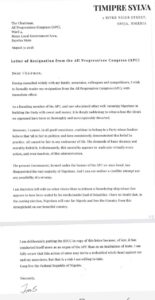 o remain aboard what he calls a “floundering ship.”