
NEWS
UK Universities Withdraw Admission Offers En Masse to Nigerian, Pakistani Students Amid Visa Crackdown

Study visa withdrawals surge to 22.7% for Nigerians as UK universities fear recruitment bans, job losses and campus closures over stricter immigration rules
Universities across the United Kingdom are withdrawing admission offers to international students on a large scale, including applicants from Nigeria, Pakistan, Bangladesh and other countries, amid growing concerns that the British government’s tightening of student visa regulations could jeopardise their ability to recruit overseas students.
The development follows a sharp increase in study visa refusals by the UK Home Office during the first six months of 2026, forcing universities to reconsider their international recruitment strategies to avoid breaching stricter immigration compliance requirements.
The unfolding situation has raised concerns among prospective international students, particularly Nigerians seeking higher education opportunities in Britain, while universities warn that the restrictions could threaten their finances, academic programmes, employment and long-standing reputation as destinations for international education.
According to an analysis of Home Office data, 10.5 per cent of UK study visa applications were withdrawn in the first half of 2026, representing a significant increase from 2.3 per cent during the corresponding period in 2025 and just 0.4 per cent in 2023.
The figures highlight the growing impact of the visa crackdown on international student recruitment, with applicants from certain countries experiencing particularly dramatic increases in withdrawn applications.
### Nigerians Among the Worst Affected as Visa Withdrawals Rise
Nigeria has emerged as one of the countries significantly affected by the growing uncertainty surrounding UK student visas.
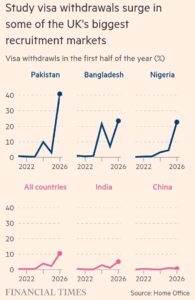
Data show that 22.7 per cent of study visa applications from Nigerian applicants were withdrawn between January and June 2026, compared with 4.5 per cent during the first half of 2025.
The increase places Nigerian students among the groups facing substantial disruption as universities become increasingly cautious about issuing and maintaining admission offers to applicants from countries experiencing higher visa refusal rates.
Pakistan has experienced an even more dramatic increase, with 40.9 per cent of prospective students’ visa applications withdrawn in the first six months of 2026, compared with just 3 per cent during the same period last year.
Bangladesh also recorded a significant rise, with its proportion of withdrawn study visa applications increasing from 7.1 per cent to 23.5 per cent.
For India, the proportion rose from 1.2 per cent to 5.2 per cent over the same period.
The figures reflect a growing divide in the international student recruitment market, as universities increasingly weigh applicants’ nationalities and associated visa refusal risks when deciding where to focus their recruitment efforts.
International students generally need an offer from a university before applying for a UK study visa. Consequently, when a university withdraws an admission offer, the associated visa application may also be withdrawn.
Although visa applications can be withdrawn for several reasons, universities have indicated that the increasing number of institutions revoking admission offers has become a major factor behind the latest figures.
### Universities Fear Recruitment Bans Under Stricter Visa Rules
The surge in withdrawals comes amid tighter rules governing universities’ ability to sponsor international students.
Under the revised requirements, institutions where more than 5 per cent of prospective international students who receive offers subsequently have their visa applications rejected risk being prohibited from recruiting overseas students.
The threshold represents a significant tightening of the previous 10 per cent limit, leaving universities with less room to accommodate visa refusals without facing potential restrictions on their international recruitment activities.
The stricter requirements have prompted institutions to adopt defensive recruitment strategies, including withdrawing offers from applicants in countries where visa refusal rates are rising.
Figures within the higher education sector suggest that approximately 15 UK universities have suspended recruitment from Pakistan entirely this year.
Data from Enroly, a company that processes international student visa applications, also indicate that refusal rates at almost half of UK universities are above the 5 per cent threshold that could expose them to a recruitment ban.
The situation has placed university administrators under pressure to protect their institutions from regulatory penalties, even when they believe individual applicants have legitimate reasons for seeking admission.
### University Leaders Question Visa Refusal Decisions
University leaders have raised concerns about what they describe as the unpredictability and inconsistency of visa decisions, arguing that some refusals have been based on questionable assessments of prospective students.
Sir David Bell, vice-chancellor of the University of Sunderland, said: “The recent and unexpected spike in visa refusals has prompted pre-emptive action in several universities. This has involved pulling back from international markets where a tougher approach is being taken to visa applications.”
His remarks underline the difficult position universities now face as they attempt to comply with immigration rules while maintaining access to international talent.
Jamie Arrowsmith, director of Universities UK International, which represents institutions recruiting students from overseas, acknowledged the importance of maintaining public confidence in Britain’s immigration system but expressed concern about the visa processing environment.
He said “visa processing has become markedly less predictable”.
“Many refusals appear to rest on flawed, inconsistent and highly subjective reasoning, forcing universities to withdraw offers at scale to avoid breaching compliance thresholds,” he added.
The concerns have intensified calls for greater clarity and consistency in how applications are assessed, particularly where a refusal could affect a university’s ability to recruit students from an entire region.
### Rejected Applicants Face Questions Over Study Plans
Universities have cited examples of visa applications being rejected for reasons they consider questionable, including cases where applicants had previously explored studying in other countries.
Other cases reportedly involved PhD applicants who were unable to name course modules that did not exist as conventional modules for their research degrees.
Professor Steven McGuire, deputy vice-chancellor of the University of East Anglia, said his institution began withdrawing offers from certain countries at the end of 2025 after visa refusals increased markedly.
“We were getting some very arbitrary and ill-informed refusals,” he said.
He recounted an incident involving an applicant whose visa was rejected after an interviewer apparently failed to understand the university’s location.
“We had one where the interviewer did not seem to understand that UEA was in Norwich \[and so rejected the applicant for not knowing where they were going to study\].”
The university’s experience, he suggested, illustrated the challenges institutions face when visa decisions appear to depend on assessments that university officials consider inaccurate or insufficiently informed.
The resulting uncertainty has encouraged some universities to reduce recruitment from countries where applications are more likely to be refused, rather than risk falling foul of the stricter compliance threshold.
### Universities Warn of Job Losses and Campus Closures
Beyond the immediate impact on international applicants, university leaders have warned that the visa restrictions could deepen financial pressures across Britain’s higher education sector.
International students are an important source of tuition-fee income for many UK institutions. Their fees help support academic programmes, research, facilities and other university operations.
However, overseas applications are already under pressure from tougher visa regulations and increasing competition from other countries seeking to attract international students.
The latest wave of withdrawn admission offers could further reduce enrolment, leaving universities with difficult decisions about staffing levels, course availability and campus operations.
Vanessa Wilson, chief executive of University Alliance, a group representing 20 professional and technical universities, warned of the potential consequences.
“This is going to result in restructures, which inevitably results in job losses, course closures, campus closures.”
Her warning reflects fears that institutions facing a substantial decline in international fee income may be forced to reduce their operations to remain financially sustainable.
Professor James Miller, vice-chancellor of the University of the West of Scotland and convener of Universities Scotland, also criticised the nature of some visa refusals.
He said some decisions were “extremely spurious” and that the Home Office had provided “no real explanation \[for the increase\] other than concern about number of students claiming asylum”.
According to Miller, some institutions have responded by abandoning recruitment from particular geographical areas to keep their refusal rates below the regulatory threshold.
He warned that many universities could experience a decline of more than 20 per cent in overseas student numbers this year, potentially making job cuts unavoidable if the situation continues.
“It’s harming the UK’s reputation, it’s contrary to other government policies and at an individual level it’s denying opportunity to people who want to advance their careers and their lives.”
### Fears of Greater Dependence on Chinese and Indian Students
The policy is also raising concerns about the long-term composition of the UK’s international student population.
Professor McGuire warned that universities could increasingly concentrate their recruitment efforts on China and India, where visa refusal rates have been comparatively lower than in some other markets.
He said the policy’s effect is for all universities to “double down on China and India”.
Such a shift could reduce opportunities for students from Nigeria, Pakistan and other countries whose applicants are facing increased scrutiny, regardless of the individual merits of their academic applications.
It could also leave British universities more dependent on a narrower range of international recruitment markets, increasing their exposure to changes in demand, international competition and future immigration policies.
For Nigerian students, the figures point to a more challenging admissions environment, with applicants potentially facing greater uncertainty even after securing offers from British universities.
Prospective students may consequently need to pay closer attention to their institutions’ sponsorship status, documentation requirements and visa application procedures before making significant financial commitments.
### UK Government Defends Its Immigration Policy
The Home Office has defended the government’s approach, maintaining that international students remain welcome in Britain but insisting that universities must recruit responsibly and comply with immigration regulations.
The department said international students “make a positive contribution” to the country, but added that “this must not be at the expense of recruiting responsibly, in turn protecting the integrity of our immigration system”.
It also said it was offering universities “support where needed to improve recruitment practices”.
The government’s position reflects its stated objective of protecting the immigration system against abuse, including concerns that some people may use the student visa route to enter Britain before subsequently claiming asylum.
However, university leaders argue that the implementation of the stricter rules is creating uncertainty for legitimate applicants and institutions, with potentially serious consequences for higher education.
The central challenge for the British government is balancing immigration enforcement with the country’s continued ability to attract qualified international students, whose contributions extend beyond tuition fees to research, skills development and the wider economy.
As universities respond to the new compliance pressures, Nigerian and other international applicants face a period of heightened uncertainty over their educational plans.
With visa withdrawals rising sharply, recruitment strategies changing and institutions warning of possible job losses and campus closures, the unfolding dispute has become a signi 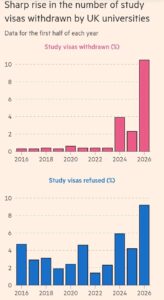
 ficant test of Britain’s ability to protect its immigration system without undermining its global higher education standing.