
NEWS
₦21bn VP Residence Still Unoccupied More Than Two Years After President Tinubu Commissioned Abuja Project

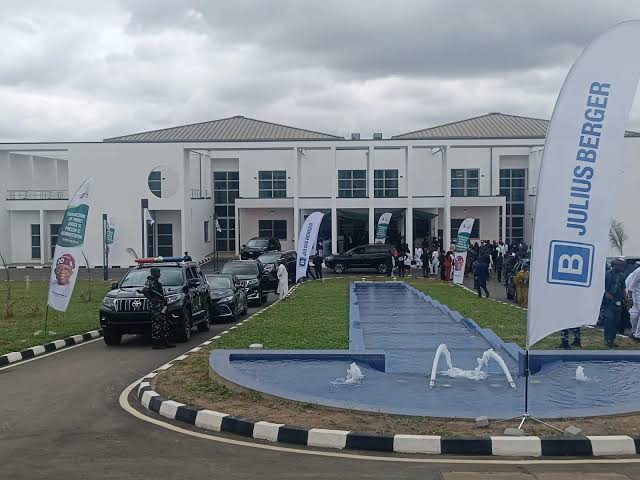
More than two years after the Federal Capital Territory Administration (FCTA), under Minister Nyesom Wike, completed and handed over the official residence built for Vice President Kashim Shettima, the multi-billion-naira facility is reportedly yet to be occupied by its intended occupant.
The development has renewed public interest in the utilisation of the imposing residence, which was commissioned by President Bola Tinubu on June 7, 2024, after years of delays and abandonment.
Located within Abuja’s prestigious Three Arms Zone, the project was originally awarded in 2010 at an estimated cost of N7 billion during the administration of former President Goodluck Jonathan. It was subsequently abandoned before being revived and completed under the FCT Administration.
By the time the project was completed, reports put the total expenditure at approximately ₦21 billion, although the precise figure varies depending on whether the original contract sum, variations and subsequent expenditures are included.
At the commissioning ceremony, the Federal Government presented the completion of the project as part of efforts to ensure that abandoned government projects were completed rather than allowing public funds already committed to them to go to waste.
Despite the commissioning, however, Shettima has continued to operate from Akinola Aguda House within the Presidential Complex, which has remained his official residential base.
The apparent non-occupation of the newly completed residence has therefore become a subject of public discussion, particularly because the facility was specifically constructed to serve as the official residence of the vice president.
Security considerations have been mentioned in reports as one possible reason for the delay in relocation.
However, no detailed official explanation has publicly established the specific security issues allegedly preventing Shettima from taking possession of the residence.
The FCTA had previously indicated that its role in the project had been completed and that the facility was handed over to the relevant authorities following its commissioning.
The prolonged absence of the vice president from the residence has consequently raised questions about whether further security assessments, structural works, operational installations or other requirements remain outstanding.
Social media speculation has added another layer to the controversy, with claims suggesting that Shettima had initially moved into the residence before allegedly discovering hidden closed-circuit television cameras and subsequently leaving the facility.
There is, however, no credible evidence establishing that Shettima ever occupied the residence and later vacated it because of surveillance equipment. The vice president’s spokesperson had also dismissed the claim and maintained that Shettima continued to reside at Akinola Aguda House.
That controversy has not resolved the broader question surrounding the facility: why has the vice president still not relocated to a residence completed and commissioned specifically for his use more than two years ago?
The project itself has a long history. Initiated and awarded in 2010 during the Jonathan administration, it survived several changes of government and periods of inactivity before being completed under Wike’s tenure as FCT minister.
Its completion became one of the FCT Administration’s prominent infrastructure projects, alongside efforts to revive several abandoned projects across Abuja.
But while the physical structure has been completed, its continued non-use for its primary purpose has created a fresh layer of scrutiny around the project.
Questions now include whether the facility has received all necessary security clearances, whether it has been formally certified for residential occupation, whether additional modifications are required and what specific factors have kept the vice president at his existing residence.
There are also questions about the continuing cost of securing, maintaining and preserving a facility reportedly completed at a cost running into tens of billions of naira while it remains largely unused for residential purposes.
The Presidency has yet to provide a comprehensive public explanation addressing the prolonged delay in Shettima’s relocation.
For a project whose total expenditure has been widely reported at about ₦21 billion, the unanswered questions surrounding its utilisation are likely to keep the residence firmly in the spotlight and sustain public scrutiny over how major government infrastructure projects are planned, completed and ultimately put to use.