
NEWS
2027 Presidency: Wike Predicts Tinubu Will Dominate North, Says Atiku May Struggle for 10% in Some Southern States

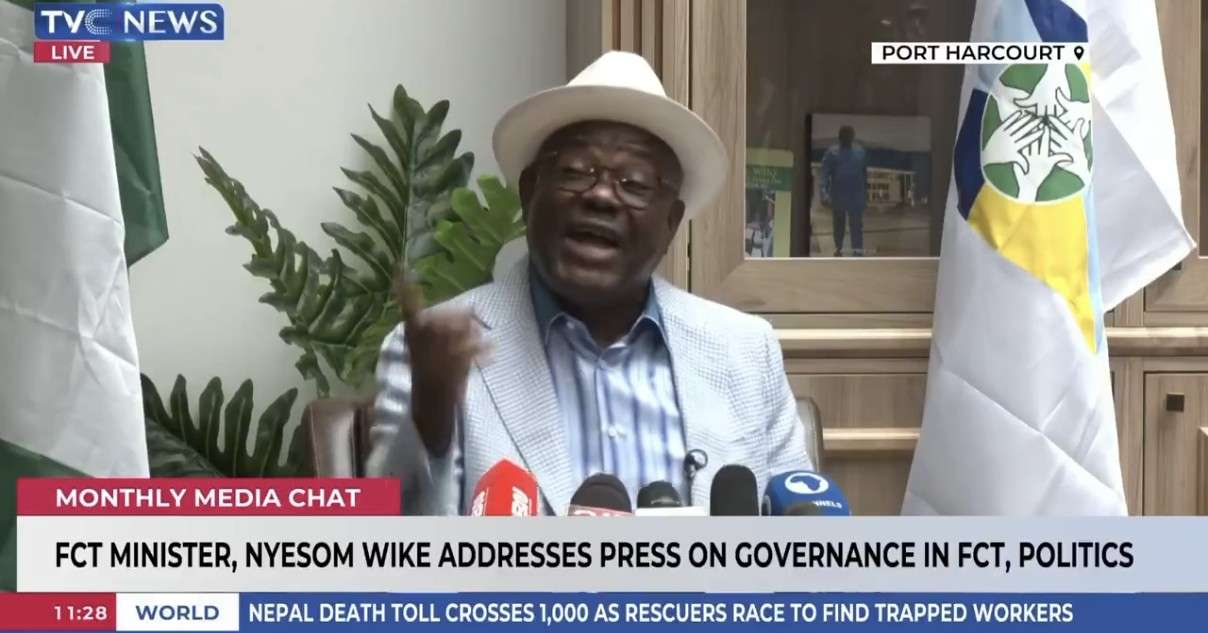
Minister of the Federal Capital Territory (FCT), Nyesom Wike, has offered a bold assessment of the 2027 presidential election, arguing that President Bola Ahmed Tinubu remains strongly positioned across the northern region while suggesting that former Vice President and ADC Presidential Candidate, Alhaji Atiku Abubakar could struggle to secure even 10 per cent of the votes in some southern states.
Wike made the remarks while discussing the likely political calculations ahead of the 2027 election, insisting that the electoral contest should be assessed based on the realities of Nigerian politics rather than theoretical assumptions.
“There is nowhere in the North that the President (Tinubu) will not make 25%, there are so many places in the South Atiku won’t have 10%,” Wike said.
He proceeded to illustrate his argument with the North-Central geopolitical zone, beginning with Plateau State.
According to Wike, President Tinubu would win Plateau State in 2027, despite the fact that Labour Party presidential candidate Peter Obi won the state during the 2023 presidential election.
When reminded by a reporter that Obi had emerged victorious in Plateau in 2023, Wike dismissed the comparison, arguing that the political circumstances that produced that outcome had changed.
“You can see the reason is not there again, it’s not there anymore,” he said.
Wike went on to predict victories for Tinubu in Nasarawa, Kwara, Kogi and Benue states, presenting the North-Central region as one of the areas where the President could make significant gains in the next presidential election.
However, when the discussion shifted to the economic hardship Nigerians are experiencing, including complaints over hunger and the removal of fuel subsidy, Wike maintained that economic difficulties alone would not necessarily determine the outcome of an election.
“Hold on. The problem I have with you people is that you are theorists. Is there any election in this country that people do not complain of hunger? Name one.”
The FCT Minister pointed to previous elections, particularly the administration of former President Muhammadu Buhari, arguing that widespread complaints about hunger and insecurity did not prevent Buhari from winning elections.
“Even under Buhari, people were complaining of hunger and insecurity, he still won. I want you people to be practical about this thing,” Wike said.
He further argued that Nigerian politics is heavily influenced by local structures, family ties, community relationships and political loyalties, factors which he said could outweigh broader public dissatisfaction with economic conditions.
“These people that you are shouting hunger hunger, do you know they look up to some people? In every state, in every LGA, in every Ward,” he said.
Wike used his own political base as an example, questioning the assumption that economic grievances automatically translate into electoral opposition.
“Take for example: in my family today, in my community today, who told you they will be against me?”
He urged commentators and political observers to understand what he described as the peculiar nature of Nigerian politics, arguing that political decisions in the country are often influenced by established relationships and community structures.
“You have to understand the culture of Nigerian politics? It’s not like in foreign countries, where your son or even your wife is independent and can do whatever he or she likes and don’t swallow everything hook, line and sinker.”
Wike also challenged media commentators to consider how much direct contact they have with ordinary Nigerians, particularly those facing economic hardship.
“As you are talking in AriseTV everyday, how many poor people are seeing you?”
While defending the possibility of political support for the Tinubu administration despite economic challenges, Wike acknowledged that Nigerians are experiencing difficulties.
“I am not saying that things are okay, but a foundation has been laid.”
He argued that fixing the country’s economic challenges would require time and sustained policy implementation, contrasting economic reforms with situations he described as requiring immediate divine intervention.
“Solving economic problems is not the same as praying for your child who is sick, that one is miracle.”
Wike’s comments come as political calculations and alliances ahead of the 2027 presidential election continue to attract intense attention, with parties and politicians already positioning themselves for what is expected to be a highly competitive contest.
The minister also referenced the political crisis surrounding the administration of former President Goodluck Jonathan, asking Nigerians to remember the circumstances that eventually contributed to Jonathan’s defeat in the 2015 presidential election.
“This is a country that was so battered and we are now forgetting that it was in this country there was a conspiracy against Jonathan. What was the issue?”
His remarks have further intensified the debate over whether economic hardship, political structures, regional calculations and established loyalties will ultimately prove decisive in determining the direction of the 2027 presidential election.