
NEWS
Satellite Images Reveal Iran Rebuilding Missile Sites Struck by Israel, But Key Solid-Fuel Mixers Still Missing

Iran has begun the reconstruction of its missile-production facilities destroyed during the 12-day war with Israel in June, new satellite images analyzed by the Associated Press have confirmed. Despite this rapid rebuilding effort, experts note that a vital component for resuming large-scale missile production, the planetary mixers required to produce solid fuel is still absent.
For Tehran, the resumption of its missile program is seen as essential. With fears of another direct confrontation with Israel looming, the Islamic Republic views its missile arsenal as one of the few credible deterrents it retains after Israeli strikes decimated its air defense systems. Iranian leaders have consistently ruled out any negotiations with the West over these missile capabilities.
Missile analysts told AP that the re-acquisition of planetary mixers remains a priority for Iran, especially as the country braces for potential reimposed United Nations sanctions later this month. These sanctions would target any development of the missile program among other restrictions. Known as planetary mixers, these machines use orbiting blades to ensure thorough blending of solid-fuel components, a process critical for producing missiles at scale. Experts and US officials suggest that Iran could once again turn to China, where it has sourced missile-related materials in the past.
“If they’re able to reacquire some key things like planetary mixers, then that infrastructure is still there and ready to get rolling again,” said Sam Lair, a research associate at the James Martin Center for Nonproliferation Studies. Iran’s mission to the United Nations has not responded to inquiries about the rebuilding of its missile program.
The Israeli military specifically targeted Iran’s solid-fuel missile facilities during the war, knowing their strategic importance. Unlike liquid-fuel missiles, which must be fueled before launch, solid-fuel missiles can be fired almost immediately, reducing the chances of being destroyed on the ground. Iran operates missile manufacturing bases at Khojir and Parchin near Tehran, and at Shahroud northeast of the capital. All three sites have suffered repeated Israeli strikes, first in October 2024 and then again during the June conflict.
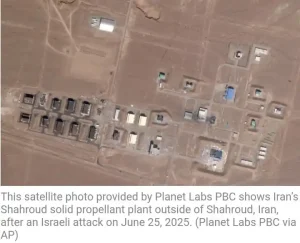
Satellite analysis shows significant rebuilding at Parchin and Shahroud, particularly at the mixing facilities. Experts say the speed of reconstruction demonstrates how central missile production remains to Tehran, even more so than nuclear facilities hit in the same period. During the June war, Iran launched 574 ballistic missiles at Israel, according to the Washington-based Jewish Institute for National Security of America.
In earlier skirmishes leading up to the war, Iran fired an additional 330 missiles. Israel had estimated Iran’s total arsenal at around 2,500 missiles, meaning Tehran expended over a third of its stockpile.
“Israel’s targeting indicates that they believed mixing was a bottleneck in Iran’s missile production.
“If Iran is able to overcome their mixing limitations, they’ll have all the casting capacity that they need to start producing at high volumes again,” said Carl Parkin, a fellow at the James Martin Center.
Israel has long argued that Iran’s missile program, coupled with its nuclear ambitions, represents an existential threat. Prime Minister Benjamin Netanyahu has claimed Iran was working toward an arsenal of 20,000 missiles before the June war. Iran, however, insists on pressing forward. Defense Minister Gen. Aziz Nasirzadeh recently announced that the war had shifted Tehran’s priorities toward producing missiles with “higher precision and greater operational capabilities.”
The question of whether China will support Iran’s reconstruction efforts remains open. In April, a massive explosion linked to missile fuel chemicals killed at least 70 people at an Iranian port. Shortly afterward, the US sanctioned several Chinese firms accused of supplying Tehran with ballistic missile ingredients. Footage from a September 2024 Israeli strike on a missile site in Syria revealed a planetary mixer that bore striking resemblance to Chinese-manufactured equipment, raising further questions about Beijing’s role.
China’s Foreign Ministry has maintained that it supports Iran’s sovereignty and security while urging calm in the Middle East. Analysts, however, warn that Chinese technology, including guidance systems and microprocessors, could significantly accelerate Iran’s missile program if transferred.
“If Iran uses its relationship with China to bolster its disruptive military capabilities, the 12-day war could be a mere speed bump for the Iranian regime, rather than a decisive defeat,” wrote Can Kasapoğlu, a senior fellow at the Hudson Institute.
Should Iran succeed in restoring its missile production to prewar levels, analysts caution that the sheer volume of new missiles would overwhelm Israel’s ability to strike them preemptively or intercept them in flight.
“They are clearly very invested in their missile program, and I don’t think that they’re going to negotiate it 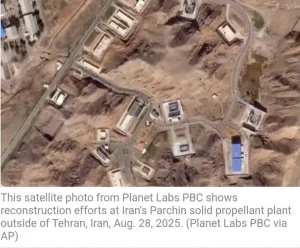
 away, ever,” Lair concluded.