
NEWS
Nigeria Emerges as One of the World’s Leading English-Speaking Nations, Ranking Above Many European and Asian Powers

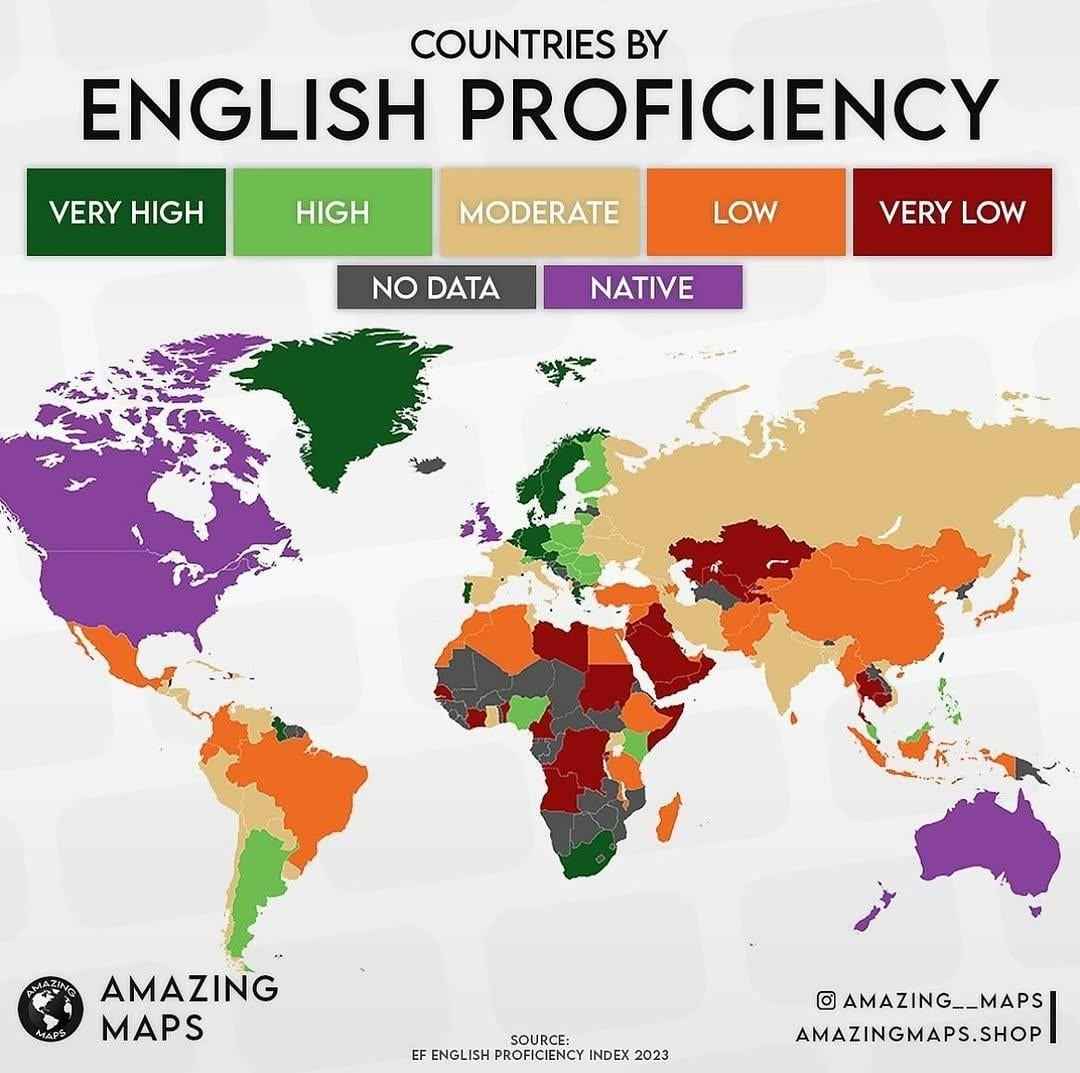
Nigeria has once again affirmed its status as a global English-speaking heavyweight, with more than half of its population speaking fluent English, placing the country ahead of several major economies across Europe, Asia, and Latin America.
According to aggregated data drawn from population censuses, Crystal reports, Euromonitor, Eurobarometer, and other international language studies, between 51 and 57 percent of Nigerians speak English fluently. This places Nigeria firmly among the top English-speaking nations globally, despite not being a Western country.
The figures highlight a striking contrast between Nigeria and some of the world’s most populous and industrialized nations. China, the world’s most populous country, records less than 1 percent English fluency. Brazil and Russia follow with about 5 percent each, while India often assumed to be highly English-speaking, records just over 10 percent of its population fluent in the language.
Mexico, Italy, Turkey, and Spain also fall well below Nigeria’s level, with English fluency rates ranging between 12 and 22 percent. Even Indonesia, Africa’s most populous counterpart in Asia, records just above 30 percent.
Within Africa, Nigeria stands shoulder to shoulder with Egypt, which records just under 40 percent, while outperforming many non-native English-speaking European countries. Poland, Greece, France, and Germany all record English fluency levels within the 49 to 57 percent range, comparable to or slightly below Nigeria’s upper estimates.
Nigeria’s performance is particularly notable when placed beside South Africa, another English-speaking African nation, which records about 31 percent fluency. This underscores Nigeria’s unique position as Africa’s largest English-speaking population, driven by its colonial history, educational system, media landscape, and the role of English as the country’s official language and primary medium of national communication.
Globally, Nigeria ranks alongside countries such as France, Germany, and the Philippines, and sits just below traditionally high-performing English-speaking nations like Canada, Denmark, Sweden, and the Netherlands. While countries such as the United Kingdom, Ireland, the United States, Singapore, and Australia record fluency rates above 90 percent, Nigeria’s standing remains exceptional for a multilingual developing nation with over 500 indigenous languages.
Experts attribute Nigeria’s strong showing to the widespread use of English in governance, education, business, technology, entertainment, and international diplomacy. From Nollywood to fintech, academia to journalism, English remains the central language connecting Nigeria’s diverse population.
As Nigeria continues to expand its influence in global trade, digital services, creative industries, and international relations, its high English proficiency rate remains a strategic advantage, positioning the country as a key communication and economic bridge between Africa and the rest of the world.
LIST:
🇨🇳 China – 0.9%
🇧🇷 Brazil – 5%
🇷🇺 Russia – 5%
🇮🇳 India – 10.5%
🇲🇽 Mexico – 12.9%
🇮🇹 Italy – 13.74%
🇹🇷 Turkey – 17%
🇪🇸 Spain – 22%
🇮🇩 Indonesia – 30.8%
🇿🇦 South Africa – 31%
🇷🇴 Romania – 31%
🇪🇬 Egypt – 39.9%
🇵🇱 Poland – 49.1%
🇵🇰 Pakistan – 4957%
🇩🇪 Germany – 56%
🇫🇷 France – 57.2%
🇵🇭 Philippines – 58.2%
🇧🇪 Belgium – 60%
🇦🇹 Austria – 73%
🇫🇮 Finland – 75%
🇨🇦 Canada – 83%
🇩🇰 Denmark – 86%
🇸🇪 Sweden – 89%
🇳🇴 Norway – 90%
🇳🇱 Netherlands – 90.9%
🇦🇺 Australia – 92.8%
🇺🇸 USA – 95.5%
🇸🇬 Singapore – 96.4%
🇳🇿 New Zealand – 97.8%
🇬🇧 UK – 98.3%
🇮🇪 Ireland – 98.37%
🇬🇮 Gibraltar – 100%