
NEWS
ABA NORTH’S QUIET REVOLUTION: HOW MAYOR TIMOTHY KALU IHEKE IS CONSOLIDATING SECURITY, RESTORING BUSINESS CONFIDENCE, AND DRIVING THE NEW ABA AGENDA


…as Abia Arise Structure, Inaugurates Ochendu Market Chapter
The story of transformation often begins in adversity. In ancient scripture, a people burdened by hardship cried out for change and leadership emerged with purpose, clarity, and resolve. Today, that same arc of history finds a modern echo in Abia State, where governance is steadily shifting from years of stagnation to a renewed era of structure, security, and visible progress.
For traders in Ochendo Shoes and Bags Parts Industrial Market in Aba North, governance once felt distant and unresponsive. Poor road networks choked the movement of goods. Insecurity cast a shadow over enterprise. Economic survival required resilience in the absence of support. Like many across the state, they endured, adapted, and waited.
That waiting is now giving way to something different under the leadership of Alex Otti. Across Abia, reforms are beginning to take root, roads are being rehabilitated, salaries are paid with consistency, and investor confidence is gradually returning. But while the broader vision is set at the state level, its real impact is being felt most tangibly at the grassroots.
Nowhere is this more evident than in Aba North, where the Executive Mayor, Hon. Timothy Kalu Iheke, is quietly but firmly establishing himself as a central figure in translating state policies into real, everyday outcomes for the people.
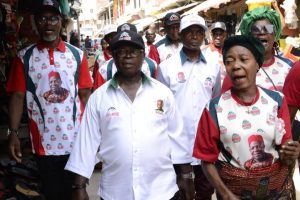
At a recent gathering marking the inauguration of the Abia Arise chapter in the Ochendo market, Mayor Iheke delivered a message grounded not in rhetoric, but in results. His focus was clear: security first.
Under his watch, Aba North has witnessed a noticeable improvement in safety, a development that traders and residents alike acknowledge as the foundation upon which every other progress rests. Markets that once emptied early out of fear are regaining their vibrancy. Business owners are extending their hours. Movement within the LGA has become freer and more predictable.
This renewed sense of safety is not abstract, it is visible in the return of traders who had previously relocated, and in the arrival of new entrants seeking opportunity in Aba’s commercial ecosystem.
According to the Mayor, people from outside the state are now choosing Abia as a place to live and do business, a statement that reflects a growing shift in perception about the state’s economic climate.
Beyond security, the administration in Aba North is addressing long-standing infrastructural challenges. Roads that had deteriorated into near impassability are being fixed. Drainage systems are receiving attention, easing the flooding and sanitation issues that once disrupted market activities. The environment is changing—not overnight, but steadily and deliberately.
Mayor Iheke’s leadership style appears to hinge on alignment, ensuring that local governance is not isolated but connected to the broader developmental blueprint of the state. His assurance of full cooperation with grassroots political and civic structures underscores a governance approach that values coordination over fragmentation.
The event itself drew a wide spectrum of stakeholders, reflecting the growing reach of the movement behind these changes. From party leaders to market authorities, the convergence of voices pointed to one thing: trust is being rebuilt, not through promises, but through visible effort.
When Elder Gabriel Kelechi, the Market Chairman, lent his presence to the occasion, it carried significance beyond ceremony. In a place like Aba, where markets are the heartbeat of the economy, the endorsement, implicit or explicit of market leadership signals acceptance from those who truly understand the pulse of commerce.
The inauguration of Chief Christian Nwachukwu as Chapter Coordinator of the Ochendo market further extends this structure into one of the most industrious clusters in the Southeast. It is a strategic move, embedding organization within a community that thrives on precision, durability, and purpose, qualities that mirror the expectations of governance itself.
What is unfolding in Aba North is not loud, but it is unmistakable. It is a recalibration of governance at the local level, driven by leadership that understands the weight of responsibility closest to the people.
Across just a few days, similar engagements have taken place in multiple LGAs, signaling a coordinated expansion of influence and structure. The pace is deliberate. The direction is clear.
And at the center of Aba North’s contribution to this broader movement stands Mayor Timothy Kalu Iheke: steady, pragmatic, and increasingly pivotal in shaping what many are beginning to recognize as a genuine turnaround story.
Abia is not merely talking about change anymore. In places like Aba North, it is being worked on street by street, market by m


























 arket, and community by community.