
NEWS
Abia State Govt Fully Funds Statewide Hospitality Grading Exercise, Moves to Digitise Sector and Unlock 55 Natural Heritage Sites for Global Tourism Visibility

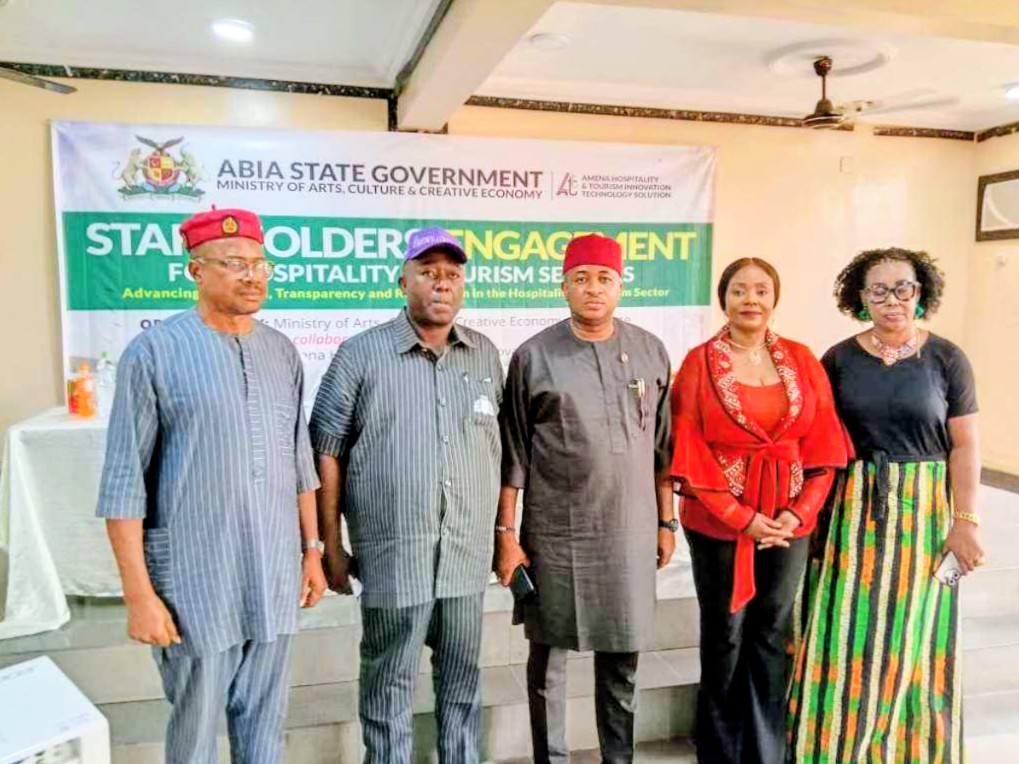
The Abia State Government has taken a bold and investor-friendly step to reposition the State’s hospitality and tourism industry by announcing that owners of hotels, bars, lounges, and restaurants will not pay any fees for the forthcoming hospitality grading and classification exercise.
The Permanent Secretary, Ministry of Arts, Culture and Creative Economy, Mrs. Chibuzo Ehiemere, made this known on Thursday during a high-level Stakeholders’ Engagement Meeting for operators in the hospitality and tourism sectors held in Aba. The engagement was convened as part of the State Government’s broader reform agenda to standardise, digitise, and globally project Abia’s hospitality ecosystem.
Addressing stakeholders, Mrs. Ehiemere moved swiftly to dispel apprehensions about possible financial implications of the exercise. In a room filled with hotel proprietors and tourism operators, she directly confronted what she described as the “unspoken concern” among participants.
“I know that the unspoken question in your hearts right now is, ‘How much is government going to ask you to pay?’ But His Excellency has decided that this grading will be fully funded by the State and not by you,” she said.
Her assurance was received as a significant relief to operators, many of whom had expressed concern about potential regulatory costs. By assuming full financial responsibility for the exercise, the government signalled its commitment to partnership rather than burden, and reform without financial strain on businesses.
The grading initiative follows a recent Memorandum of Understanding (MoU) signed between the Ministry of Arts, Culture and Creative Economy and Amena Hospitality and Tourism Innovative Technology. The partnership is aimed at digitising and standardising hospitality operations across the State.
This collaboration is expected to introduce technology-driven assessment tools, enhance transparency in classification, and create a unified database of hospitality establishments in Abia. The move aligns the State with modern tourism management systems, positioning local operators for increased visibility and competitiveness.
The Commissioner for Arts, Culture and Creative Economy, Chief Mathew Ekwuribe, elaborated on the strategic intent behind the grading system, describing it as a unifying mechanism designed to elevate standards and boost traveller confidence.
“The main purpose of this grading is to bring all the hospitality industry together and to expose them to travellers, so that visitors can have confidence in where they are going to stay.
“We are therefore calling on all hospitality establishments in the State to collaborate with the Government to achieve this goal,” Chief Ekwuruibe said.
According to the Commissioner, the grading system is not merely a regulatory exercise but a branding strategy aimed at creating trust, improving service delivery, and promoting Abia as a reliable destination for both domestic and international visitors.
Beyond hospitality establishments, the government’s tourism development agenda extends to natural and heritage assets scattered across the State. Mr. Ekwuribe revealed that 55 natural heritage sites have been identified and are earmarked for development into viable tourist centres.
“Currently, there are 55 natural heritage sites discovered in the State to be developed into tourist centres. These include Azummiri River, Aro Waterfall, gigantic caves in different parts of the State, and many others,” he said.
The proposed development of these sites is expected to create a tourism value chain that connects accommodation providers, tour operators, local communities, and investors, thereby stimulating economic growth and job creation.
Providing technical insight into the exercise, the Managing Director of Amena Hospitality and Tourism Innovative Technology, Mr. Edosa Eghobamien, explained that the grading and classification system would introduce measurable and internationally recognised benchmarks into the State’s hospitality sector.
“The Hospitality and Tourism Grading and Classification is a systematic evaluation process used to assess establishments based on standardised service delivery, facility infrastructure, operational efficiency, hygiene compliance, safety practices, and customer experience benchmarks,” Eghobamien explained.
He further emphasised that the initiative would strengthen competitiveness, improve investor confidence, and strategically position Abia as a preferred hospitality and tourism destination within Nigeria and beyond.
With the State Government funding the grading exercise, forging digital partnerships, and unveiling plans to develop 55 heritage sites, the initiative marks a comprehensive reset of Abia’s hospitality and tourism architecture.
By combining regulation, digitisation, infrastructure development, and stakeholder collaboration, the State is laying the groundwork for a modern tourism ecosystem built on standards, trust, and global visibility, a move that industry watchers say could redefine Abia’s econ omic landscape in the years ahead.