
NEWS
FEDERAL GOVT UNVEILS 2026/2027 UNITY SCHOOLS CUT-OFF MARKS AS ABIA, ENUGU, IMO, ANAMBRA AMONG HIGHEST IN NIGERIA AS COMPETITION INTENSIFIES FOR ADMISSION INTO FEDERAL GOVERNMENT COLLEGES

By @TheKELVINATOR, The Eyes Opener News | April 27, 2026
The Federal Government of Nigeria, through the Federal Ministry of Education, has released the official cut-off marks for admission into Federal Government Colleges, popularly known as Unity Schools, for the 2026/2027 academic session.
These schools, established to promote national unity and academic excellence across Nigeria’s diverse regions, continue to attract thousands of applicants annually, making admission highly competitive especially in academically strong regions such as the South-East.
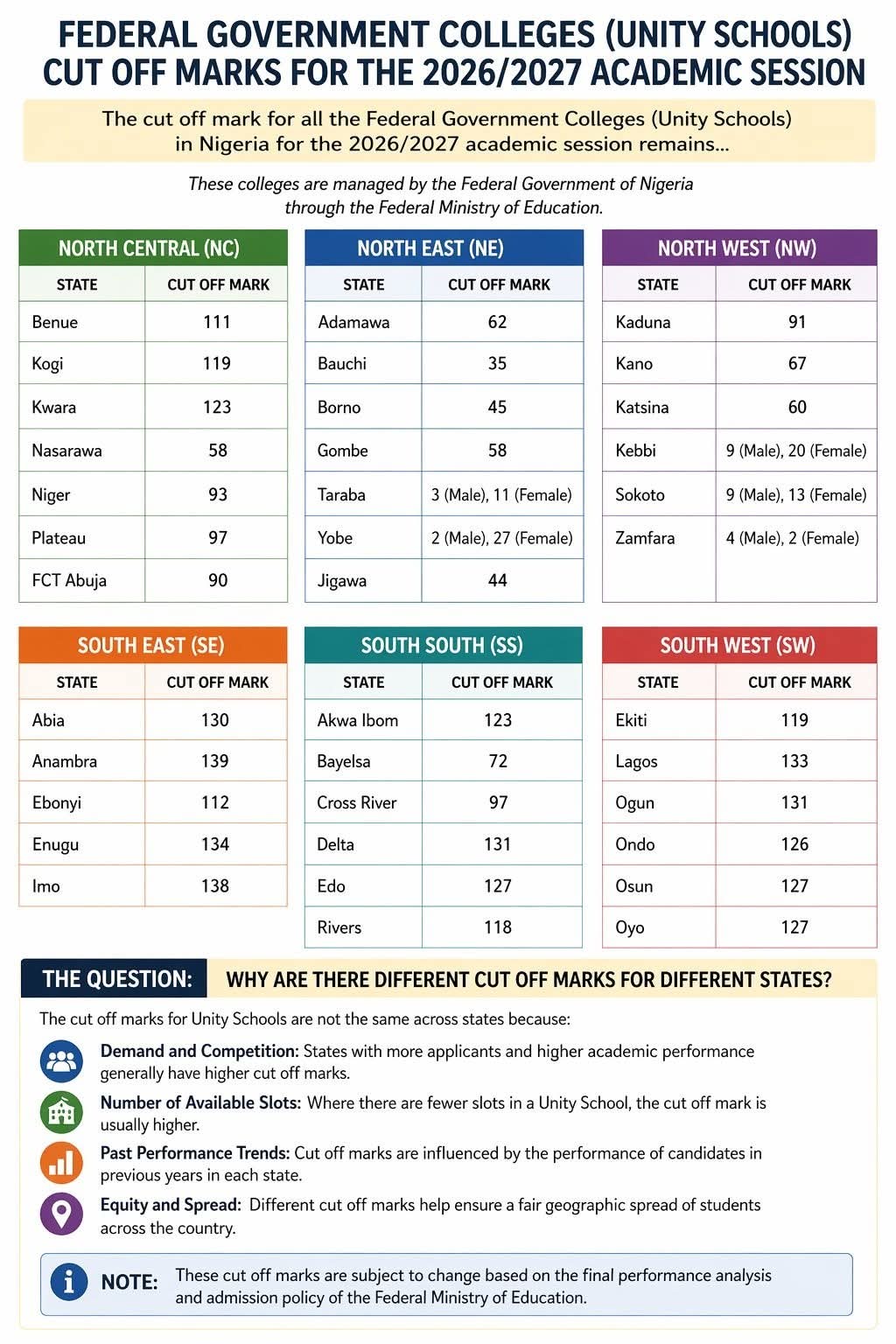
The South-East region once again stands out prominently in the newly released admission benchmarks, reflecting its long-standing reputation for academic excellence. Anambra State records one of the highest cut-off marks nationwide with 139, followed closely by Imo State with 138 and Enugu State with 134. Abia State records 130, while Ebonyi State stands at 112. This places the South-East among the most competitive regions for admission into Unity Schools in Nigeria, with all five states maintaining relatively high entry requirements compared to several other regions. For Abia State in particular, the 130 cut-off mark reinforces its consistent academic standing and growing competitiveness among candidates seeking federal school placements.
Across the South-South and South-West, similarly strong academic competition is observed. In the South-South, Delta records 131, Edo 127, Akwa Ibom 123, Rivers 118, Cross River 97, and Bayelsa 72. In the South-West, Lagos leads with 133, followed by Ogun at 131, Ondo at 126, Osun and Oyo both at 127, and Ekiti at 119. These figures highlight a nationwide pattern of increasing competition for limited Unity School placements.
In the Northern regions, cut-off marks show wide variations, reflecting differences in applicant volume, academic performance trends, and available admission slots. Kwara records 123, Kogi 119, Plateau 97, Kaduna 91, Kano 67, Borno 45, Bauchi 35, while Yobe records 2 for male candidates and 27 for female candidates. Kebbi stands at 9 for males and 20 for females, Zamfara at 4 for males and 2 for females, and the Federal Capital Territory, Abuja, records 90.
Education authorities explain that the variation in cut-off marks across states is influenced by several key factors including demand and competition levels, where states with higher numbers of applicants and stronger academic performance naturally record higher cut-off marks. The availability of admission slots also plays a major role, as limited spaces in Unity Schools raise entry thresholds in some states. Historical performance trends from previous years equally influence current benchmarks, while the Federal Government’s equity policy ensures fair geographic representation across all regions.
For the South-East, the latest figures reaffirm the region’s strong academic identity, with Abia, Enugu, Imo, and Anambra continuing to rank among Nigeria’s most competitive states for Unity School admission. The trend underscores both the high level of academic preparedness among students in the region and the increasing pressure on limited federal school placements.
The Federal Ministry of Education has also clarified that these cut-off marks remain subject to final review based on performance analysis and national admission policy adjustments before full placement lists are finalized for the 2026/2027 academic session.
The Federal Government of Nigeria, through the Federal Ministry of Education, has released the official cut-off marks for admission into Federal Government Colleges, popularly known as Unity Schools, for the 2026/2027 academic session.
These schools, established to promote national unity and academic excellence across Nigeria’s diverse regions, continue to attract thousands of applicants annually, making admission highly competitive especially in academically strong regions such as the South-East.
The South-East region once again stands out prominently in the newly released admission benchmarks, reflecting its long-standing reputation for academic excellence. Anambra State records one of the highest cut-off marks nationwide with 139, followed closely by Imo State with 138 and Enugu State with 134. Abia State records 130, while Ebonyi State stands at 112. This places the South-East among the most competitive regions for admission into Unity Schools in Nigeria, with all five states maintaining relatively high entry requirements compared to several other regions. For Abia State in particular, the 130 cut-off mark reinforces its consistent academic standing and growing competitiveness among candidates seeking federal school placements.
Across the South-South and South-West, similarly strong academic competition is observed. In the South-South, Delta records 131, Edo 127, Akwa Ibom 123, Rivers 118, Cross River 97, and Bayelsa 72. In the South-West, Lagos leads with 133, followed by Ogun at 131, Ondo at 126, Osun and Oyo both at 127, and Ekiti at 119. These figures highlight a nationwide pattern of increasing competition for limited Unity School placements.
In the Northern regions, cut-off marks show wide variations, reflecting differences in applicant volume, academic performance trends, and available admission slots. Kwara records 123, Kogi 119, Plateau 97, Kaduna 91, Kano 67, Borno 45, Bauchi 35, while Yobe records 2 for male candidates and 27 for female candidates. Kebbi stands at 9 for males and 20 for females, Zamfara at 4 for males and 2 for females, and the Federal Capital Territory, Abuja, records 90.
Education authorities explain that the variation in cut-off marks across states is influenced by several key factors including demand and competition levels, where states with higher numbers of applicants and stronger academic performance naturally record higher cut-off marks. The availability of admission slots also plays a major role, as limited spaces in Unity Schools raise entry thresholds in some states. Historical performance trends from previous years equally influence current benchmarks, while the Federal Government’s equity policy ensures fair geographic representation across all regions.
For the South-East, the latest figures reaffirm the region’s strong academic identity, with Abia, Enugu, Imo, and Anambra continuing to rank among Nigeria’s most competitive states for Unity School admission. The trend underscores both the high level of academic preparedness among students in the region and the increasing pressure on limited federal school placements.
The Federal Ministry of Education has also clarified that these cut-off marks remain subject to final review based on performance analysis and national admission policy adjustments before full placement lists are finalized for the 2026/2027 academic session.