
BUSINESS
FIRS Clarifies MoU With France’s Tax Authority, Says Nigeria’s Data and Sovereignty Fully Protected

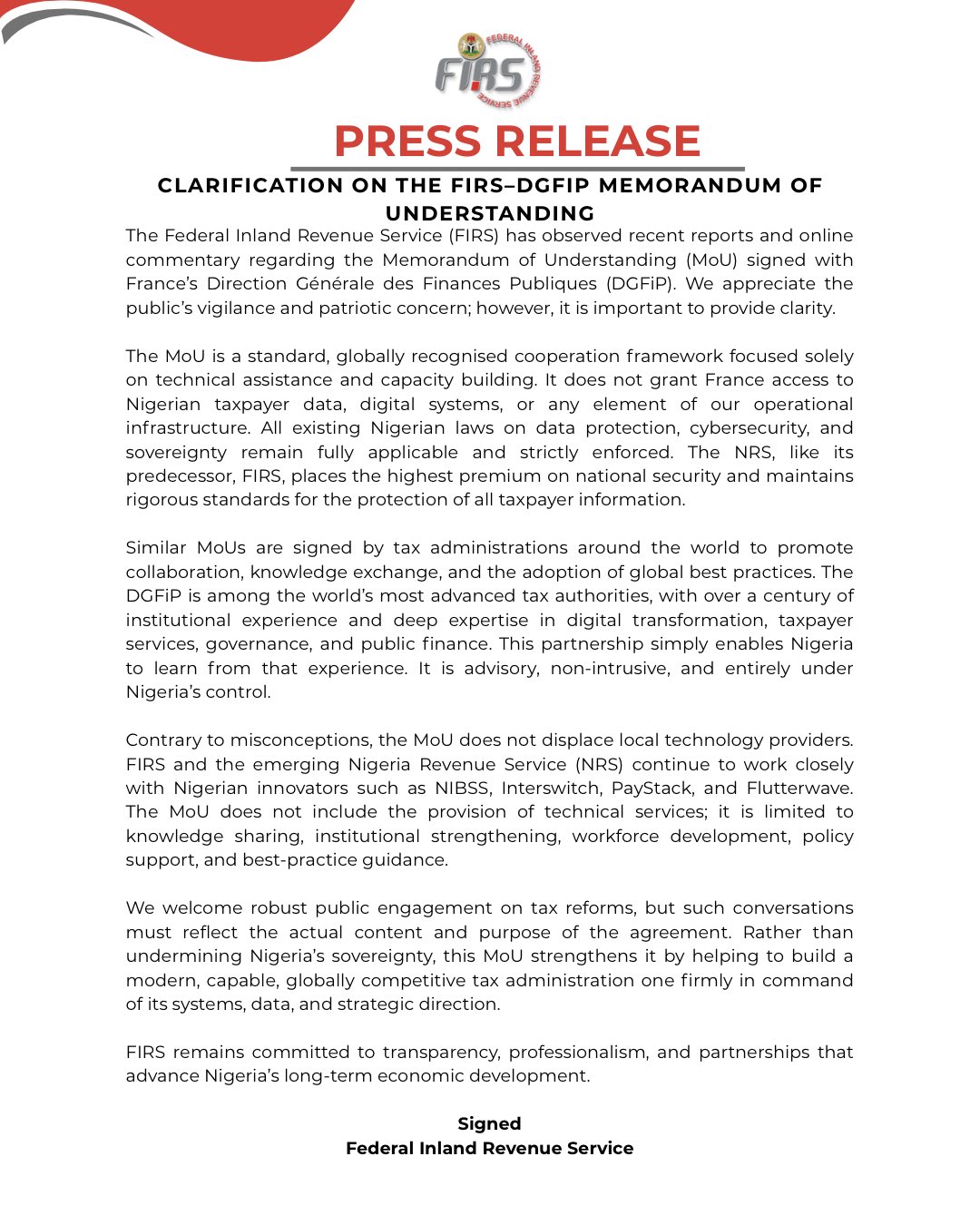
The Federal Inland Revenue Service (FIRS) has issued a clarification on the Memorandum of Understanding (MoU) it recently signed with France’s Direction Générale des Finances Publiques (DGFIP), following public debates and online commentary surrounding the agreement.
In a statement released on Saturday, the revenue agency explained that the MoU is a standard international cooperation framework designed strictly for technical assistance and capacity building. It stressed that the agreement does not grant France access to Nigerian taxpayer data, digital platforms, or any part of the country’s tax administration infrastructure.
According to FIRS, all Nigerian laws on data protection, cybersecurity, and national sovereignty remain fully in force under the agreement. The Service reaffirmed that the protection of taxpayer information and national security remains a top priority, adding that the same high standards guiding FIRS will equally apply to the emerging Nigeria Revenue Service (NRS).
The agency noted that similar cooperation agreements are routinely entered into by tax administrations across the world to encourage knowledge exchange, institutional learning, and the adoption of global best practices. It described France’s DGFIP as one of the world’s most advanced tax authorities, with over a century of experience in digital transformation, governance, taxpayer services, and public finance management.
FIRS explained that the partnership is advisory in nature, non-intrusive, and fully controlled by Nigeria. Its scope is limited to knowledge sharing, workforce development, institutional strengthening, policy support, and best-practice guidance, without any provision for direct technical service delivery.
Addressing concerns about the displacement of local technology firms, the Service clarified that the MoU does not sideline Nigerian innovators. It reaffirmed its ongoing collaboration with local financial and technology partners, including NIBSS, Interswitch, Paystack, and Flutterwave, noting that these partnerships remain central to Nigeria’s tax digitalisation efforts.
The revenue agency welcomed public interest and engagement on tax reforms but urged that discussions be guided by the actual content and intent of the agreement. It maintained that the MoU strengthens, rather than weakens, Nigeria’s sovereignty by supporting the development of a modern, efficient, and globally competitive tax administration firmly in control of its systems, data, and strategic direction.
FIRS concluded by restating its commitment to transparency, professionalism, and partnerships that support Nigeria’s long-term economic growth and development.