
POLITICS
From Indictment to Investment: Probe Tracks Orji Uzor Kalu’s Multimillion-Dollar U.S. Property Trail Amid Corruption Charges

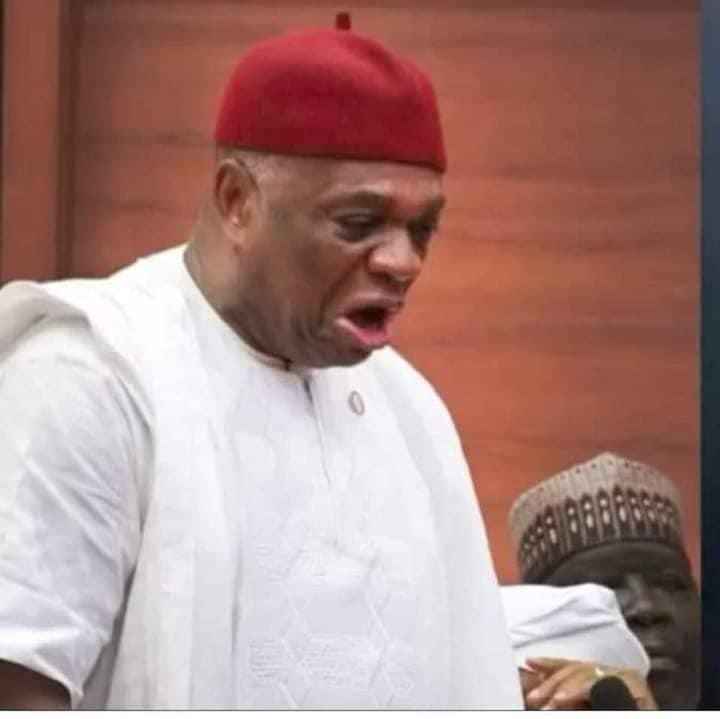
A fresh investigation has raised renewed questions over the source of wealth of Senator Orji Uzor Kalu, former governor of Abia State, after findings revealed that he and members of his family acquired extensive real estate assets in the United States while he was facing corruption and money-laundering charges in Nigeria.
The investigation, released on Monday by the Platform to Protect Whistleblowers in Africa (PPLAAF), in collaboration with The Post and Courier of South Carolina, shows that Kalu spent millions of dollars on U.S. properties during and after his time in office. Documents reviewed by the investigators indicate that while serving as governor, Kalu acquired American properties worth about USD 3.3 million, and in the 18 months following his exit from office while under indictment by Nigerian authorities—he purchased additional assets valued at USD 4.4 million.
In total, the report estimates that Kalu and his family have owned U.S. properties worth approximately USD 20 million across several states, including Maryland, North Carolina, South Carolina, and Texas. These assets reportedly include multiple residential homes, more than a dozen condominium units, undeveloped agricultural land, and a commercial property that once housed a restaurant known as Kalu.
Nigerian authorities have long accused Kalu of embezzling at least USD 24 million in public funds, allegedly siphoned through a family-owned company. In 2007, the Economic and Financial Crimes Commission (EFCC) arraigned him on 34 counts bordering on corruption and money laundering.
After nearly a decade of legal proceedings, Kalu was convicted and sentenced to prison, but the conviction was overturned by Nigeria’s Supreme Court on May 8, 2020, on procedural grounds.
Although the ruling nullified the conviction, PPLAAF said the newly uncovered property records raise fresh concerns over whether misappropriated public funds may have been used to acquire assets abroad.
According to the investigation, Kalu acquired many of the U.S. properties through an American company he incorporated in the final days of his governorship. At the time, the company was reportedly co-owned by Kalu and his two minor children. As his corruption trial progressed in 2014, ownership of several properties was transferred to SLOK, LLC, a U.S.-based entity described as an affiliate of SLOK Holding, the family conglomerate and a named defendant in the Nigerian government’s corruption case.
The report further states that during this period, Kalu’s relatives—also beneficiaries of SLOK Holding—spent an additional USD 2.3 million on U.S. real estate, including a lakeside mansion near Houston, Texas. Kalu and his brother were also said to have jointly acquired properties during the same timeframe.
Reacting to the findings, PPLAAF’s West Africa Director, Jimmy Kandé, said the investigation highlights how easily potentially illicit funds can move from countries like Nigeria into the United States.
“Our recent investigations show how effortlessly suspect funds can flow into the U.S. and be converted into real estate and other valuable assets,” Kandé said, warning that weak enforcement of anti-corruption laws undermines accountability in developing countries.
Marie Paule Conaré, PPLAAF’s West Africa Project Officer, also questioned the handling of the case by Nigerian authorities, noting that no visible steps were taken to pursue the U.S.-based assets allegedly linked to the corruption case.
The publication forms part of a broader series of investigations by PPLAAF into assets held abroad by politically exposed Nigerians. Earlier reports focused on properties linked to former National Security Adviser Sambo Dasuki, who is accused of diverting billions of dollars meant for counterterrorism operations during his tenure.
Despite intensified anti-corruption efforts in Nigeria—where the EFCC says it secured over 3,000 convictions and recovered more than ₦156 billion between 2023 and 2024, corruption remains a major challenge, draining resources that could otherwise fund essential public services.
The report also draws attention to recent regulatory rollbacks in the United States, including the decision not to enforce aspects of the Corporate Transparency Act, a move critics argue could further enable money laundering through real estate purchases.
PPLAAF urged Nigerian and U.S. authorities to re-examine the findings, reopen relevant cases where necessary, and strengthen oversight mechanisms to curb illicit financial flows and ensure accountability across borders.
By:
The Platform to Protect Whistleblowers blowers In Africa ( PPLAAF)