
NEWS
“I Go by Secret Service and the Military. They Wanted Me to Go in a Different Flight, Different Plane” — U.S. President Donald Trump Confirms Secret Air Force One Swap Over Alleged Threat

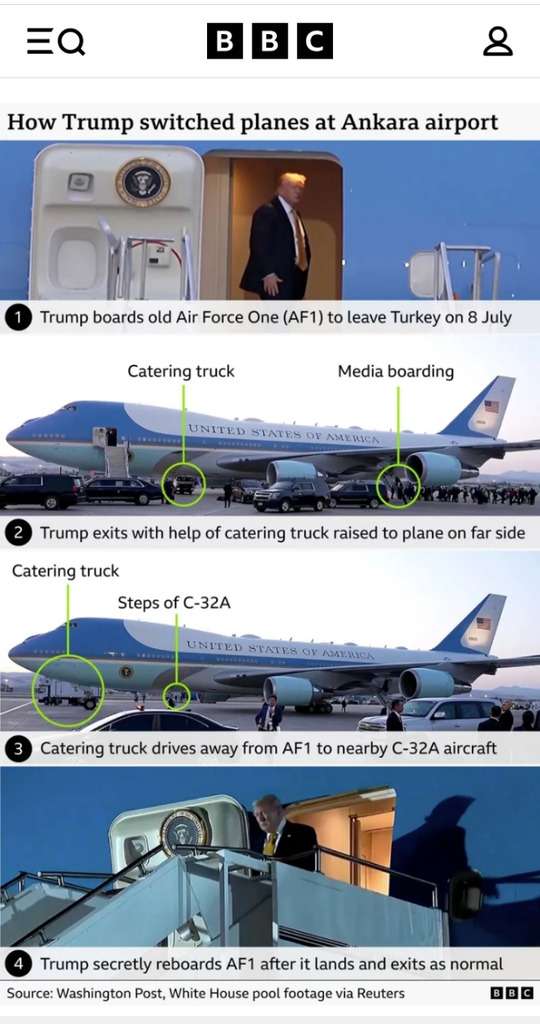
United States President Donald Trump has confirmed that he was secretly moved from Air Force One to a military aircraft during his departure from a NATO summit in Turkey last month following what officials described as a possible security threat linked to Iran.
Speaking to reporters on Tuesday, Trump disclosed that the decision to change aircraft was made by the Secret Service and the military as part of an extraordinary security operation designed to protect the president.
“I go by Secret Service and the military. They wanted me to go in a different flight, different plane.
“I just have to do what they say,“ Trump told reporters on Tuesday.
The revelation sheds new light on one of the most unusual presidential security operations in recent years and confirms reports that an elaborate deception plan was executed at Ankara airport on 8 July.
According to reports, Trump was seen by television cameras boarding the ageing Air Force One aircraft in full public view, creating the impression that he would depart aboard the presidential jet as scheduled.
However, behind the scenes, a covert operation was already underway.
Officials told CBS News, the BBC’s US partner, that American intelligence agencies had detected what was considered a credible Iranian threat involving a possible missile attack targeting the president’s aircraft.
The operation reportedly involved Trump quietly leaving Air Force One through an exit hidden from public view before being transported by means of an elevated catering truck to a nearby C-32A military aircraf, a modified Boeing 757 frequently used by the vice-president and senior government officials.
The move came amid heightened tensions between Washington and Tehran, just one day after the United States renewed military strikes on Iran following the collapse of negotiations aimed at ending hostilities between the two countries.
Trump, who had earlier described himself as Iran’s “number one target,” acknowledged that threats against him remain frequent.
“I guess there was a threat out there.
“I didn’t really ask too much about it. I get a lot of threats,“ Trump said on Tuesday.
He added:
“I have a lot of threats that you don’t know about.“
The secret flight arrangement has also sparked debate over the safety of journalists and White House staff who remained aboard the decoy Air Force One aircraft without knowing that the president had already departed.
Reports indicate that members of the travelling press corps and some White House personnel boarded Air Force One and were instructed to keep their window shades closed throughout the flight. Many reportedly remained unaware that the president was not on board.
A report released by the White House Correspondents’ Association detailed accounts from a media pool producer who found the unusual security measures suspicious, particularly the insistence that passengers keep the shades down. A photographer who briefly opened a window shade was reportedly told immediately to close it.
Additional observations included the presence of multiple catering trucks positioned around the aircraft and unusual movements on the tarmac that only later became significant after details of the operation emerged.
To preserve the deception, the aircraft carrying journalists reportedly continued using the prestigious “AF1” call sign, while the military aircraft carrying Trump flew under the code name “Reach 18.”
Defence Secretary Pete Hegseth also reportedly boarded the C-32A separately using external stairs to avoid drawing attention and to make the operation appear routine.
After leaving Turkey, Trump travelled to the United Kingdom, where he later rejoined the older Air Force One aircraft before landing at RAF Mildenhall. He subsequently transferred to the newer Boeing 747-8 aircraft donated by Qatar for the final leg of his journey back to Washington.
During the return flight, Trump alluded to the dangers surrounding his travels but did not publicly disclose the aircraft switch at the time.
When asked then why reporters had been ordered to lower the window shades, Trump replied:
“Because you’re probably on a dangerous flight because of the sleazebags we have to deal with.“
He also reiterated that he faces constant threats and remains, in his words, “number one” on Iran’s “list”.
The episode has prompted concerns from press freedom advocates over whether journalists travelling with the president should be informed of credible security risks.
Jose Zamora, regional director for the Americas at the Committee to Protect Journalists, argued that governments have an obligation to balance security operations with the safety of reporters.
“Reporters should be informed of credible security threats so they can make informed decisions about their safety,“ he added.
Trump’s confirmation has now brought into the open an operation that, until now, had been known only through leaks and media investigations, a dramatic reminder of the extraordinary measures sometimes taken to protect world leaders amid rising global tensions.