
NEWS
INSIGHT: FBI, DEA Seek Fresh Extension in High-Stakes Tinubu Records Case


U.S. federal authorities have returned to court seeking more time to file their response in a long-running legal battle involving records connected to Nigerian President Bola Ahmed Tinubu, just hours before their latest deadline was set to expire.
The Federal Bureau of Investigation (FBI) and the Drug Enforcement Administration (DEA) have filed a renewed motion before the United States District Court for the District of Columbia, asking for an extension until August 28, 2026, to submit their Cross-Motion for Summary Judgment and opposition to plaintiff Aaron Greenspan’s motion.
The case, filed as Civil Action No. 23-1816 (BAH), pits Greenspan against the Executive Office for U.S. Attorneys and other federal defendants over the release of records sought under the Freedom of Information Act.
President Bola Ahmed Tinubu is also listed in the court proceedings as an intervenor, with his legal team having previously filed a motion for joinder.
Under the court’s existing schedule, the FBI and DEA are required to file their cross-motion and opposition by August 21, 2026. However, in their latest filing, the agencies argued that they need an additional week, pushing the deadline to August 28.
The request comes after federal authorities had already received previous extensions from the court.
According to the filing, the parties initially proposed their respective briefing schedules in a joint status report submitted on June 18, 2026. The court subsequently issued a schedule directing Greenspan to file his motion for summary judgment by June 26, while the defendants were initially expected to file their cross-motion and opposition by July 27.
Greenspan filed his motion on June 25.
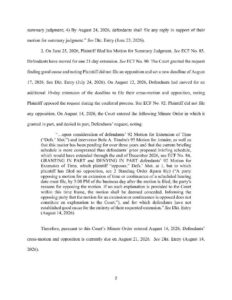
The defendants later sought and obtained a 21-day extension, with the court moving their deadline to August 17 after finding good cause for the request.
However, the FBI and DEA returned to court on August 12 seeking another 10-day extension. Although Greenspan opposed the request during discussions with government lawyers, he did not file a formal opposition with the court.
In a Minute Order issued on August 14, the court granted only part of the government’s request and refused to give the agencies the full extension they had sought.
The judge noted that the matter had already been pending for more than three years and pointed out that the government’s earlier proposed schedule could have pushed the briefing process all the way to the end of December 2026.
The court also emphasized that the defendants had not demonstrated sufficient justification for the entirety of their requested extension.
The August 14 order stated that the matter had been pending for over three years and that the current briefing schedule was already more compressed than the timetable the defendants had originally proposed.
As a result of that ruling, the FBI and DEA were given until August 21 to submit their cross-motion and opposition.
Now, with that deadline arriving, the agencies have again approached the court for more time.
The renewed request sets the stage for another decision by the federal judge, who must determine whether the government has established sufficient grounds for yet another delay in a case that has attracted significant attention because of the records at its centre and the involvement of President Tinubu as an intervenor.
If granted, the extension would move the government’s filing deadline from August 21 to August 28, 2026.
The court’s decision on the latest request could prove crucial in determining whether the long-running case proceeds immediately to the next stage of summary judgment briefing or faces another delay.
With the deadline now at hand, attention is once again focused on the U.S. District Court in Washington, D.C., where the years-long battle over the 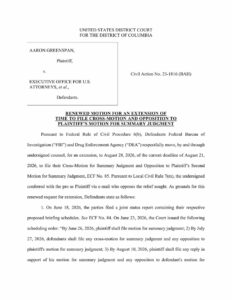
 disputed records continues to unfold.