
NEWS
Iranian Commander, Ali Abdollahi Threatens Retaliation Against US Forces as Tehran Rejects Ceasefire Without Strait of Hormuz Demands

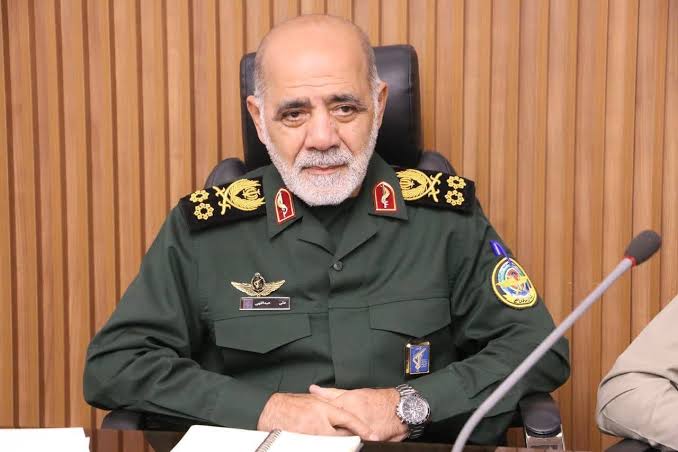
…says He’ll Kill One U.S. Service Member for Every Iranian Killed
A senior Iranian military commander has issued a stark warning to the United States, declaring that Iran would retaliate directly against American forces if Iranian citizens are killed in future US attacks, as tensions between Tehran and Washington continue to escalate.
The statement, made by Ali Abdollahi, commander of Iran’s Khatam al-Anbiya Headquarters, signals a significant hardening of Iran’s rhetoric amid the ongoing regional crisis and comes as both nations continue exchanging warnings over the conflict.
Speaking on Friday, Abdollahi said what he described as a principle previously demonstrated on the battlefield would now become an official equation guiding Iran’s military response to any future US action.
According to Abdollahi, any American attack that results in the death of an Iranian citizen would trigger a direct retaliatory strike against US military personnel.
“For every martyr from the proud people of the Islamic Republic of Iran, one American force will be eliminated,“ he said.
He concluded his remarks with an even stronger warning directed at US forces, saying they had been issued what he described as “a one-way ticket to hell.”
The comments underscore the increasingly confrontational tone between Tehran and Washington, raising fresh concerns over the possibility of further military escalation in the region.
In a separate development, Iranian Foreign Minister Abbas Araghchi declared that Tehran would not agree to any temporary ceasefire unless its demands concerning the Strait of Hormuz are met.
Araghchi dismissed suggestions that the diplomatic deadlock stems from a lack of international mediators, emphasizing instead that the dispute is rooted in US policies.
According to the Iranian foreign minister, countries such as Pakistan and Qatar continue to play mediation roles, but meaningful progress will remain elusive unless Washington changes its approach.
Responding to questions regarding his recent diplomatic engagements with counterparts from Russia, China, Ukraine, and Pakistan, Araghchi said Iran maintains continuous and structured consultations with Moscow and Beijing while engaging in dialogue whenever opportunities arise.
He noted that his recent meetings with Chinese Foreign Minister Wang Yi and Russian Foreign Minister Sergey Lavrov provided an opportunity to examine the conflict in greater detail and discuss possible developments.
On Pakistan’s role, Araghchi said it was natural for Tehran to discuss mediation efforts and various proposals with Islamabad but insisted once again that the principal obstacle remains US policy rather than the absence of intermediaries.
Reaffirming Tehran’s position, Araghchi stressed that Iran would not yield to what he described as American pressure or intimidation.
“Iran has shown that it will not bow to US coercion. We do not respond to the language of force, pressure, or threats.
“We are not afraid of threats, we do not submit to pressure, and we do not accept the language of intimidation,“ he said.
The Iranian foreign minister further reaffirmed that protecting the Iranian people and safeguarding Iran’s interests in the Strait of Hormuz remain fundamental and non-negotiable priorities for Tehran.
He added that Iran would continue to maintain its current position until what he described as the legitimate demands of the Iranian people are achieved, signaling that the country is unlikely to soften its stance despite growing international pressure.