
NEWS
NIGERIAN SCIENTIST, DR. FESTUS ANAGWU, FROM ANAMBRA MAKES GLOBAL HEADLINES WITH GROUNDBREAKING DISCOVERY IN HIGH-PERFORMANCE POLYMER TECHNOLOGY

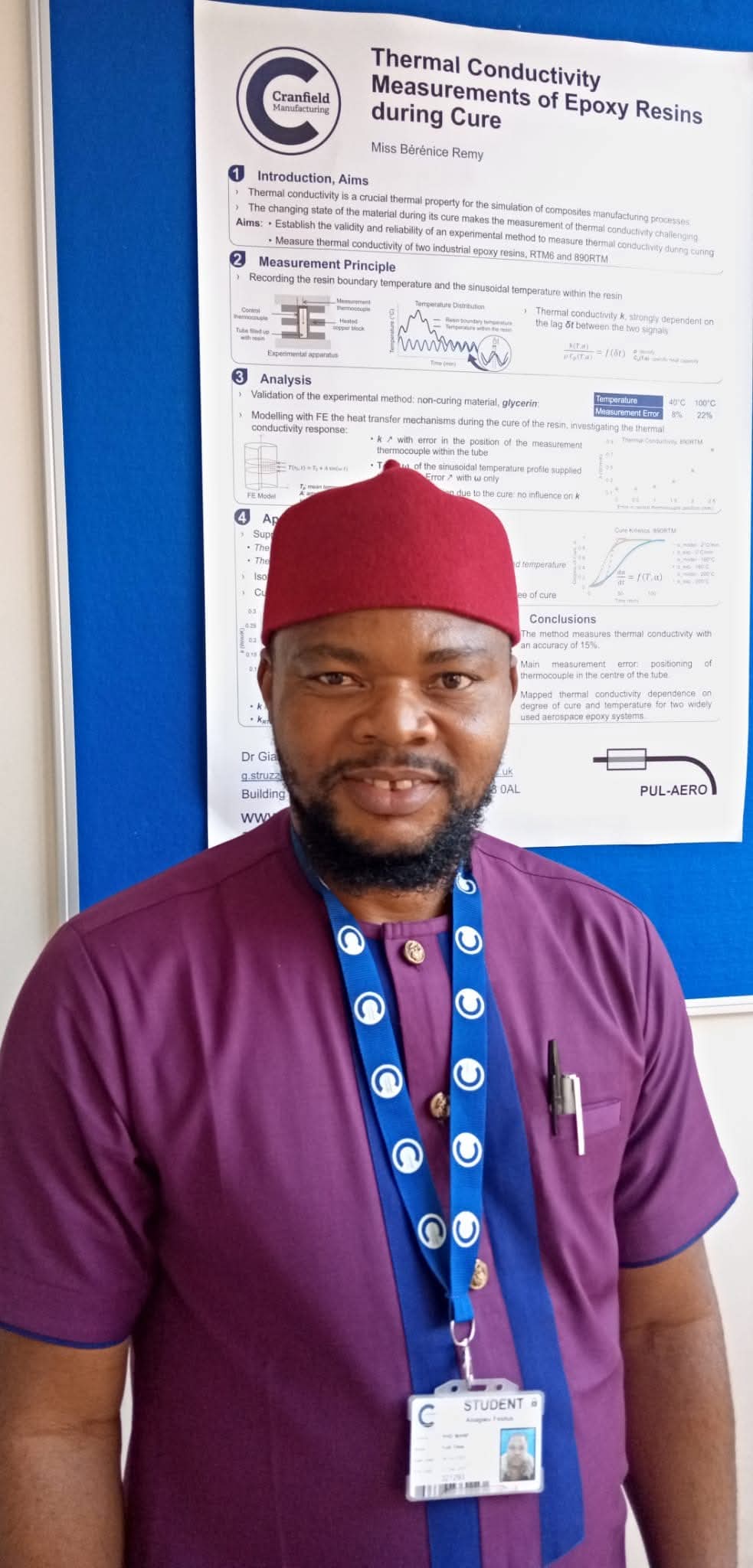
Nigeria has recorded another major scientific milestone as Dr. Festus Ifeanyi Anagwu, an accomplished researcher from Ihembosi in Anambra State, unveiled a breakthrough that is already reshaping conversations in global material science. The discovery, made at Cranfield University in the United Kingdom, positions Nigeria once again at the centre of world-class innovation in advanced engineering materials.
Dr. Anagwu, who earned his bachelor’s degree in Chemical Engineering from Anambra State University, Uli, and a master’s degree from Nnamdi Azikiwe University, Awka, conducted the pioneering research alongside British scientist Daniel Preston and Greek researcher Alex Skordos. His publication, featured in the internationally acclaimed journal Polymer, reveals a scientific phenomenon previously unknown in the processing of high-performance polymers.
These polymers, vital to aviation, defence, space exploration, marine engineering, energy systems and the oil-and-gas sector have long been the focus of intense global research, especially since the 2011 discovery of “vitrimers” by renowned physicist Ludwik Leibler. Vitrimers are celebrated for their ability to enable repairable, recyclable and sustainable composite structures, overcoming the limitations of traditional high-temperature thermosets.
Dr. Anagwu’s work takes this field a remarkable step further. His study shows that this category of polymers does not experience the abrupt, dramatic viscosity increase typically associated with thermosetting materials at the “gel point.” Instead, they enter a stable viscosity plateau, a behaviour he identifies as “gelation suppression,” driven by rapid internal bond rearrangements within the polymer network during curing.
For engineers and manufacturers, this insight is revolutionary. A stable, predictable flow behaviour during processing can significantly improve how advanced polymer-based components are designed, enabling lighter, stronger and potentially recyclable structures for use in critical sectors such as aircraft manufacturing, defence systems, spacecraft engineering, naval architecture, energy platforms and high-demand oil-and-gas equipment.
The research was initially funded through the Federal Government of Nigeria’s TETFund Scholarship and later supported by the European Union’s PLEIADES Project, a consortium focused on next-generation aviation materials. The consortium has already celebrated and amplified the discovery across international scientific platforms.
Beyond identifying this new phenomenon, the publication also introduces advanced mathematical models capable of predicting curing behaviour, viscosity evolution and glass-transition patterns, tools that industries and research institutions will rely on as they push for stronger and more sustainable composite technologies.
Dr. Anagwu’s achievement underscores the rising influence of Nigerian scientists in global innovation and serves as an inspiring testament to the potential of Nigerian engineers and researchers. His work not only advances scientific understanding but also motivates a new generation of young Nigerians to pursue excellence in science, technology and world-changing research.