
NEWS
OTTI’S REFORM ROADMAP GAINS MOMENTUM AS ABIA ADVANCES TO INDUSTRIAL REVITALISATION PHASE

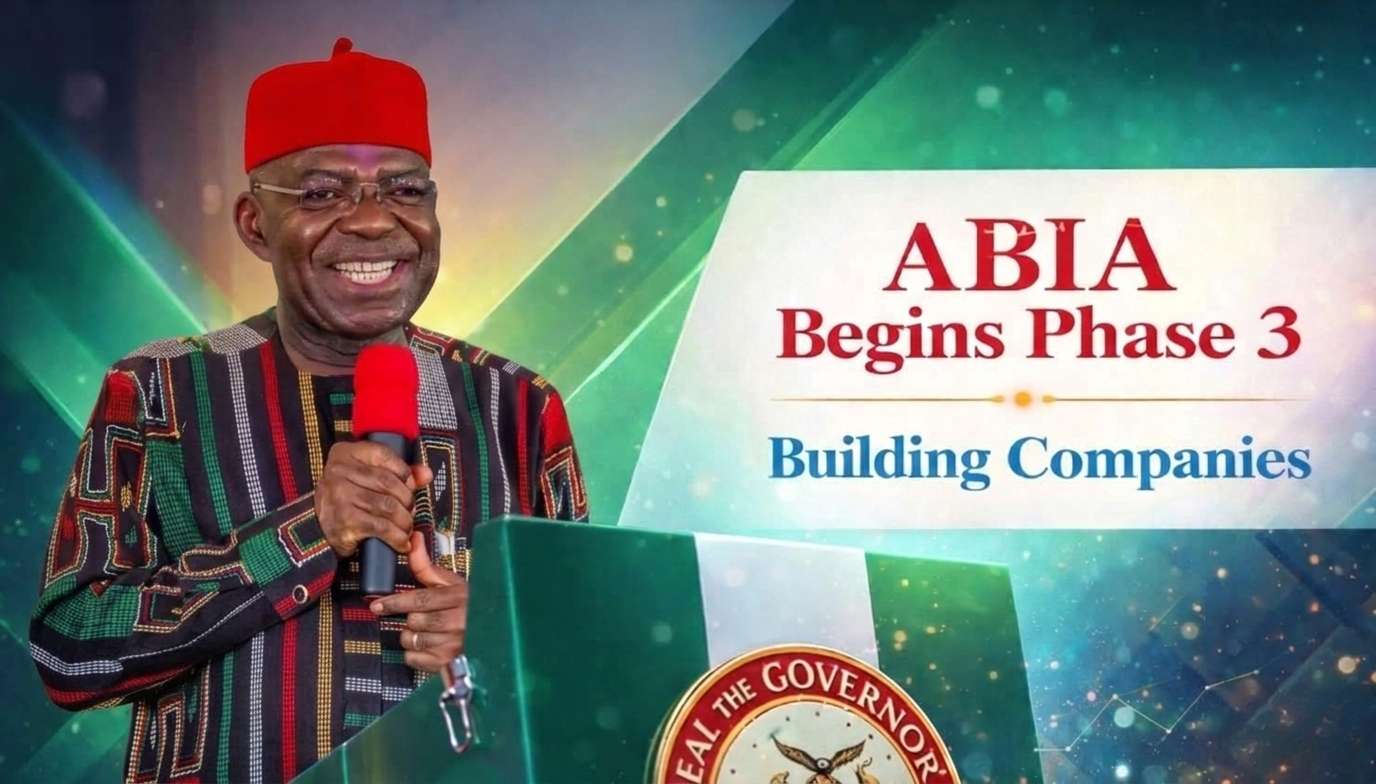
Abia State’s transformation agenda under Governor Alex Chioma Otti my, OFR, is gathering momentum, with clear progress recorded across governance, infrastructure, and industrial revitalisation, according to Prof. Ndubuisi Ekekwe, a member of the Abia State Global Economic Advisory Council.
Ekekwe stated that upon assuming office, Governor Otti came prepared with a manifesto anchored on a clearly defined execution roadmap. The framework, he explained, was not merely a collection of promises but a structured playbook designed to sequence reforms strategically across people, processes, and tools in order to reposition Abia for sustainable growth.
The first phase of the administration focused on stabilising the administrative architecture of the state. Key interventions targeted the restoration of basic services in major cities, strengthening of the school system, improvement of legal infrastructure, and regaining lost accreditations in the medical school. The government also prioritised rebuilding trust among civil servants and pensioners through the timely payment of salaries and pensions, a move widely seen as critical to restoring morale within the public service.
Outcomes from this phase include the establishment of new local courts, the re-accreditation of key institutions, improved educational performance indicators, and what observers describe as a renewed civic spirit across the state.
With administrative stability taking root, the government transitioned into a second phase focused on integrated infrastructure development. Infrastructure, in this context, is defined broadly to include not only physical assets such as roads and buildings but also institutional systems, operational processes, and market-enabling frameworks.
Central to this strategy is the economic repositioning of Aba and Umuahia as growth engines. The administration believes that a productive Aba and a revitalised Umuahia can generate the economic momentum required to accelerate development across the entire state. Aba, long regarded as the commercial heartbeat of Abia, is increasingly attracting renewed business interest, with signs that companies are responding to the improving business environment.
Beyond infrastructure and institutional reforms, the administration has moved into what has been described as the next layer of reform—practical industrial revitalisation. As part of this effort, Abia State has completed the acquisition of Afro Beverages Limited from the Asset Management Corporation of Nigeria. The move is seen as a strategic step in a broader initiative to revive dormant industrial assets within the state.
Other assets earmarked for renewal include Star Paper Mill, the Textile Mills, International Equitable Associates, and Ogwe Golden Chicken. The overarching objective is to restore production capacity, stimulate manufacturing activities, and create employment opportunities for Abians.
The government has made it clear that it does not intend to operate the revived factories directly. Instead, the model is structured to attract capable private investors and partners who can modernise operations, ensure efficiency, and sustain long-term productivity. This approach aligns with the state’s philosophy of prosperity through enterprise, as reflected in its coat of arms. Prosperity, in this context, is defined not merely by income growth but by broader improvements in health, wellbeing, opportunity, and shared progress.
Stakeholders maintain that the administration’s phased reforms are not strictly linear, as infrastructure upgrades, institutional strengthening, and industrial renewal are advancing simultaneously. They emphasise that the guiding philosophy remains shared prosperity, stressing that development must benefit all Abians rather than a select few. With reforms deepening and industrial assets positioned for revival, observers say Abia’s economic future holds significant promise as the state continues its transition from stabilisation to full-scale economic transformation.