
NEWS
Professor Develops Innovative Keyboard to Bring Igbo, Hausa and Yoruba Into the Digital Age

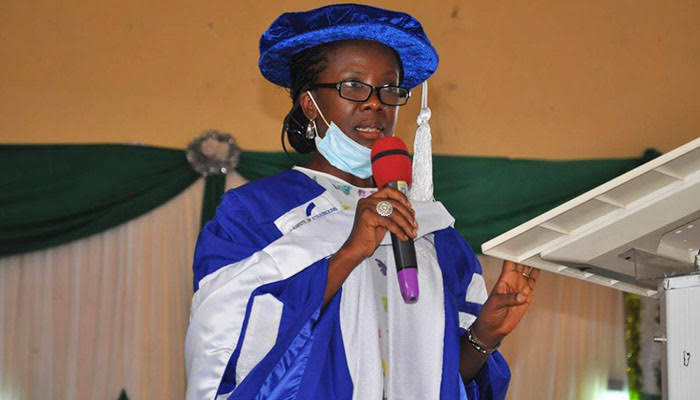
A professor of Applied Linguistics at Alex Ekwueme Federal University Ndufu-Alike (AE-FUNAI), Ebonyi State, Prof. Nnenna Nwanyioma Nwosu-Nworuh, has developed an innovative computer keyboard designed to make it easier to write and use Igbo, Hausa and Yoruba in the digital environment.
The innovation, known as Linguascript, was unveiled on Thursday, September 3, 2026, at the university’s Senate Chamber during the institution’s 10th Inaugural Lecture.
Prof. Nwosu-Nworuh unveiled the technology while delivering her inaugural lecture titled “Multilingualism and Functional Literacy: Hard, Soft or Blended Skills?” where she highlighted the growing need to integrate Nigeria’s indigenous languages into modern digital technology.
According to the professor, the development of Linguascript was driven by the inadequate representation of African and Nigerian languages on conventional computer keyboards. She noted that the absence of appropriate language features has created significant difficulties for people seeking to teach, learn, write and communicate effectively in indigenous languages using digital devices.
“No African and Nigerian language features on a computer keyboard. Hence, this is my research innovation,” she said.
The professor explained that the development of Linguascript was not an overnight achievement, revealing that the research and development process spanned several years.
She said it took four years of intensive research and development to produce the initial prototype, while another eight years of work went into developing a plug-and-play version that could be used more conveniently with computers.
With the innovation now developed, Nwosu-Nworuh called for stronger institutional and government support to move Linguascript from research laboratories into classrooms, homes, offices and the wider commercial market.
She particularly appealed to computer manufacturers to explore partnerships that would enable the mass production of computers fitted with the keyboard. She urged the Federal and state governments to engage major technology companies, including HP, Huawei, Acer and Zinox, on the possibility of incorporating Linguascript into their computer products.
The professor said wider access to the technology could transform the way Nigerian languages are taught and practised, particularly among students and young people who increasingly rely on digital devices for education, communication and other everyday activities.
She argued that making indigenous languages easier to use on computers could also contribute to efforts to preserve Nigeria’s linguistic heritage at a time when many young Nigerians are increasingly adopting English as their dominant language.
Beyond its technological application, the Linguascript project therefore represents an attempt to bridge the gap between indigenous language preservation and the realities of the digital age.
Nwosu-Nworuh, however, identified inadequate funding as one of the biggest obstacles confronting the project, revealing that she had personally shouldered much of the financial burden associated with the research and production of the innovation.
“Of course, there are challenges. I have been funding both the research and the production. Apart from the N500,000 awarded to me as the third-position winner in 2018, I have received no further incentive or funds towards the actualisation of this project,” she said.
She consequently called on governments, universities and other stakeholders to invest more deliberately in indigenous language development, stressing the importance of strengthening language programmes and creating proficiency-based curricula that would give learners meaningful opportunities to acquire and use Nigerian languages.
She also advocated greater opportunities for language immersion, noting that classroom instruction alone may not be sufficient to reverse the gradual decline in the use of indigenous languages.
The professor further called for increased collaboration between Nigerian universities and French organisations, saying such partnerships could provide students with practical language exposure, improve their proficiency and ultimately expand their career opportunities in an increasingly multilingual global economy.
Nwosu-Nworuh warned that language loss was not an Igbo-only problem, noting that the growing preference for English in children’s upbringing and education could result in a generation of Nigerians who struggle to speak their indigenous languages fluently.
She stressed the importance of parents, teachers and counsellors in identifying children’s interests, abilities and areas of strength at an early age, and guiding them towards fields where they could develop their potential more effectively.
The Linguascript innovation consequently emerged as one of the major highlights of the inaugural lecture, drawing attention to the intersection between language, education, technology and cultural preservation.
Earlier, the Vice-Chancellor of AE-FUNAI, Prof. Daniel Nwachukwu, said the university’s mandate extended beyond the awarding of academic degrees, stressing that higher education institutions must equip graduates with knowledge and skills capable of addressing real-life challenges.
He said, “Literacy without application is empty, and multilingualism without purpose is noise.”
Nwachukwu reaffirmed the university’s commitment to an education system that combines academic scholarship with practical relevance, innovation and service to society.
The development of Linguascript adds to growing calls for Nigerian educational and technology institutions to create solutions that reflect the country’s linguistic diversity and ensure that indigenous languages are not left behind as education, communication and commerce become increasingly digitised.
With adequate funding, institutional backing and collaboration with computer manufacturers, the innovation could potentially provide millions of Nigerians with a more accessible way to use their indigenous languages in the digital space while contributing to the broader preservation of Nigeria’s rich linguistic heritage.