
COMMENTARY
Rivers Impeachment Crisis: Constitutional Lawyer, Liborous Oshoma Reveals How Chief Judge’s Independence Has Shielded Governor Fubara Amid Power Struggle

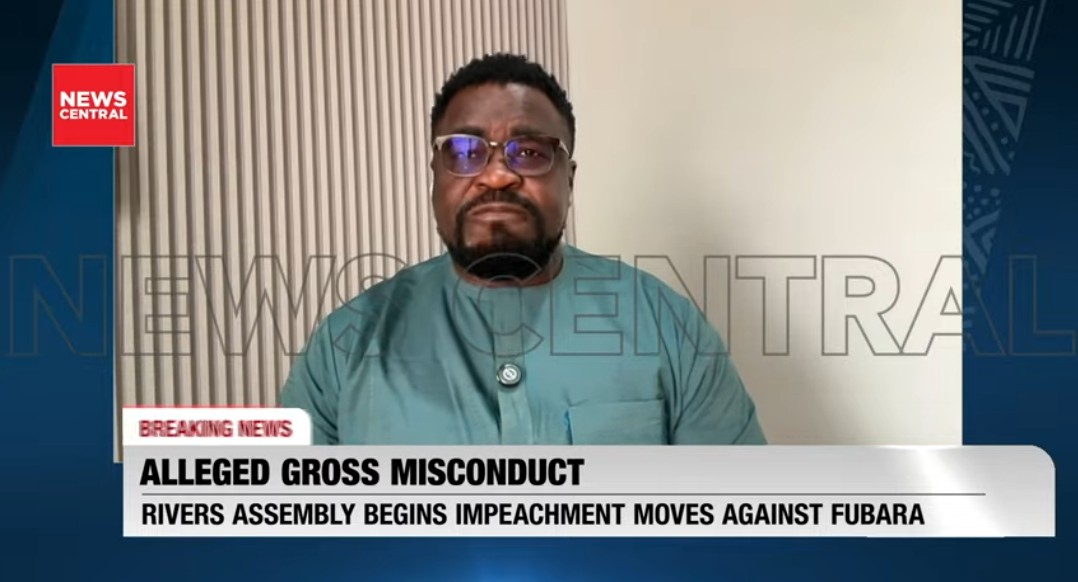
Constitutional lawyer, Liborous Oshoma, has revealed that the continued survival of Rivers State Governor, Sir Siminalayi Fubara, in office is largely tied to the principled and independent posture of the state’s Chief Judge, especially in the face of sustained political pressure.
Oshoma made the disclosure during an interview with News Central TV, shortly after the Rivers State House of Assembly commenced impeachment proceedings against Governor Fubara, a development that has further deepened the state’s lingering political crisis.
According to the constitutional lawyer, earlier efforts to remove the governor failed not necessarily because of political alliances, but due to the refusal of the Chief Judge to be drawn into partisan interests, particularly during the height of the standoff between Governor Fubara and his predecessor, Nyesom Wike, now the Minister of the Federal Capital Territory (FCT).
“The chief judge consistently had not been on the side of Wike and that’s what had sustained Fubara up to this time,” Oshoma stated during the programme.
He explained that under Nigeria’s constitutional framework, the Chief Judge occupies a central and decisive role in any impeachment process involving a sitting governor. Once impeachment proceedings are initiated by the legislature, the Chief Judge is constitutionally empowered to constitute a seven-member investigative panel to examine the allegations brought against the governor.
Oshoma noted that the integrity, neutrality, and composition of this panel are critical, as its findings often determine whether an impeachment process succeeds or collapses.
In Rivers State, he said, the Chief Judge’s refusal to compromise judicial independence or bow to political pressure had effectively stalled previous attempts to oust Governor Fubara.
The lawyer further suggested that this independence acted as a protective buffer for the governor during earlier political turbulence in the state, particularly at a time when the rift between Fubara and Wike was at its peak.
According to him, without the cooperation or alignment of the Chief Judge, impeachment efforts even when aggressively pursued cannot legally progress beyond a certain point.
As impeachment proceedings now move forward, Oshoma’s remarks have reignited public debate on the role of the judiciary in safeguarding constitutional democracy, as well as the delicate balance of power between the executive, legislature, and judiciary in Rivers State.
Observers say the unfolding events will once again test the resilience of democratic institutions in the state and determine whether the rule of law or political muscle will ultimately prevail.