
NEWS
“Trump’s Presidency, As We Know It, Ends In November” — California Governor, Gavin Newsom Declares, Predicts Democratic House Takeover

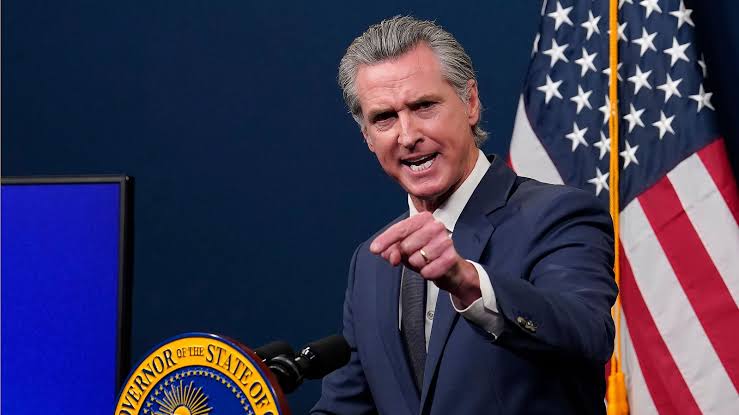
California Governor Gavin Newsom has predicted a major political shift in the United States after the November elections, declaring that Democrats will regain control of the House of Representatives and suggesting that President Donald Trump’s presidency could fundamentally change as a result.
Newsom made the prediction during an interview with AFP and two other media organisations following a United Nations climate summit in New York, where he discussed both the upcoming US elections and his broader political outlook.
“We’re going to take back the House of Representatives. It’s a day of reckoning, a new day coming,” Newsom said.
“Trump’s presidency, as we know it, ends in November,” added the 58-year-old California governor, who is widely regarded as one of the prominent Democratic figures who could potentially seek the party’s presidential nomination in 2028.
Although Newsom did not provide specific details about how a Democratic victory in the House would effectively bring an end to Trump’s presidency as it currently operates, a change in congressional control could significantly affect the administration’s ability to advance its legislative agenda.
If Republicans lose control of the House or Senate, Democrats would have greater capacity to challenge, investigate or block elements of the president’s programme through congressional powers.
However, the president would continue to retain substantial executive authority even if Democrats regain control of one or both chambers of Congress.
Newsom also used the interview to argue that climate change should be presented to voters not simply as an environmental or “green” issue, but as an economic and everyday-life issue affecting food prices, housing, insurance, energy, national security and household finances.
“People say ‘why the hell are you talking about that, you should be talking about the kitchen table,’ I said ‘I am!’”
The California governor pointed to the rising cost of commodities such as beef and coffee, as well as growing difficulties surrounding home insurance and mortgages in areas increasingly exposed to climate-related risks.
He referenced the growing threat posed by extreme wildfires and coastal erosion, arguing that climate policy has increasingly direct consequences for household expenses and economic security.
Newsom also defended California’s record as a leader in climate policy, arguing that environmental action can coexist with economic expansion.
He said politicians sometimes avoid discussing climate change because they struggle to connect the subject with issues that directly affect voters, adding that previous climate messaging had sometimes been portrayed as disconnected from everyday economic concerns.
He conceded that “some of our language did get a little apocalyptic.”
According to Newsom, the political message should instead focus on economic competitiveness, technological development and national power.
The key, he said, is demonstrating that “it’s not about electric power; it’s about economic power. It’s about statecraft.”
At the United Nations climate summit, Newsom presented California as an example of how climate policies can be combined with economic growth.
He pointed to California’s position as the world’s fourth-largest economy and said its gross domestic product has increased by about 40 percent since 2019.
Newsom also highlighted California’s clean-energy performance, saying the state had operated on 100 percent clean energy for at least part of the day on 90 percent of days during the year.
California’s climate policies have nevertheless remained a major source of conflict between Newsom’s administration and the Trump administration, particularly over federal efforts to roll back or challenge state environmental regulations.
Among the issues at stake are California’s planned phase-out of gasoline-powered vehicles and policies concerning offshore wind development.
“Donald Trump wants to recreate the 19th century. He’s doubling down on stupid. He’s putting America in reverse,“ Newsom said.
The California governor also turned his attention to the next presidential contest, expressing confidence in the Democratic Party’s prospects for 2028.
“Whoever the nominee is of the Democratic Party is going to be the next president of the United States,” he said.
Newsom also mentioned possible Republican contenders, including Secretary of State Marco Rubio and Vice President JD Vance, both of whom are widely discussed as potential Republican candidates despite neither having formally declared a presidential bid.
He argued that Democratic contenders would be “exponentially better than a Rubio or Vance that have countenanced this corruption, this grift, this graft, this destruction of truth and trust and institutions,” referring to Rubio and Vance.
The remarks come as potential Democratic contenders begin positioning themselves ahead of the 2028 presidential race, even though the election remains more than two years away.
Newsom was also asked about Congresswoman Alexandria Ocasio-Cortez, who has recently generated renewed speculation about a possible presidential bid.
Ocasio-Cortez made headlines after telling The New York Times that she was considering whether to run, while reflecting on the challenges women and other historically underrepresented groups have faced in presidential politics.
Newsom rejected the argument that a woman could not win the presidency, saying Ocasio-Cortez could potentially become the Democratic nominee.
“She absolutely could become the nominee of the party. That’s my assessment of electability. This notion that a woman can’t win is insulting,” Newsom said.
He attributed what he described as assumptions about candidates’ electoral limitations to political commentary and argued that factors such as gender, age, religion and state of origin should not automatically determine how candidates are viewed.
“I’m done with people talking like that. Or that if you’re from California or you’re Jewish or you’re old or you’re too young — give me a damn break. Our politics is completely scrambled post-Trump. The old rules, they do not apply.”
Newsom described Ocasio-Cortez as a “generational talent,” while stopping short of ruling out the possibility of competing against her if both eventually seek the Democratic nomination.
His comments contrasted with his recent position concerning Vice President Kamala Harris, the Democratic presidential nominee in 2024.
Newsom has previously said he would not challenge Harris, citing their longstanding relationship dating back to before either entered national politics.
“It’s a different framework. I don’t have a relationship that goes back to before we were both in politics. I don’t have a relationship in the context of our base overlaying in remarkable ways,“ he said.
Asked about his own ambitions, Newsom said any decision to seek the presidency would ultimately depend on whether he believed he could offer Democratic voters something distinctive.
He said the question would be whether he could “look them and you in the eye and say I have something unique they don’t… voice, experience, perspective, capacity that is unique and distinctive.”
Newsom’s comments add to growing speculation surrounding the Democratic Party’s future leadership as politicians, activists and potential presidential contenders begin positioning themselves for the political battles that will follow the 2026 midterm elections.