
NEWS
U.S. Apache Helicopter Goes Down Near Strait of Hormuz; Crew Rescued as Tensions Flare in Region

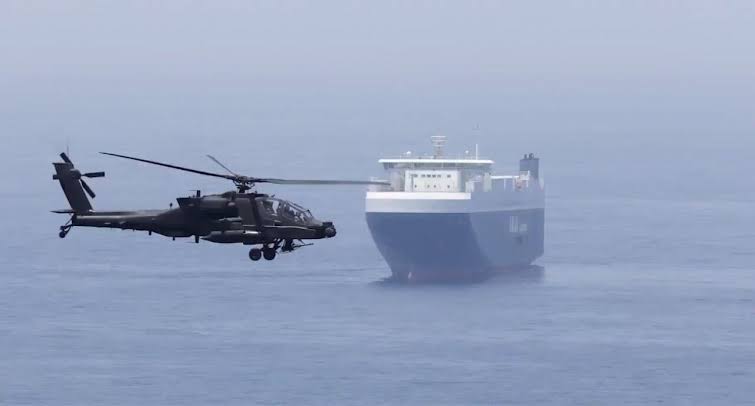
A U.S. Army Apache helicopter went down near the strategic Strait of Hormuz on Monday, with both crew members safely rescued, according to officials familiar with the incident.
The cause of the crash remains unclear. Investigators are still working to determine whether the aircraft was brought down by Iranian fire, suffered a mechanical failure, or encountered another technical issue. One source familiar with the situation said the incident is under active investigation as tensions in the region continue to simmer.
The development comes against the backdrop of rising and fluctuating hostilities in the Middle East, where Israel and Iran have recently exchanged strikes before easing off, underscoring the fragile and unpredictable nature of the current ceasefire dynamics.
Former U.S. President Donald Trump, speaking to reporters on Tuesday, confirmed that the two crew members were safe but declined to provide further details, saying an official report would be released later.
The U.S. Central Command has not yet commented on the incident.
The Apache crash occurs amid heightened U.S. military activity in and around the Strait of Hormuz, a critical global shipping route that has become a focal point of confrontation between U.S. and Iranian forces. The U.S. military has deployed a range of assets in the area, including Apache gunships, MQ-9 Reaper drones, and F/A-18 and F-35 fighter jets, as part of efforts to challenge what Washington describes as Iran’s interference with commercial navigation through the waterway.
The AH-64 Apache, armed with Hellfire missiles and widely regarded as one of the most lethal attack helicopters in service, has been used to patrol the strait, deter small-boat threats, and intercept hostile drones. In recent months, however, these aircraft have reportedly been operating closer to Iranian-controlled islands in both the Strait of Hormuz and the Persian Gulf, reflecting an increasingly assertive military posture.
The region has seen significant losses and confrontations since the escalation of conflict began in late February. Iran has reportedly downed around 30 U.S. MQ-9 Reaper drones, while several American fighter jets have been lost to a mix of hostile action and operational incidents. If confirmed, this would mark the first reported loss of an Apache helicopter in the ongoing tensions.
U.S. naval forces have also intensified operations in the region. In April, the U.S. imposed restrictions on vessels linked to Iranian ports and has since turned back more than 130 commercial ships. Additionally, seven vessels were reportedly disabled after ignoring warnings, including a Palau-flagged oil tanker intercepted in the Gulf of Oman.
Earlier in the year, two crew members of a downed F-15E Strike Eagle were rescued after ejecting and landing in hostile territory, highlighting the persistent risks faced by military personnel operating in the region.
As investigations continue into Monday’s Apache incident, the Strait of Hormuz remains a flashpoint in an already volatile geopolitical landscape, where military maneuvers and diplomatic tensions continue to collide.