
NEWS
BULGARIA IN TURMOIL AS PRIME MINISTER, ROSEN ZHELYAZKOV, RESIGNS AMID NATIONWIDE MASS PROTESTS, CORRUPTION OUTCRY, ECONOMIC ANGER, AND POLITICAL INSTABILITY AHEAD OF EUROZONE ENTRY


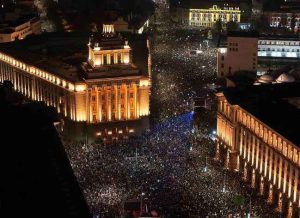 Bulgaria has been plunged into a fresh wave of political uncertainty as Prime Minister Rosen Zhelyazkov tendered his government’s resignation after less than a year in office, following weeks of nationwide protests condemning his administration’s economic policies and its perceived failure to tackle entrenched corruption.
Zhelyazkov announced his resignation live on national television on Thursday, moments before parliament was scheduled to vote on a no-confidence motion initiated by the opposition. His departure also comes as the country approaches its anticipated entry into the eurozone on 1 January, a development already generating public anxiety.
“Our coalition met, we discussed the current situation, the challenges we face and the decisions we must responsibly make.
“Our desire is to be at the level that society expects. Power stems from the voice of the people,” he said.
After meeting with leaders of the ruling parties, he added: “People of all ages, ethnic backgrounds and religions have spoken out in favour of [the government’s] resignation. This civic energy must be supported and encouraged.”
Zhelyazkov’s resignation follows massive demonstrations that have engulfed Bulgaria for weeks. Tens of thousands of citizens rallied in Sofia on Wednesday evening, while protests erupted simultaneously in dozens of towns and cities. Drone imagery estimated that more than 100,000 people joined the capital’s protest alone, an astonishing figure in a nation of under 7 million.
Protesters held up placards declaring “Resign” and “I’m fed up!” alongside caricatures of government officials. Their chants echoed the growing public anger over corruption, rising living costs, and perceived government incompetence.
Gergana Gelkova, a 24-year-old shop worker, told Agence France-Presse that corruption had become “intolerable.” University students from across Sofia joined the marches, further highlighting the depth and diversity of the discontent.
Public outrage initially erupted last week after the government’s budget plans proposed tax increases, higher social security contributions, and expanded state spending. Critics labelled the draft 2026 budget a covert attempt to mask rampant corruption. Although the government eventually withdrew the budget, protesters continued to push for the centre-right government to step down entirely.
Adding further pressure, Bulgaria’s Moscow-friendly president, Rumen Radev, publicly urged the government to resign.
On Facebook, he wrote: “Between the voice of the people and the fear of the mafia. Listen to the public squares!”
Radev will now consult parliamentary parties in an attempt to form a new government. If unsuccessful as analysts widely predict he will appoint an interim cabinet to steer the country toward yet another election, which would be Bulgaria’s eighth in four years.
The EU’s poorest member state has long struggled with political instability, worsened by fears of rising prices as it prepares to adopt the euro. The European Commission has repeatedly criticised Bulgaria’s governance, warning in a recent report that the country’s perceived judicial independence is “very low” and its anti-corruption strategy “limited.”
Dobromir Zhivkov, director of the Market Links sociological agency, observed that Bulgarian society had reached “broad unity against the model of governance,” adding that the collapse of trust in ministers and MPs reflected a “severe political and institutional crisis.”
Bulgaria remains near the bottom of Transparency International’s European Corruption Perception Index, haunted by years of corruption scandals and ineffective governments. Since widespread anti-graft protests in 2020 targeted Boyko Borissov, a three-time former prime minister, the nation has faced repeated elections and unstable coalitions.
Borissov’s GERB party, which won the most seats in last year’s election, formed the current coalition government in January with Zhelyazkov, a senior GERB figure, as prime minister.
Anger has also been directed at Delyan Peevski, a former media mogul and influential political figure whose DPS, New Beginning party is one of several factions propping up Zhelyazkov’s minority government.
Peevski, sanctioned by both the US and UK for alleged corruption, bribery, and embezzlement, is accused by protesters of shaping government policies to protect oligarchic interests. He has denied all allegations.
With Zhelyazkov’s resignation now official, Bulgaria enters yet another uncertain chapter. The likelihood of another national election looms large, and public frustration continues to mount as the country edges closer to its eurozone deadline. The nation remains deeply unsettled, divided by economic anxieties, united by a shared demand for accountability, and desperate for meaningful reform.