
NEWS
“Development Is All About Input and Output” — Gov. Alex Otti Says as He Hosts 2024 Nobel Laureate, Prof. James Robinson, Positions Abia as Hub for Global Development Research

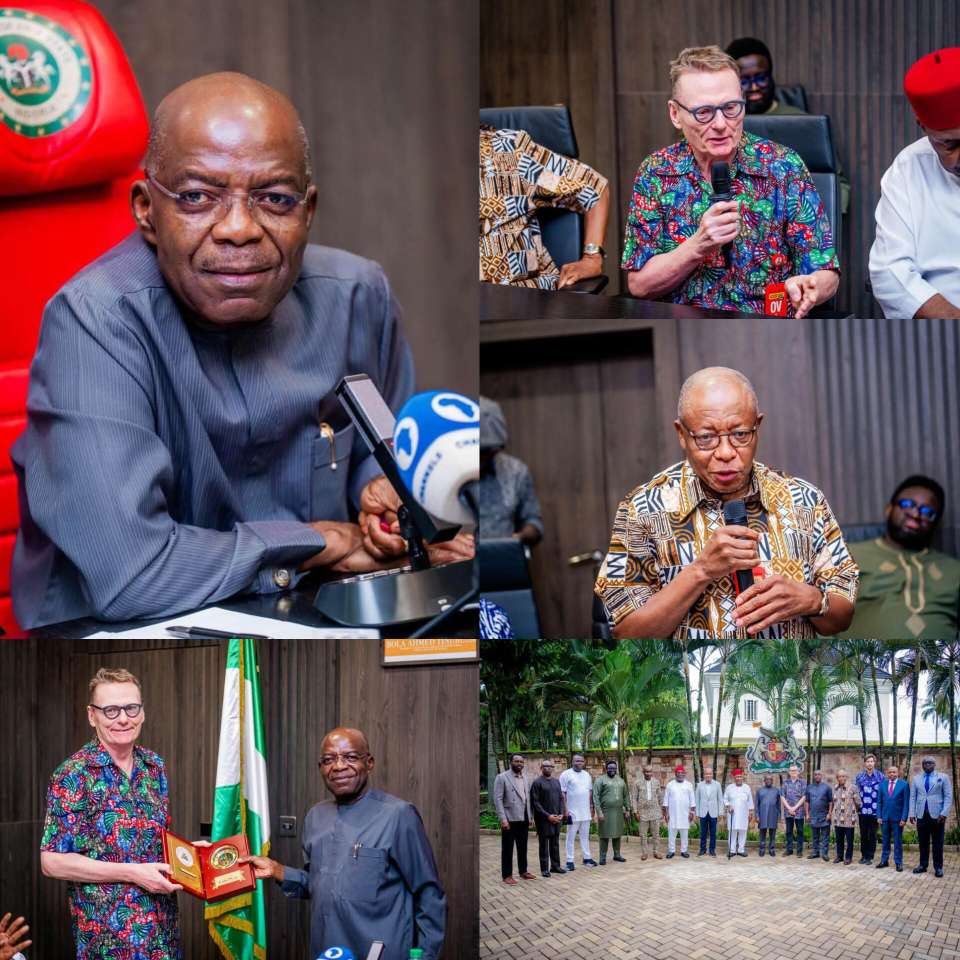
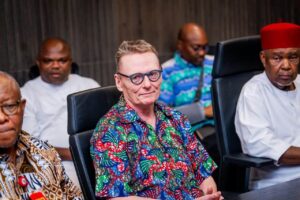
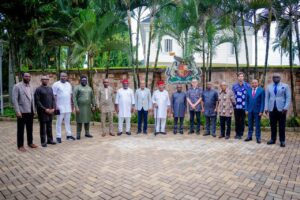
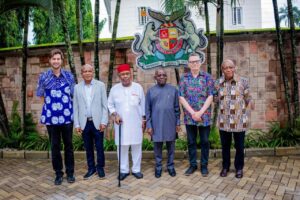
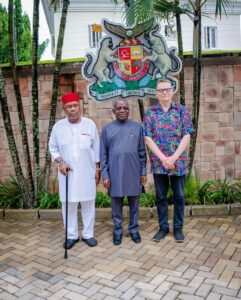
The Executive Governor of Abia State, Dr. Alex Chioma Otti, OFR, on Monday, July 27, 2026, welcomed the 2024 Nobel Laureate in Economics, Prof. James Alan Robinson, and a delegation of renowned professors from leading universities in the United States in what has been described as a landmark engagement aimed at strengthening research collaboration, policy innovation, and sustainable development in the State.
The high-powered academic delegation, led by Nigeria’s former Minister of Education and Health, Prof. Ihechukwu Madubuike, paid a courtesy visit to the Governor’s Office to explore opportunities for knowledge exchange and gain firsthand insight into the development reforms being implemented by the Otti administration.
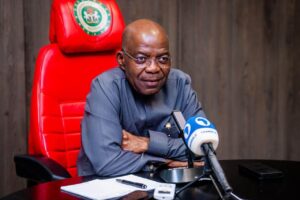
Receiving the visitors, Governor Otti warmly congratulated Prof. Robinson on his emergence as the 2024 Nobel Prize winner in Economics, describing the achievement as well-deserved and expressing delight at finally meeting the globally respected development economist after years of following his work and scholarly contributions.
The Governor noted that among all branches of economics, development economics remains the most critical because of its direct impact on improving the quality of life and addressing the everyday realities faced by citizens.
“Anyhow you look at it, development is all about input and output. A lot of times you do things that will lead to growth, but then, they don’t speak to development,“ the Governor stated.
Drawing from his background as a First-Class graduate of Economics from the University of Port Harcourt, Governor Otti emphasized that modern economic thinking has moved beyond the era where Gross Domestic Product (GDP) growth alone was regarded as a reliable measure of progress.
“You can have empty growth; that does not affect development. A clear example is when you have economic growth, GDP growth; maybe 3% or 5% GDP growth, that may look significant, but when you have population growth of 10%, then clearly that growth is actually a decline because you have more mouths to feed than the food that is available,” Governor Otti explained.
The Governor stressed that this philosophy forms the foundation of his administration’s governance model, noting that every policy and programme is carefully designed to produce measurable improvements in the lives of Abia people rather than simply creating impressive economic statistics.
According to him, the State Government consistently prioritizes initiatives capable of breaking the structural causes of poverty, unemployment, and low productivity, believing that genuine development can only be achieved by addressing the root causes of economic hardship.
“In taking decisions, we look at those desiderata that would impact development, not necessarily growth. Everything is interconnected. You end up looking at a poverty rate of some percentage.
“But there are some fundamental things that lead to that poverty.
“One of them may just be unemployment; the other may be poor productivity, which is exacerbated by poor input.
“And, at the end of the day, you find out that you would end up in a vicious cycle.
“And until you break that circle, everything will keep reinforcing each other.
“For us here, we start from that point: what is it that we need to do to break the cycle of poverty? And it may just be outside the circle. It may be an externality,” Governor Otti added.
Expanding on his administration’s economic strategy, Governor Otti explained that creating an enabling business environment alone is insufficient if citizens are not equipped with the skills, knowledge, and capacity needed to seize available opportunities.
He noted that infrastructure development, investment-friendly policies, and capital injections must be matched with human capital development to produce sustainable economic transformation.
“You see things that have been done to enable trade, enable commerce, enable productivity; nothing is happening.
“You may also inject funds or capital into the system; if there is no resource to take that, it’s a waste,” Governor Otti stated.
Reaffirming his administration’s commitment to evidence-based governance, Governor Otti expressed the readiness of the Abia State Government to partner with Prof. Robinson in research, policy formulation, institutional strengthening, and knowledge exchange whenever the Nobel Laureate’s schedule permits.
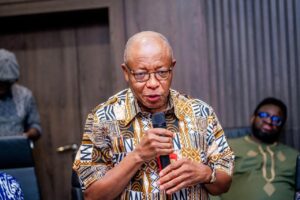
Earlier, Prof. James Alan Robinson, Professor at the University of Chicago and recipient of the 2024 Nobel Prize in Economics, said he was delighted to visit Abia State and looked forward to meaningful conversations on Nigeria’s development challenges, institutional reforms, Governor Otti’s governance approach, and the contributions the academic community could make toward advancing sustainable development.
Also speaking, Prof. Leander Heldring of Northwestern University observed that the prosperity of nations is largely determined by the quality of their institutions and the choices made by their people. He commended the remarkable development strides recorded in Abia and expressed admiration for the far-reaching reforms being implemented under Governor Otti’s leadership.
Adding his voice, Prof. Chima Korie of Marquette University, USA, who recently reviewed the book Nigeria, a Crumbling State authored by Prof. Ihechukwu Madubuike, remarked that the narrative of the book would become unnecessary if every Nigerian state embraced the style of governance being witnessed in Abia.
“Many of us, including those living in the Diaspora, are really proud of you and what is happening in Abia State.
“We are really hoping that other States, including those around the eastern region, will learn from what is happening in Abia,” Prof. Korie stated.
Leading the delegation, Prof. Ihechukwu Madubuike explained that the visit was conceived as a platform for intellectual engagement that would deepen Abia’s development model through collaborative research, policy advisory services, leadership development, capacity building, and stronger partnerships with the global academic and policy community.
He described Abia State under Governor Otti as a model of prudent economic management, noting that the administration’s emphasis on fiscal discipline, transparency, productivity, accountability, and value for money closely reflects the development principles championed by Prof. Robinson throughout his distinguished academic career.
Also speaking, the President of the Abia State Leadership Academy (ASLA) and former Secretary to the State Government, Prof. Kenneth Kalu, disclosed that Prof. Robinson’s writings have profoundly shaped his academic journey since 2001.
He further highlighted the establishment of the Abia State Leadership Academy through an Executive Order signed by Governor Otti, explaining that the institution is committed to nurturing ethical, empathetic, institution-driven leaders with a strong sense of civic responsibility and the capacity to provide transformational leadership for Abia State, Nigeria, and beyond.
The meeting was attended by the Chief of Staff to the Governor, Pastor Caleb Ajagba, Ph.D, the Attorney General and Commissioner for Justice, Hon. Ikechukwu Uwana (SAN), the Commissioner for Information, Prince Okey Kanu, the Special Adviser to the Governor on Media and Publicity, Hon. Ferdinand Ekeoma, the Special Assistant to the Governor on Public Communication, Hon. Dodoh Okafor, al

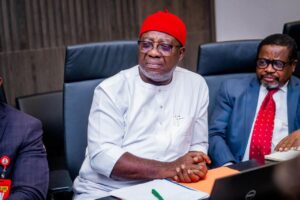
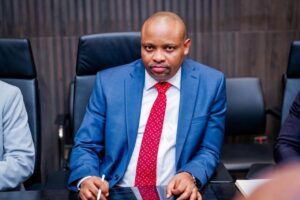

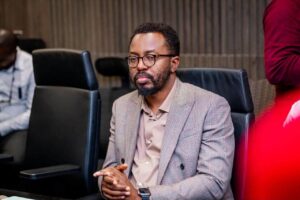
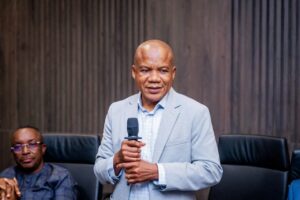
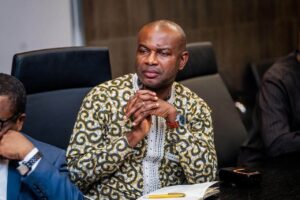

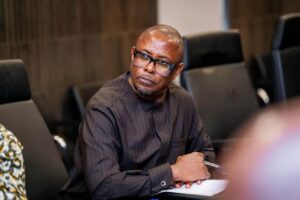

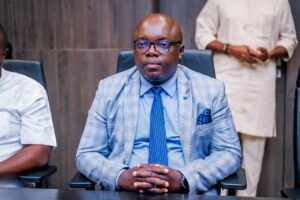
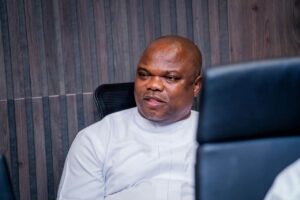

 ongside other members of the Abia State Executive Council.