
NEWS
Dangote, Ramaphosa Debate Why Africa Still Struggles to Fund Power Projects Despite Available Money

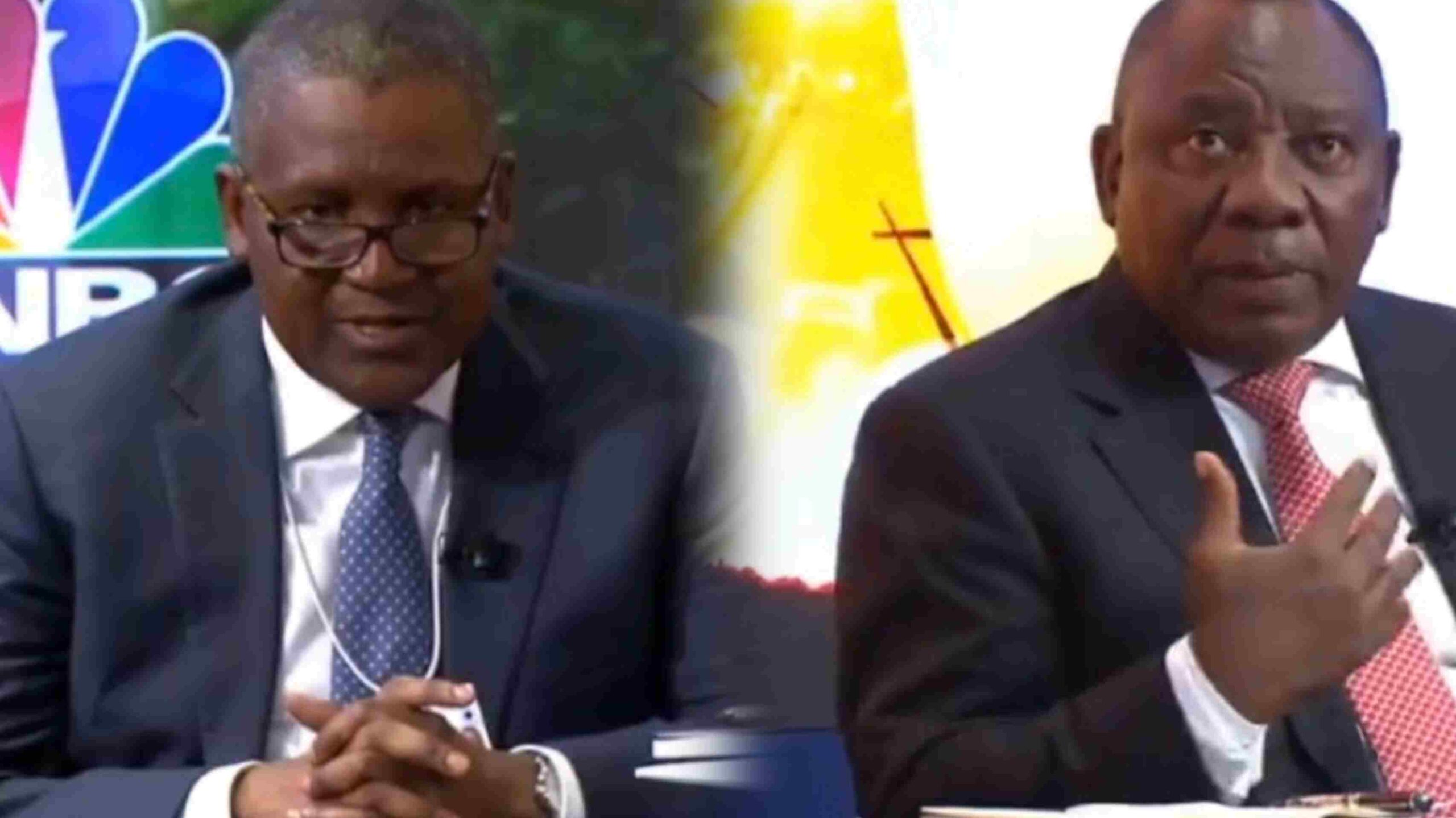
A revealing debate has emerged between Africa’s richest man, Aliko Dangote, and South African President Cyril Ramaphosa over one of the continent’s most pressing development challenges: why Africa continues to struggle to finance major power projects despite the availability of money in local markets.
The conversation, which took place during a panel session focused on infrastructure financing and renewable energy development, brought to the fore the difficult realities facing investors, governments and businesses seeking to expand electricity generation across Africa.
While both leaders agreed that Africa has access to investment opportunities and capital, they differed on the extent to which local financing can realistically solve the continent’s enormous energy deficit.
President Ramaphosa maintained that money exists within African markets, but stressed that the real challenge is ensuring that power projects are properly designed and structured to convince banks and investors to commit their funds.
“Our experience has been that the money is there in the local market. And in fact, our complaint with the renewable power production is that quite a big chunk of that money has come from the local market rather than as a direct investment from outside,” Ramaphosa said.
He argued that investors and financial institutions are more likely to support projects that are commercially viable, well-organised and capable of delivering sustainable returns.
“It really revolves around the bankability of the project. The project is innovatively well-structured, and it’s bankable. Banks in the local market can fund it. There is always money there,” he said.
However, Dangote pushed back on the argument that the availability of money automatically translates into accessible financing for major infrastructure projects.
According to the Nigerian industrialist, local banks may have funds, but the high cost of borrowing remains a major obstacle for businesses and investors, particularly those seeking to finance capital-intensive projects such as power generation.
“Yes, there is money in the local banks. But if you really look at it, the interest rates are high,” Dangote said.
He also drew attention to another major risk confronting African investors the danger of borrowing in foreign currencies while generating revenue in unstable local currencies.
“Also, if you go and borrow money out there, you know, really, in Africa, in some countries, we don’t have a stable currency. It is very dangerous for you to go and borrow money in dollars while your own generating machine is in Kwacha.”
The issue of foreign exchange risk remains a major concern for infrastructure investors across Africa. A project financed with dollar-denominated loans could face enormous financial pressure if the local currency weakens significantly, making repayment far more expensive.
Dangote argued that investors should, where possible, begin with local currencies to reduce their exposure to volatile exchange rates.
“What they need to do is to make sure that they make the foreign exchange available. But it is much better if I’m going to invest in Nigeria, I would like to put my Naira first and then buy dollars so that I have to risk that currency exchange rate,” he said.
Beyond the debate over interest rates, bankability and currency stability, both leaders agreed that solving Africa’s electricity crisis could unlock enormous economic opportunities.
Dangote stressed that improved power generation would not only support industries but would also create employment, strengthen businesses and increase government revenue.
“Wherever you go and double your power, even your internally generated funds, that’s government revenue, will increase, because you will now put a lot of people at work,” he added.
The exchange between Dangote and Ramaphosa underscores a broader problem confronting the continent. Africa has huge energy needs, growing populations and enormous opportunities for investment in conventional and renewable power, yet many projects continue to struggle to reach financial close.
High interest rates, unstable currencies, foreign exchange shortages and concerns over project viability have continued to discourage investment and make large-scale energy development more difficult.
With millions of Africans still living without reliable electricity, the debate highlights the urgent need for governments, banks and private investors to develop financing models capable of reducing risk and making power projects more attractive.
For Africa, the solution may not simply be about finding more money. As Dangote and Ramaphosa’s debate showed, the bigger challenge is creating the right conditions to make available capital affordable, stable and accessible enough to
 power the continent’s economic future.