
NEWS
Dangote Unveils $10bn Power Investment Plan, Says Africa Must End Dependence on Imports

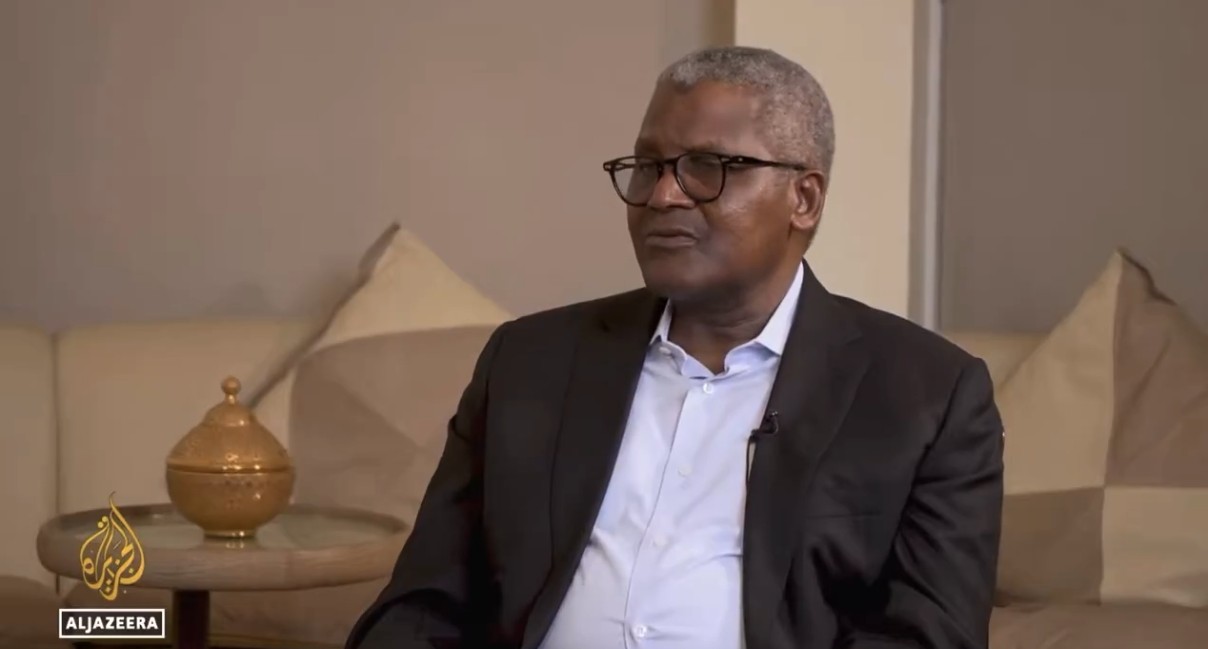
Africa’s richest man and President of the Dangote Group, Aliko Dangote, has announced plans by his conglomerate to invest more than $10 billion in the power sector over the next few years, describing electricity as a critical foundation for industrialisation, job creation and sustainable economic growth across Africa.
Dangote made the disclosure during an interview with Al Jazeera, where he identified unreliable electricity supply and inconsistent government policies as some of the major obstacles discouraging investment and slowing industrial development across the continent.
According to the industrialist, the Dangote Group is considering redirecting capital from some of its planned or existing business ventures, including steel, into electricity generation and other power-related investments.
He said the company believes that addressing Africa’s electricity deficit could trigger a major transformation in the continent’s economic fortunes within the next three to four years.
“And I’m telling you in the next three to four years, there will be a major transformation in Africa, and that’s why we’re looking at power. We are going to invest in power. There are one or two businesses that we might cancel, like steel, and we will put the money in power. We want to invest over $10bn alone in power.”
Dangote’s proposed investment comes against the backdrop of Africa’s long-standing electricity deficit, with hundreds of millions of people still lacking reliable access to power.
He expressed concern over the scale of the challenge, stressing that the continent could not achieve meaningful economic transformation while such a large proportion of its population remained without electricity.
“We Africans should not really allow over 600 million of our people to remain in darkness.”
The billionaire industrialist argued that electricity supply was directly connected to economic growth, industrial productivity and the ability of governments to deliver tangible improvements in the lives of citizens.
According to him, politicians who successfully address electricity challenges could potentially make a lasting impact without relying heavily on campaign promises during subsequent elections.
“You know, if some politicians work hard and have a plan, when you deliver power, you don’t need to go for a campaign when you’re going for an election.
“Power is key; we will never create growth without power. That’s why they say power is growth. When I say power, I mean electricity is growth.”
Dangote also linked Africa’s unemployment crisis to the continent’s limited industrial capacity, arguing that the creation of sustainable jobs would remain difficult without increased investment in manufacturing and other productive sectors.
He maintained that Africa must move away from an economic model heavily dependent on imported goods and instead develop the capacity to produce more of what its population consumes.
Addressing concerns over why some investors remain reluctant to commit capital to African economies, Dangote pointed to policy uncertainty and inadequate electricity supply as persistent problems.
“The problem really is, it takes two to tango. I think in the past, there’s been a lot of flip-flops in government policies. Government policies were changing every day, and then, the lack of electricity is also there.
“So, these two issues haven’t gone away. They are still there. But for some of us that really mean business, we are here, and we know that yes, without our intervention, Africa will never be able to create jobs. If there’s no industrialisation, how do you create jobs? You can’t,” he said.
Dangote warned that Africa’s continued dependence on imports could become increasingly difficult to sustain if the continent eventually lacks sufficient foreign exchange and financial resources to pay for the goods it imports.
He said the long-term solution was to develop local industries, increase domestic production and encourage Africans to invest in African economies.
“One day we will not have money to import what we are consuming.
“So how can we remain an import continent? It has to change.
“But that change can only happen when Africans believe in Africa, and they invest in Africa,” he stated.
The businessman also said there was growing interest among investors in African businesses because of the opportunities presented by the continent’s large population, natural resources and emerging markets.
He explained that his own approach to investment was not simply about expanding individual businesses but also about broadening participation, improving corporate governance and ensuring that wealth creation reached more people.
“We want to make sure it’s about spreading the wealth. It’s about getting more people in the business. It’s also about corporate governance. So that’s the direction.”
Dangote also addressed criticism that the rapid expansion of his business interests across several sectors was contributing to monopolistic conditions.
Rather than allowing such criticism to distract him, he said he remained focused on the objectives of his investments, using football superstar Lionel Messi as an analogy to explain his approach.
“Well, you know, if I’m going to listen to that, have you ever seen a footballer looking at the audience? He has to continue looking at the ball. If I’m Messi, for example, I’m kicking the ball, and I’m looking at the audience, do you think I won’t miss the ball? I will miss the ball,” he stated.
Dangote argued that businesses would inevitably attract criticism, particularly when they become prominent in important sectors of the economy.
However, he maintained that accusations of monopoly would not prevent him from pursuing investments he believes are necessary for Africa’s development.
“If I’m going to make my continent great and people want to call me a monopoly for no reason, so be it. I mean, it’s not going to reduce the colour of my face or whatever. You can call me whatever you want to call me; I didn’t stop anybody; it is an opportunity given to everybody, every one of us has that opportunity whether Africans, foreigners or whoever,” he stressed.
He further rejected the suggestion that his companies had received exclusive government privileges that prevented competitors from entering the sectors in which the Dangote Group operates.
According to him, governments establish policies for particular sectors and provide frameworks within which businesses can participate, rather than granting his companies exclusive ownership of those industries.
“There’s nothing that the government gave us and say, ‘this is only for Dangote ’. The government will create a policy around a sector, and they will blow a whistle and say, ‘ Yes, this is it,” he noted.
Using the example of a 100-metre race, Dangote said investors who choose not to participate should not blame those who enter the market, compete and emerge successful.
“If there’s a 100-metre race, some people were on the bench while I’m on the track, and I agreed to run that race, and I won that race alone, are you going to blame me or are you going to blame people who just sat on the bench?” he asked.
He maintained that Africans who want to benefit from the continent’s enormous economic potential must be prepared to commit capital, take risks and participate actively in developing local industries.
“They’re not ready, they’re not prepared, they don’t even believe in Africa itself. If you don’t invest, you are not going to get fruit of that labour,” he replied to those accusing him of monopoly.
Dangote also acknowledged that criticism and opposition would remain part of the business environment, but insisted that the Dangote Group would continue pursuing its long-term objectives despite the distractions.
He described Africa’s industrialisation as a responsibility requiring persistence and sacrifice, stressing that he was prepared to continue investing in the continent despite the challenges associated with doing business at such a scale.
“The distraction will continue. But we have what you call a very thick skin. No matter what you do, even if you take bullets, you are hitting our body with it; we’re not going to stop. We have a target, and we’re getting to our target.
“And if we don’t do it, believe me honestly, Africa will be in trouble. And I would rather save my continent at the expense of even my life. This continent must get to the promised land,” he declared.
Beyond electricity and industrialisation, Dangote called for greater processing of Africa’s raw materials within the continent before they are exported to international markets.
He argued that keeping more of the processing chain in Africa would allow countries to capture greater economic value from their natural resources, create jobs, develop industries and reduce dependence on the export of raw materials.
According to him, once the economic benefits of local processing become clearer, African governments could introduce stronger measures to encourage industries to process resources domestically rather than exporting them in raw form.
“Eventually they (foreigners) will stop taking our raw materials. They must produce on our own continent.
“You see, once we show people how to do all these, even the governments themselves will start saying, no, you can’t take our cocoa, process it here and add value, then you take it out,” he stated.
Dangote’s comments place electricity supply, industrialisation, local manufacturing and investment at the centre of his broader argument for Africa’s economic transformation.
His proposed more-than-$10 billion power investment would represent a major expansion of the Dangote Group’s activities in the electricity sector, while his wider message was that Africa’s economic future depends on the continent’s ability to attract investment, strengthen infrastructure, process its own resources and build industries capable of producing goods for its rapidly growing population.