
NEWS
EFCC Sacks Over 40 Personnel for Corruption, Prosecutes More Than Five, Says Chairman, Ola Olukoyede

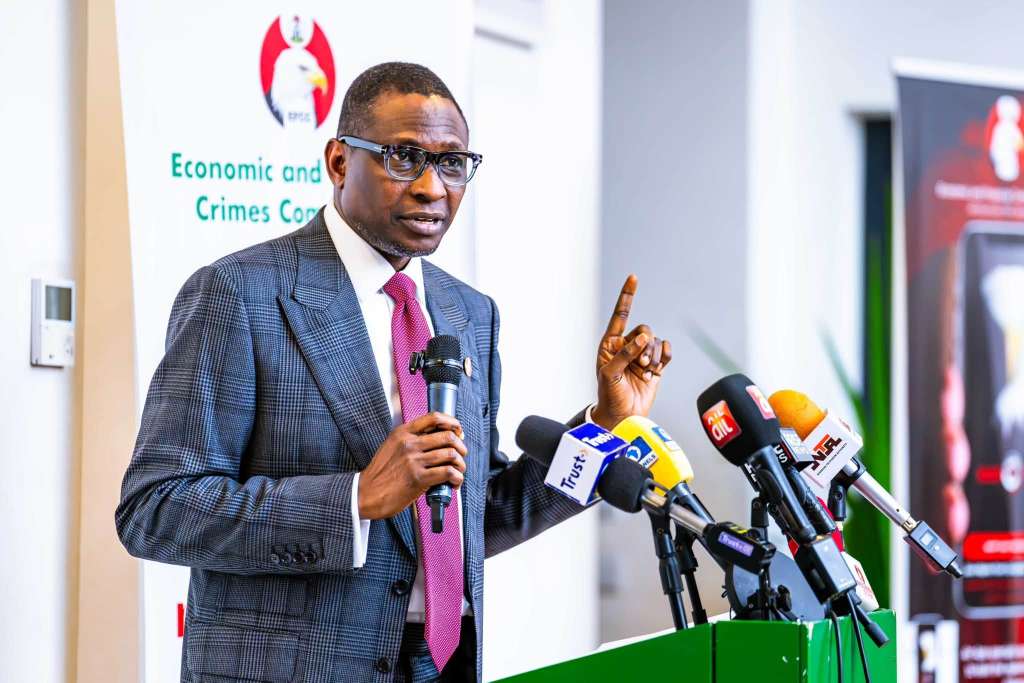
The Economic and Financial Crimes Commission (EFCC) has dismissed more than 40 of its personnel over alleged corruption and financial malpractice in the past two and a half years, as the anti-graft agency intensifies efforts to clean up its ranks and enforce strict standards of integrity.
EFCC Chairman, Ola Olukoyede, disclosed this on Monday in Abuja during an engagement with media executives and journalists, where he outlined measures being implemented to strengthen accountability within the commission.
Olukoyede said the affected personnel were removed from the agency after being found involved in conduct capable of undermining public confidence in the EFCC and damaging its reputation as Nigeria’s foremost anti-corruption institution.
He further revealed that more than five of the dismissed officials are currently facing prosecution, while case files involving other personnel are being prepared for possible prosecution.
“In the past two and a half years or three years of my service, I have asked them to dismiss over 40 staff on account of corruption and financial malpractice.
“More than five of them are being prosecuted at the moment. You can follow those cases in court; they are public knowledge,” the anti-graft agency boss told journalists.
The EFCC chairman explained that the disciplinary measures were part of a broader strategy to ensure that officers entrusted with investigating and prosecuting financial crimes operate above reproach.
According to him, the commission cannot credibly confront corruption in the wider society if its own personnel are found engaging in similar practices.
EFCC Tightens Rules on Gifts, Assets:-
Olukoyede also disclosed that the commission had introduced additional safeguards to promote transparency and accountability among its officers.
Among the measures is a new gift policy aimed at regulating the acceptance, declaration and valuation of gifts received by EFCC personnel. He said officers would be required to declare gifts above a specified value, including gifts received from relatives living abroad.
The commission, he explained, would establish categories and monetary thresholds for gifts that personnel could legitimately accept, with the broader objective of ensuring that officers are able to explain their sources of income and maintain lifestyles consistent with their legitimate earnings.
The EFCC boss stressed that personnel involved in the fight against corruption must themselves demonstrate a high level of personal integrity.
Internal Affairs Department Renamed:-
As part of the institutional reforms, Olukoyede said the EFCC had also renamed its former Department of Internal Affairs as the Department of Ethics and Integrity.
The new designation, he explained, reflects the commission’s renewed emphasis on ethical conduct, internal accountability and professional standards among its personnel. The move is expected to strengthen mechanisms for monitoring officers and addressing misconduct within the agency.
EFCC Reports ₦288.1bn in Tax Recoveries:-
Beyond its traditional anti-corruption enforcement responsibilities, Olukoyede said the EFCC’s activities had also contributed substantially to government revenue mobilisation. He disclosed that approximately ₦288.1 billion had been recovered through federal and state tax enforcement during the period under review. The figure comprises approximately ₦173.2 billion in federal tax recoveries and ₦114.9 billion attributed to state internal revenue services.
“This is fiscal value recovered through enforcement of existing obligations, not through the imposition of new taxes,” he said.
The chairman further disclosed that approximately ₦257.2 billion in naira recoveries had been recorded for federal ministries, departments and agencies.
EFCC Recovers ₦1.23tn, $684.48m in Three Years:-
Olukoyede provided a broader breakdown of the commission’s recovery activities, revealing that the EFCC recovered ₦1.23 trillion, $684.48 million, £373,905.78 and €9.34 million between October 1, 2023, and June 30, 2026.
According to him, approximately ₦397.26 billion, representing 33 per cent of the total naira recoveries, constituted direct recoveries for the Federal Government.
The remaining ₦836.34 billion, representing 67 per cent, comprised indirect recoveries made on behalf of ministries, departments and agencies, state revenue services, companies, individuals and foreign victims.
The figures highlight the scale of the commission’s financial enforcement activities during the period, with recoveries extending beyond direct government funds to obligations involving private entities, individuals and international victims.
₦661.32bn, $492.37m Released to Beneficiaries:-
Olukoyede also gave an account of the utilisation of recovered funds, stating that ₦661.32 billion and $492.37 million had been released to beneficiaries during the period.
He explained that the naira disbursements included approximately ₦325.35 billion paid directly to individuals and corporate organisations. Another ₦335.97 billion was released to various ministries, departments and agencies, the Nigerian Revenue Service and state internal revenue services, among other beneficiaries.
The EFCC chairman’s disclosures underscore the commission’s dual focus on recovering illicit funds and strengthening internal discipline, as the agency seeks to maintain public confidence in its mandate while ensuring that its own personnel remain subject to the same standards of accountability it demands from those under investigation.