
DEVELOPMENT
Nigeria Ranks Among World’s Top Four Countries With Largest Homeless Population as Global Housing Crisis Deepens

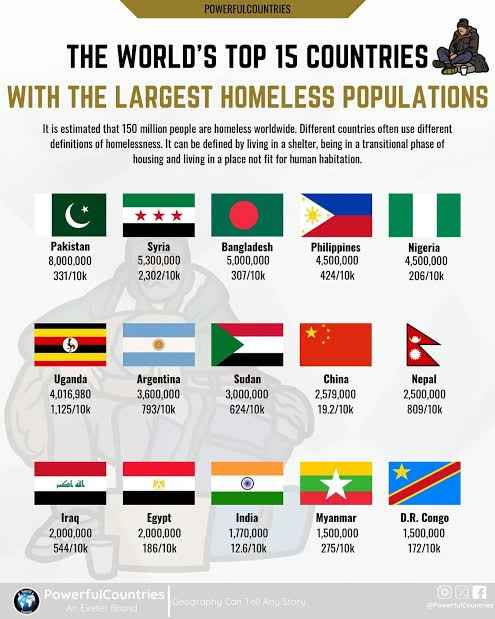
Nigeria has emerged as one of the countries with the highest number of homeless people in the world, ranking fourth globally with an estimated 4.5 million citizens lacking stable shelter. This alarming figure places Africa’s most populous nation alongside some of the world’s most vulnerable and conflict-affected countries, underscoring the scale of Nigeria’s housing and social welfare challenges.
According to compiled data from multiple international sources, including global homelessness databases and population reviews, Pakistan tops the list with about 8 million homeless people, followed by Bangladesh with 5 million and Afghanistan with approximately 4.66 million. Nigeria and the Philippines are tied in fourth place, each recording an estimated 4.5 million homeless persons.
Nigeria’s position on this list highlights the growing strain caused by rapid urbanisation, population growth, economic hardship, insecurity, climate-related displacement, and inadequate access to affordable housing. Major cities such as Lagos, Abuja, Port Harcourt, Onitsha, Aba, and Ibadan continue to attract millions in search of better livelihoods, but limited housing infrastructure has left many residents in informal settlements, on the streets, or in overcrowded and unsafe living conditions.
Analysts note that homelessness in Nigeria goes beyond people sleeping rough. It includes internally displaced persons affected by insurgency and banditry in the North-East and North-West, flood victims, urban poor communities living without secure tenure, and families forced into temporary shelters due to poverty or eviction. Seasonal flooding, which has intensified in recent years, has further worsened the crisis by displacing thousands annually.
Within Africa, Nigeria is not alone. Somalia, Sudan, South Sudan, the Democratic Republic of Congo, Egypt, Ethiopia, and Uganda also feature prominently on the global list, reflecting the continent’s ongoing struggles with conflict, poverty, and weak housing systems. However, Nigeria’s ranking stands out due to its economic size and regional influence, raising concerns about policy effectiveness and long-term urban planning.
Globally, the data shows that homelessness is not limited to developing countries. Nations such as the United States, United Kingdom, France, Germany, Canada, and Australia also record significant homeless populations, although their figures are lower compared to heavily populated and crisis-prone countries. The United States ranks 23rd with over 650,000 homeless people, while the United Kingdom stands at 27th with about 380,000.
Experts caution that the figures represent the most recent available data for each country, drawn from different years, meaning actual numbers may be higher today. They also stress that the list is not exhaustive, as many countries lack reliable or up-to-date homelessness statistics.
For Nigeria, the ranking has renewed calls for urgent action, including large-scale investment in affordable housing, strengthened social protection programmes, better urban planning, and coordinated responses to displacement caused by insecurity and climate change. Civil society groups argue that without decisive intervention, homelessness will continue to grow alongside Nigeria’s population, deepening inequality and social instability.
As global attention increasingly turns to housing as a fundamental human right, Nigeria’s position among the world’s worst-affected countries serves as a stark reminder that economic growth must be matched with inclusive policies that ensure safe and dignified shelter for all.
LIST:
1. 🇵🇰 Pakistan – 8,000,000
2. 🇧🇩 Bangladesh – 5,000,000
3. 🇦🇫 Afghanistan – 4,660,000
4. 🇳🇬 Nigeria – 4,500,000
5. 🇵🇭 Philippines – 4,500,000
6. 🇾🇪 Yemen – 3,858,000
7. 🇸🇴 Somalia – 2,968,000
8. 🇸🇩 Sudan – 2,730,000
9. 🇨🇳 China – 2,579,000
10. 🇪🇬 Egypt – 2,000,000
11. 🇮🇳 India – 1,770,000
12. 🇸🇸 South Sudan – 1,542,000
13. 🇨🇩 DR Congo – 1,500,000
14. 🇮🇶 Iraq – 1,224,000
15. 🇿🇼 Zimbabwe – 1,200,000
16. 🇨🇲 Cameroon – 1,033,000
17. 🇲🇿 Mozambique – 769,000
18. 🇦🇿 Azerbaijan – 735,000
19. 🇺🇦 Ukraine – 734,240
20. 🇵🇪 Peru – 700,000
21. 🇧🇫 Burkina Faso – 700,000
22. 🇨🇫 Central African Republic – 686,200
23. 🇺🇸 United States – 653,104
24. 🇪🇹 Ethiopia – 600,000
25. 🇺🇬 Uganda – 500,000
26. 🇬🇹 Guatemala – 475,000
27. 🇬🇧 United Kingdom – 380,000
28. 🇹🇩 Chad – 342,680
29. 🇲🇱 Mali – 332,700
30. 🇫🇷 France – 330,000
31. 🇬🇪 Georgia – 304,010
32. 🇧🇷 Brazil – 281,000
33. 🇱🇾 Libya – 278,000
34. 🇩🇪 Germany – 262,600
35. 🇨🇦 Canada – 235,000
36. 🇿🇦 South Africa – 200,000
37. 🇻🇳 Vietnam – 162,000
38. 🇭🇳 Honduras – 150,000
39. 🇦🇺 Australia – 122,494
40. 🇮🇩 Indonesia – 122,000
41. 🇳🇿 New Zealand – 102,123
42. 🇬🇭 Ghana – 100,000
43. 🇮🇹 Italy – 96,197
44. 🇹🇷 Turkey – 70,000
45. 🇲🇽 Mexico – 40,911
46. 🇸🇾 Syria – 40,500
47. 🇬🇷 Greece – 40,000
48. 🇭🇹 Haiti – 37,867
49. 🇸🇪 Sweden – 33,269
50. 🇳🇱 Netherlands – 32,000
51. 🇦🇱 Albania – 32,000
52. 🇵🇱 Poland – 30,330
53. 🇭🇺 Hungary – 30,000
54. 🇪🇸 Spain – 28,552
55. 🇨🇿 Czech Republic – 23,830
56. 🇦🇹 Austria – 22,580
57. 🇰🇪 Kenya – 20,095
58. 🇷🇸 Serbia – 20,000
59. 🇮🇷 Iran – 15,000
60. 🇹🇬 Togo – 15,000
61. 🇨🇱 Chile – 14,013
62. 🇧🇪 Belgium – 13,524
63. 🇨🇴 Colombia – 13,252
64. 🇮🇪 Ireland – 11,632
65. 🇰🇷 South Korea – 11,340
66. 🇷🇺 Russia – 11,285
67. 🇸🇰 Slovakia – 10,661