
NEWS
Nigeria, U.S Sign Landmark Mineral Investment Pact as Alake Says Country Will Not Remain Raw Material Supplier

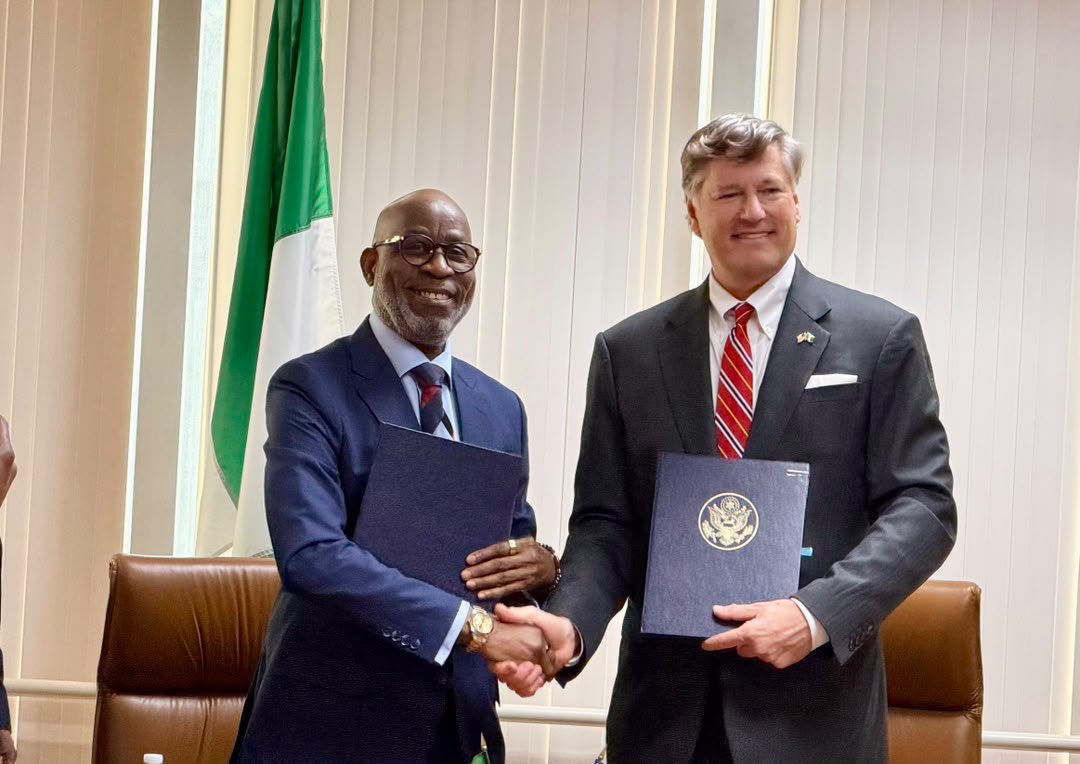
Nigeria and the United States have entered a new phase of cooperation in the solid minerals sector with the signing of a framework agreement designed to deepen investment, strengthen critical mineral supply chains and promote greater value addition within Nigeria.
The agreement was signed on the sidelines of the 81st United Nations General Assembly in New York by Nigeria’s Minister of Solid Minerals Development, Dele Alake, and the United States Deputy Secretary of State, Christopher Landau, at the Nigerian Mission House.
The pact provides a framework for collaboration in key areas of the mining value chain, including geological data and exploration, mineral development and processing, infrastructure development and technical capacity building. Nigerian officials have described the framework as an avenue to attract increased American investment into the country’s mineral sector and translate Nigeria’s substantial mineral resources into broader economic opportunities.
Speaking at the signing ceremony, Alake described the agreement as a future-driven framework capable of establishing deeper and more structured cooperation between both countries in the development of critical minerals.
The Minister said the framework reflects a shared understanding that critical mineral supply chains must be secure, resilient and supported by responsible investment. He stressed that Nigeria’s objective goes beyond extracting minerals and exporting them in their raw form, insisting that the country must build greater value around its resources domestically.
“But let me be clear about Nigeria’s ambition. We are not here to remain a source of raw material for the value that others create.
“Our goal is to turn potential into lasting value at home through stronger local processing, new skills, quality jobs, and new opportunities for Nigerian businesses.”
The position places local processing, skills development and job creation at the centre of Nigeria’s approach to the emerging partnership.
The Federal Government has increasingly emphasised the need to move from raw mineral exports towards processing and industrial activities that can retain more economic value within the country.
Alake further said implementation of the framework would support the economic diversification objectives of President Bola Ahmed Tinubu’s Renewed Hope Agenda while strengthening Nigeria’s industrial base.
He also stressed that the signing ceremony should be regarded as the beginning of a broader implementation process, with attention expected to shift towards identifying commercially viable projects, mobilising investment and developing partnerships capable of producing measurable economic benefits.
The agreement comes at a time when Nigeria is seeking to position its mineral resources as an important component of its wider economic diversification strategy. The Federal Government estimates the country’s mineral resources at about $700 billion, creating significant interest in developing the sector through investment, exploration, processing and infrastructure.
Landau, while speaking at the ceremony, expressed strong agreement with Nigeria’s position and described the country as an important regional power deserving of a stronger partnership with the United States.
He said the agreement would create opportunities capable of contributing to prosperity in both countries, while reaffirming Washington’s interest in supporting Nigeria’s economic growth.
“The signal we are sending is that the United States and Nigeria are partners.
“Under President Trump and President Tinubu’s leadership, the United States and Nigeria have done many things together in the last one and a half years that we’ve never done before. I think we would like to keep building on that momentum,” he said.
The development further expands the economic dimension of Nigeria-US relations, with critical minerals emerging as an increasingly important area of international investment and strategic cooperation.
For Nigeria, the focus will be on translating the framework into actual investments, processing capacity, technical expertise, infrastructure and opportunities for local businesses.
For the United States, the partnership provides a platform for deeper engagement with one of Africa’s major economies in an area that has growing importance to global supply chains.
The signing also fits into Nigeria’s broader push at the 81st UN General Assembly to attract international partnerships and investment while advancing the country’s economic and development priorities.
With the agreement now signed, attention is expected to turn to implementation and the extent to which the proposed cooperation can translate Nigeria’s mineral potential into domestic industrial capacity, skilled employment and sustainable economic value.