
NEWS
“Once People Test Good Governance, It Becomes Difficult to Take Them Back” — Gov. Alex Otti Says, Reaffirms Merit, Ethics and Capacity as Cornerstones of New Abia

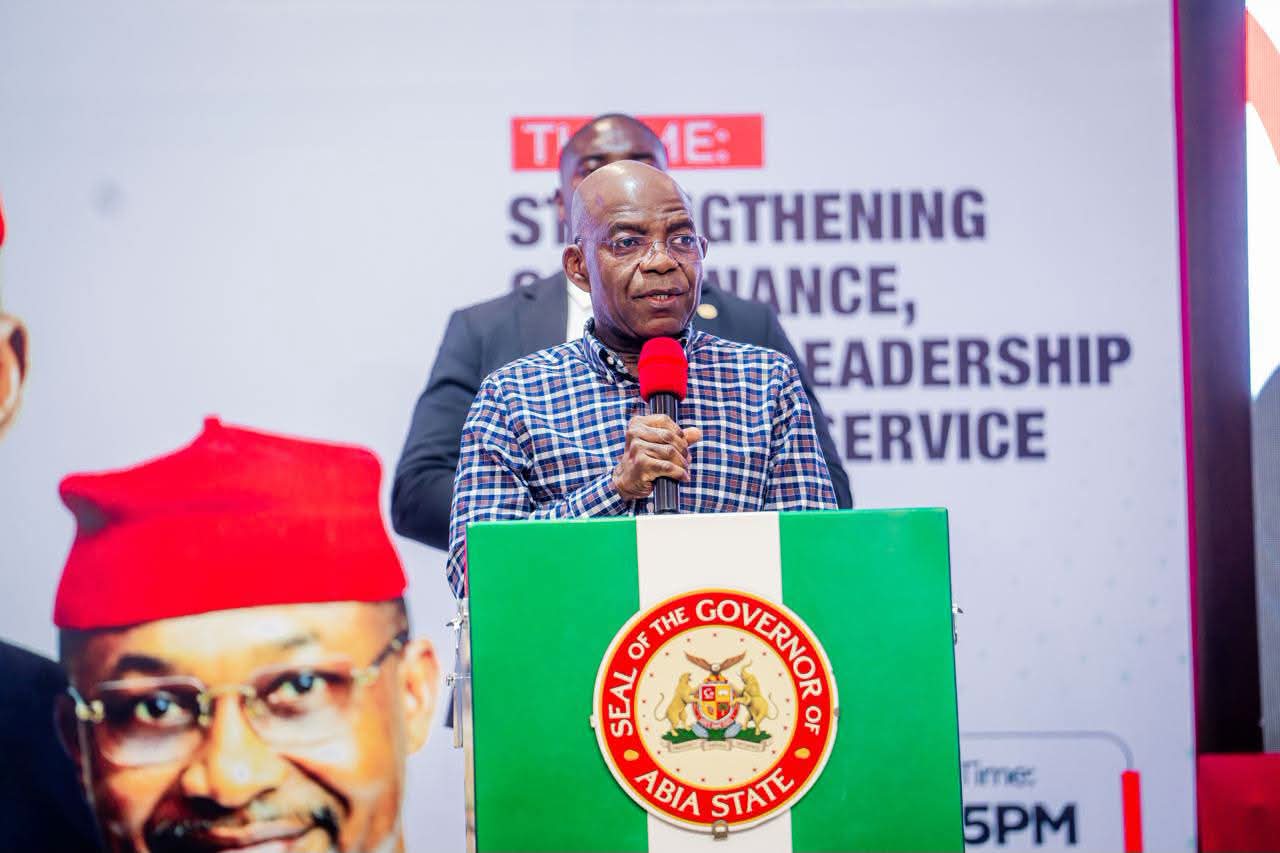
The Executive Governor of Abia State, His Excellency, Dr. Alex Chioma Otti, OFR, has once again reaffirmed his administration’s unwavering commitment to building a government driven by merit, competence, integrity, ethical leadership and the capacity to deliver tangible results to the people.
Governor Otti made the declaration on Tuesday, August 25, 2026, at the Michael Okpara Auditorium, Umuahia, during the Abia State Leadership Academy Executive Leadership Series for political appointees and senior public servants.
The high-level leadership session formed part of activities marking the 35th anniversary of the creation of Abia State and brought together key drivers of government policy, administration and public service.
With the theme, “Strengthening Government Ethical Leadership and Public Service Delivery,” the programme focused on the urgent task of developing capable leaders, strengthening public institutions, promoting accountability and preparing a new generation of professionals who can sustain Abia’s development trajectory long beyond the lifespan of the present administration.
For Governor Otti, the future of Abia cannot be built around the personality of one leader or the fortunes of a particular administration. It must rest on strong institutions and a pipeline of competent people capable of carrying the vision forward.
The Governor explained that the establishment of the Abia State Leadership Academy and the Executive Education Programme was a deliberate effort to invest in human capacity and institutional strength.
Recalling an interaction with Rwandan President Paul Kagame, Governor Otti said one of the most profound lessons of leadership is the responsibility of leaders to deliberately raise people who can eventually become even better than those who mentored them.
“It is the essence of this Leadership Academy, the essence of this executive education that we are having today. That is how we want to build our own leadership,” Governor Otti said.
The Governor made it clear that merit, competence and integrity would remain non-negotiable principles in the recruitment and appointment policies of his administration.
According to him, opportunities in government must increasingly be earned through transparent and competitive processes rather than political influence, family connections or personal relationships.
He pointed to the admission processes into Abia State University, particularly for highly competitive professional courses such as Medicine and Law, as well as the recruitment of teachers and the appointment of Permanent Secretaries as practical examples of the administration’s determination to enthrone merit.
Governor Otti noted that the first batch of 5,394 newly recruited teachers had already been engaged, while another 4,074 successful candidates were now collecting their appointment letters following a competitive recruitment process.
He said the same philosophy had been extended to the appointment of Permanent Secretaries, ending the era when sensitive positions in the public service could simply be allocated based on personal connections.
“I believe that the good thing about good governance is that once people test it, then it becomes difficult to take them back to where they are coming from.
“We had started, last week, interviewing those that had applied, were screened through computer-based testing, passed and then the oral interviews.
“Since we came in 2023, we made the appointment of Permanent Secretaries competitive. No longer, ‘this is somebody’s friend, this is somebody’s wife’, No,“ Governor Otti stated.
The Governor’s message was clear: the New Abia must be a State where competence defeats connection and where public office is earned through demonstrated ability and character.
Governor Otti also highlighted his administration’s determination to protect the future of the State through long-term planning rather than short-term political calculations.
He disclosed that a 25-year development plan had been put in place for Abia and backed by legislation, meaning that future administrations cannot simply discard it at will unless the relevant laws are repealed by the Abia State House of Assembly.
The move is aimed at ensuring continuity in development planning and protecting strategic policies from the uncertainties that often accompany changes in political leadership.
The Governor further stressed the importance of reliable data, proper planning and effective supervision in modern governance, announcing that the Abia State Bureau of Statistics would soon be established to provide credible data for planning, budgeting and decision-making.
He thanked the guest speaker and former Minister of Aviation, Chief Osita Chidoka, for delivering what he described as a thought-provoking lecture on the relationship between ethical leadership, administrative competence and public service delivery.
In his opening remarks, the Secretary to the State Government, Dr. Emmanuel Meribeole, challenged political appointees and senior public servants to approach their responsibilities with competence, integrity, accountability and transparency.
He reminded participants that public office is fundamentally a position of trust and that the quality of decisions taken by those in government directly affects the lives, welfare and future of citizens.
Dr. Meribeole explained that the Executive Leadership Session of the Abia State Leadership Academy was deliberately included among the activities marking the State’s 35th anniversary because sustainable development cannot be achieved without strong institutions, ethical leadership and a competent public service.
He urged political appointees and career civil servants to see themselves not as separate entities but as members of one government working collectively towards the vision of Governor Alex Otti for a better, more prosperous and functional Abia State.
Also speaking, the President of the Abia State Leadership Academy, Prof. Kenneth Kalu, said the academy was created as a platform for developing transformational leaders and strengthening the capacity of both public and private sector actors.
He explained that beyond leadership development, the academy operates Executive Education and Enterprise Development programmes designed to equip emerging and established leaders with practical skills while also helping small businesses improve their financial and management practices.
Prof. Kalu described the Executive Education Programme as a major milestone and welcomed Chief Chidoka to the session, urging participants to move beyond listening and apply the lessons from the programme in their respective offices and areas of responsibility.
Delivering his lecture titled “Strengthening Governance: Ethical Leadership and Public Service Delivery,” Chief Osita Chidoka placed the spotlight squarely on the people responsible for translating government policies and promises into real-life outcomes.
The former Minister of Aviation argued that the success or failure of any government ultimately depends on the administrative capacity of its people.
According to him, a government’s vision, policies, budgets and ambitious development plans can only become meaningful when the political appointees and career public servants responsible for implementation possess the competence, professionalism and discipline to turn intentions into results.
Using the story of a missing pair of scissors at a commissioning ceremony to drive home his point, Chief Chidoka described State capacity as “the ability of government to convert intention into execution.”
He explained that citizens do not ultimately judge government based on policy documents or announcements but on the actual results they experience in their daily lives.
“There is no high-capacity State without high-capacity people,” he declared, urging Abia appointees to recognise that administrative capability, competence and professionalism are indispensable to effective governance.
Drawing lessons from countries including China, Britain, Singapore and Rwanda, Chief Chidoka emphasised that enduring institutions are built on merit, administrative competence, disciplined execution and accountability.
He warned that policies without effective implementation remain mere documents, stressing that Abia’s ambitious development agenda must be matched by a public service with the capacity and determination to deliver.
Chief Chidoka also called for stronger collaboration between political appointees and career civil servants, noting that while political office holders may have only 48 months to deliver on the mandate of an administration, career officers often remain within the public service for decades and therefore represent an important pillar of institutional memory and continuity.
The session reinforced the broader message of the Otti administration’s reform agenda: transforming Abia will require more than roads, hospitals, schools and infrastructure. It will also require a new culture of leadership, a competent bureaucracy, ethical public servants, reliable institutions and a system that rewards excellence.
The event was attended by the Deputy Governor, His Excellency, Engr. Ikechukwu Emetu, FNSE; Commissioners; political appointees of t



 he State Government; Permanent Secretaries and other senior public servants.